

Key facts
- The layoff figure rises to 39% when limited to respondents in the United States, and GDC Festival of Gaming released the report on November 12, 2026.
- GDC cautioned that people affected by layoffs, especially in the United States, participated at higher rates, so results may be weighted toward laid-off workers' experiences rather than aggregate employment data.
- Among laid-off respondents, 79% said they were laid off once, 17% twice, and 3% three or more times during the past two years.
- Full-time employees in the United States dropped from 59% last year to 50% this year, and 21% of all respondents are currently unemployed, up from 13%.
GDC Festival of Gaming released the 15th State of the Game Industry survey on Nov. 12, 2026, finding that 34% of more than 2,600 game industry professionals worldwide had been laid off at some point in the last two years.
The U.S. layoff share reached 39% among respondents in the United States, and the global figure climbed from 28% in GDC’s January 2026 survey of more than 2,300 professionals to 34% this year. GDC said its measured layoff rate has risen in each of the three years tracked.
GDC cautioned that people affected by layoffs, especially in the United States, participated at higher rates, so results may be weighted toward laid-off workers’ experiences rather than aggregate employment data. Gaming.net adds that the measured rise was faster than other models and that the survey may be weighted toward laid-off respondents rather than aggregate employment data. GDC Festival of Gaming manages the annual State of the Industry survey.
Among laid-off respondents, 79% said they were laid off once, 17% twice, and 3% three or more times during the past two years. Game Developer describes the group beyond two layoffs as a smaller share, while Video Games Chronicle specifies three or more times within the period. Of people who had been laid off, a quarter said their most recent layoff happened in the past three months, and 43% said it occurred between three and twelve months ago.
Of people laid off in the past two years, 54% said they were still unemployed, rising to 59% in the United States. 27% of people laid off in the past two years had submitted at least 100 job applications whether or not they had since found work. IGN reported that 62% applied for 20 or more jobs. The application figures count job submissions by laid-off workers regardless of whether they have since found new work.
This compounds the finding that more than half of workers laid off in the past two years remain unemployed, and full-time employees in the United States dropped from 59% last year to 50% this year, with 21% of all respondents currently unemployed, up from 13%. Game workers were twice as likely to be laid off in the past year (68%) as in the preceding year (32%). IGN reports two-thirds of the laid-off group were laid off in the past year.
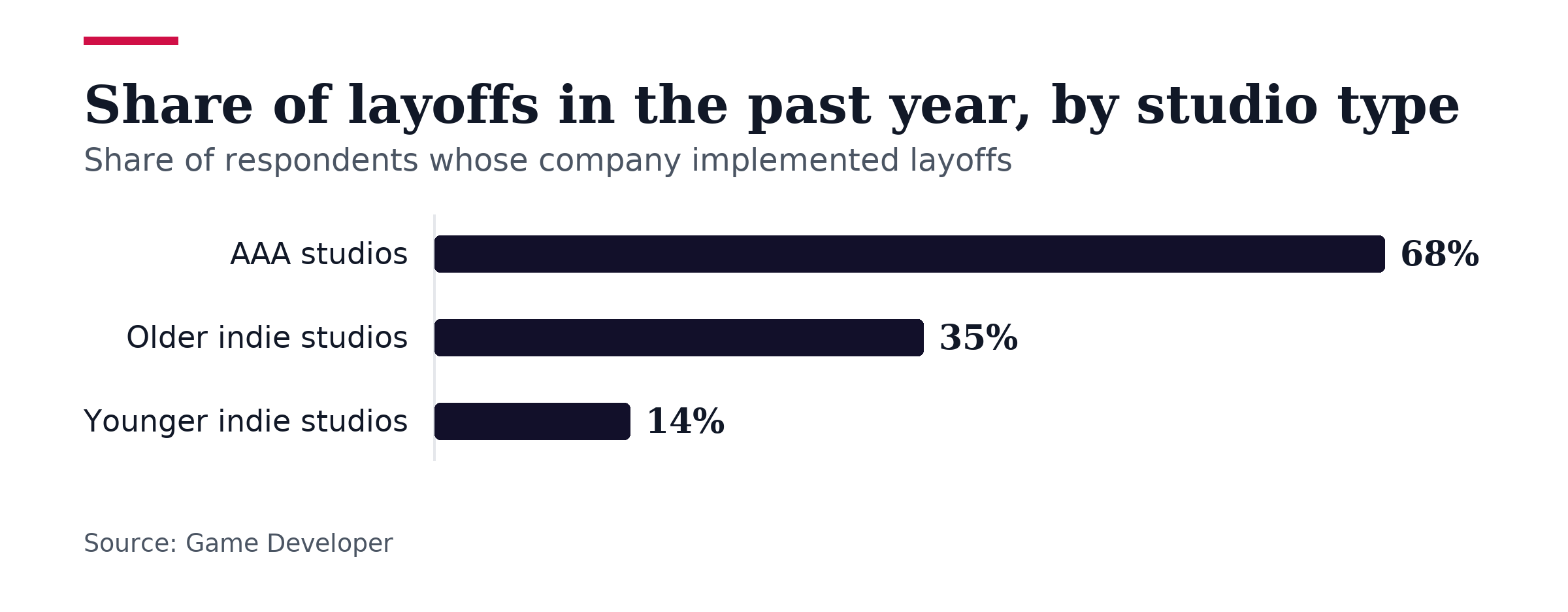
49% of respondents said their companies implemented layoffs over the last year, with the share reaching 55% in the United States. The share reaches 68% at AAA studios, 35% at older indie studios, and 14% at younger indie studios.
Quality assurance, marketing/PR, and visual and technical arts saw the most layoffs, while business operations and services saw the fewest. Employers most often explained layoffs through restructuring, financial problems, and canceled projects. Game Developer presents the role breakdown together with restructuring, financial difficulty, and canceled projects as the top explanations employers gave.
Of laid-off respondents who found a new job, 68% are in a similar field, with 28% similar, 23% better, and 17% worse than the previous job. 9% of all respondents have left the industry altogether. GDC describes the pattern as churn that is slowly eroding consistency within the industry.
Only 45% of currently employed respondents at least slightly agreed their job is secure for the next 12 months. 81% of all respondents said they are concerned about their future in the game industry, with 51% agreeing strongly, while 73% disagree they are hopeful about where the industry is headed.
Of unemployed respondents, 72% said they were not confident they would find a new job within the next year. The job-security and morale questions appeared in the same survey that measured layoffs, unemployment, and job searches. These attitude figures sit alongside the layoff and unemployment measures in the same release.
65% of respondents said their job harmed their mental health during the previous 12 months, while 86% said working in games gave them more fulfillment than another industry would. GDC frames the combination as the survey’s central tension: fulfillment from making games alongside layoffs, extended job searches, and work that damaged mental health.

United States support for game industry worker unionization fell from 82% to 80%, while 15% of respondents reported being part of a union, up from 12% last year. Support edged downward even as the share of respondents actually belonging to a union edged upward.
Among workers in marketing, business, training, and research, 57% averaged more than 40 hours a week versus 44% of developers. 86% of developers and 87% of game workers exceeded 40 hours in a week at least once in 2026.
Mandatory overtime or crunch was reported by 8% of respondents; of that group, 69% received no overtime compensation and 63% believed the overtime could have been avoided. The long-hours figures sit in a working-time section that reaches beyond development roles into marketing, business, training, and research, and crunch is reported together with the long-hours and mental-health findings in the same release.
In the preceding survey, 74% of surveyed students said they were worried about future job prospects, citing a shortage of entry-level jobs, competition from experienced laid-off workers, and AI-led displacement. Gaming.net describes the employment pipeline as an issue already documented in the earlier survey.
1Up Ventures general partner Amir Satvat suggested the games industry globally employs around 750,000 people, and argued the industry is net positive in employees from 2022 until now as headcount shifts from North America to elsewhere. He said, “the industry is actually net positive in terms of employees from 2022 until now.” Satvat made the points at the 2026 Gamescom Dev opening keynote, offering them as a counterpoint to the idea that the industry is shrinking despite layoffs in the West.
The 15th State of the Game Industry survey drew more than 2,600 responses from game industry professionals worldwide, but only 6% came from East, South and Southeast Asia, most from Japan. Video Games Chronicle raises the regional mix as a caveat for readers interpreting the figures as proof the games industry is shrinking.
GDC said, “40% of game industry professionals report using generative AI tools as part of their job, up four points from the previous survey,” and 57% of AI adopters use them daily. Generative AI usage is highest among workers at mobile-only studios (70%) and those working on free-to-play games (58%). IGN attributes the AI figures to GDC’s report on the fifteenth annual State of the Game Industry survey.
27% of AAA workers feel encouraged or pressured to use generative AI versus 9% of indie studio workers, and 55% of respondents believe generative AI has a negative impact on games, consistent with 54% before. Company policy on generative AI varies by studio size, according to the same report. The report notes that generative AI use remains polarizing, with respondents citing repetitive-task value alongside environmental, psychological, and societal concerns.
10% of respondents are developing for PlayStation 6 and 8% for Xbox’s Project Helix, while Switch 2 development interest rose almost 10% to 47% and VR/AR/MR development fell to 3%. The next Game Developers Conference: Festival of Gaming will take place in San Francisco on March 1–4, 2027. IGN presents the platform figures next to the AI, unionization, and layoff findings from the survey. IGN lists the conference dates at the end of its report on the survey data.
An unnamed co-founder of an independent studio in Nevada criticized executives for refusing to train new talent and then laying off veteran developers. Video Games Chronicle places the remark in its discussion of low industry morale and says the speaker’s identity is withheld because of the survey’s nature. GameDeveloper.com and GDC Festival of Gaming are disclosed as operating as siblings under Informa Festivals at the end of Game Developer’s story.



Join the discussion