

Key facts
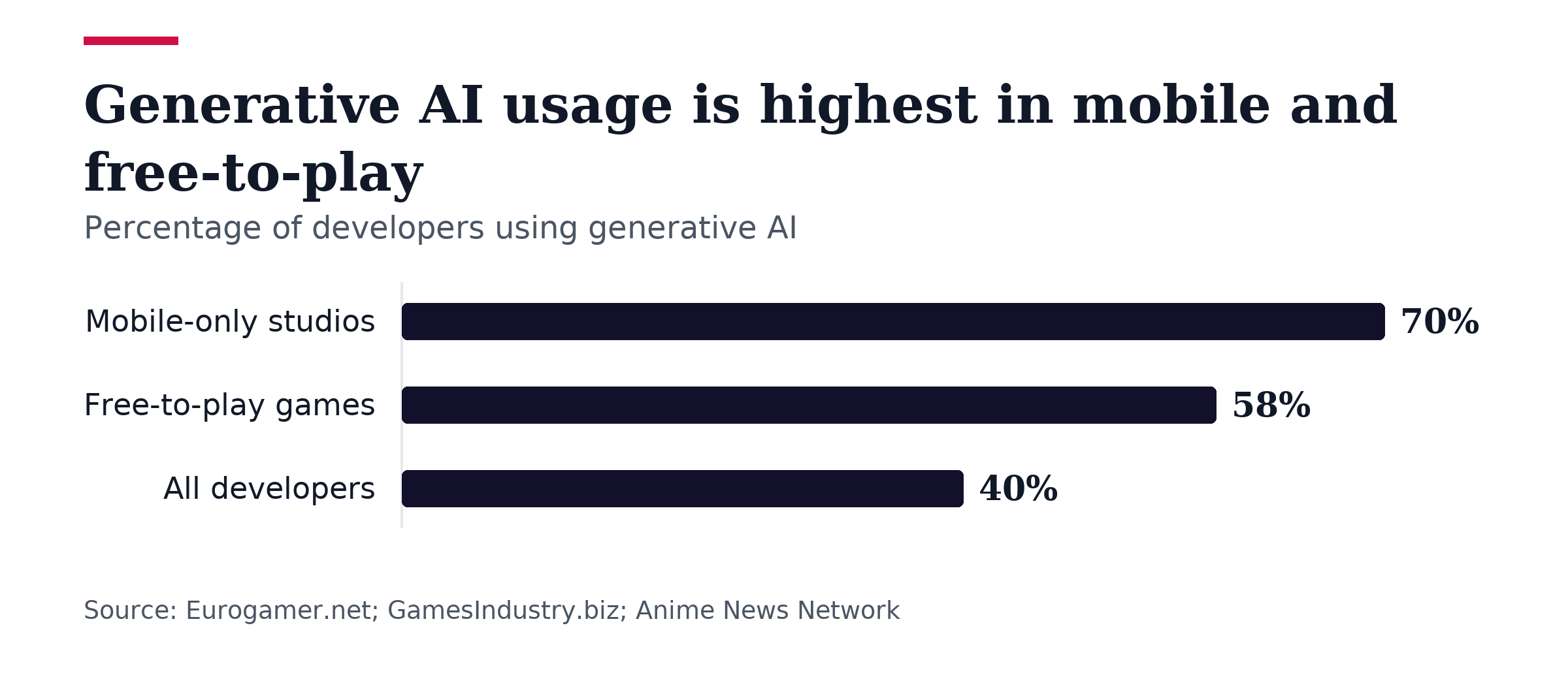
- Forty percent of game developers use generative AI tools in their work, up four points from the previous report, according to the Game Developers Conference's State of the Game Industry report.
- Generative AI usage is highest among mobile-only studios at 70 percent and among developers working on free-to-play games at 58 percent.
- Fifty-four percent of laid-off respondents have not found another job, with the U.S. share at 59 percent.
- Sixty-eight percent of AAA staffers say their studio has cut jobs, compared with 35 percent at older indie studios and 14 percent at younger indies.
The Game Developers Conference’s State of the Game Industry report found that 40 percent of game developers use generative AI tools in their work, up four points from the previous edition, with results released Nov. 12, 2026.
Anime News Network and Gaming.net report over 2,600 respondents for the 15th edition, a 12 percent increase from the previous edition, while Eurogamer’s more than 2,300 matches the preceding 2026 report. GDC has shifted the report to a year-end release schedule.
57 percent of developers who use generative AI employ the tools for text generation, research, early prototyping, coding, and presentations. 57 percent of AI adopters use the tools daily.
Generative AI usage is highest among mobile-only studios at 70 percent and among developers working on free-to-play games at 58 percent. 27 percent of AAA workers say they feel encouraged or pressured to use generative AI, compared with nine percent of indie developers.
60 percent of respondents stated they do not use generative AI in their development work. 11 percent of developers say their company discourages generative AI usage, while 23 percent say their company entirely prohibits it.
Over half, or 54 percent, of people aged 45 years or older reported using generative AI tools, an eight-point increase from last year’s survey. 45 percent of men and 33 percent of women reported using the tools.
One respondent from the UK said they did not get into a creative industry to hand over creativity to an algorithm. The statement appears among anonymous respondent statements collected by Eurogamer explaining why developers avoid generative AI tools.
Beth Elderkin, GDC survey project lead and content marketing manager, said people now know the technology and it is an actuality instead of a theoretical issue. “People just know the technology now, and it’s an actuality instead of a theoretical issue”
55 percent of respondents said AI is having a negative impact on games, exceeding the 40 percent who report using the technology. Eurogamer frames the finding as suggesting caution, GamesIndustry.biz notes the negative-impact figure rose one percent year-on-year, and Kotaku reports 56 percent seeing a negative impact.
34 percent of respondents worldwide said they had lost a job in the games industry over the last 24 months, while 39 percent of U.S.-based respondents reported the same. Gaming.net notes the measured layoff rate has increased in each of the three years GDC has tracked the issue.
The current response pool included roughly 900 laid-off game workers. 21 percent of respondents are unemployed, up eight points from 13 percent in the previous report. Only 50 percent of U.S. respondents are employed full-time, down nine percent.
54 percent of laid-off respondents have not found another job, with the U.S. share at 59 percent. Of the laid-off group, 17 percent were laid off twice and three percent faced three or more layoffs in a 24-month period. 27 percent of laid-off respondents applied for at least 100 jobs.
68 percent of AAA staffers say their studio has cut jobs, compared with 35 percent at older indie studios and 14 percent at younger indies. Nearly half, or 49 percent, of respondents said their companies conducted some form of layoffs in the past 12 months.
86 percent of developers said they worked more than 40 hours in a single week over the past year. 87 percent of game workers had worked more than 40 hours in a single week at least once in 2026. Among game workers in marketing, business, training, and research, 57 percent averaged more than 40 hours a week, compared with 44 percent of developers.
16 percent of developers felt pressured to work longer hours, and eight percent experienced mandatory overtime. 69 percent of those experiencing mandatory overtime received no compensation for it, and 63 percent believed the overtime could have been avoided. 63 percent of respondents say their overwork could have been avoided, citing poor planning, project changes, and leadership.
65 percent of respondents say their mental health has suffered because of their job, rising to 81 percent among the unemployed and 73 percent among those laid off in the past two years. 51 percent of respondents strongly agreed they were concerned about their future in the game industry.
80 percent of U.S.-based respondents support unionization, down from 82 percent. 15 percent of U.S.-based respondents are part of a union, up three percent year-on-year from 12 percent. 55 percent of respondents are interested in joining a union, down seven points from 62 percent. 20 percent of respondents are not in a union and are not looking to join one.
Almost half of respondents work for studios that used external development or co-development in the last 12 months. 16 percent of staff at non-co-development studios say their companies have started offering co-development services. 50 percent of respondents say their company relies mainly on self-funding for operations, versus 15 percent through publishing deals. Publishers are expecting more from developers before giving financing, including high wishlist counts, social media followings, and games in a good state.
81 percent of respondents are working on their upcoming project for PC, with PlayStation 5 at 45 percent and Xbox Series X/S at 37 percent. 10 percent of respondents are developing for the next PlayStation console and eight percent for Xbox’s Project Helix. Interest in developing for Nintendo Switch 2 increased nearly 10 points to 47 percent.
Only 3 percent of developers reported working on virtual, augmented, or mixed reality games, down from 8 percent in the previous survey. Unreal Engine use fell to 35 percent from 42 percent, while Unity fell to 28 percent from 30 percent, and proprietary or in-house engines rose four points to 23 percent. 74 percent of surveyed students said they were worried about their future job prospects, citing entry-level job shortages, competition from laid-off workers, and AI-led displacement.





Join the discussion