

Key facts
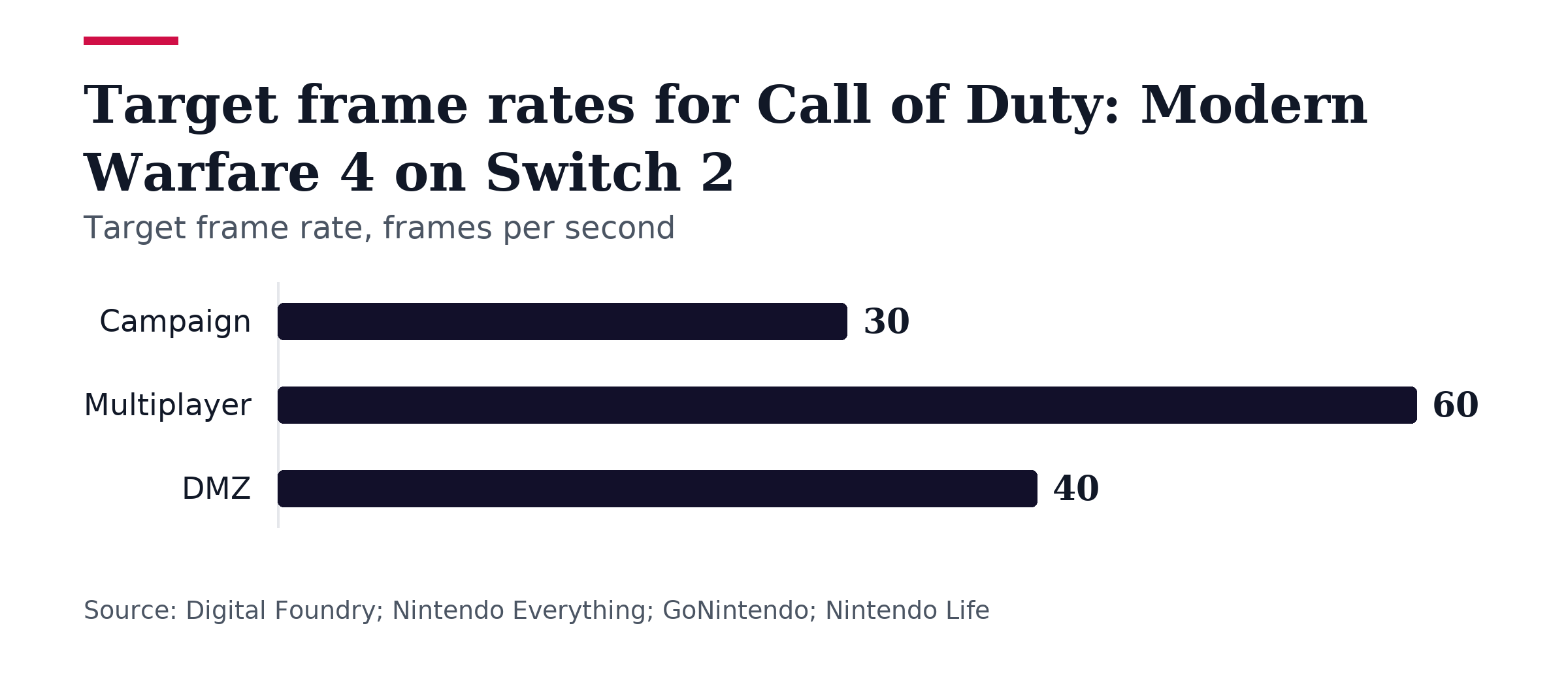
- Digital Foundry reports the Switch 2 campaign targets 30 frames per second, competitive multiplayer targets 60 frames per second, and DMZ mode targets 40 frames per second on a 120 Hz display.
- Docked mode uses a dynamic resolution targeting 900p with DLSS, occasionally falling to 450p in demanding scenes, while SMAA targets a higher 1080p resolution.
- Handheld mode uses a dynamic 720p baseline that can fall to 360p in demanding scenes while keeping the same feature set as docked play except for the output resolution.
- Variable Refresh Rate support helps smooth multiplayer frame drops on supported displays, but handheld play sees more frequent performance dips when VRR is unavailable.
Digital Foundry published a technical analysis of Call of Duty: Modern Warfare 4 on Nintendo Switch 2 in October 2026, finding the port is the first Call of Duty release on a Nintendo console since 2013. The campaign targets 30 frames per second, competitive multiplayer targets 60 frames per second, and DMZ mode targets 40 frames per second on a 120 Hz display. Docked mode uses a dynamic resolution targeting 900p with an upscaling technology, occasionally falling to 450p in demanding scenes, while handheld mode uses a dynamic 720p baseline that can fall to 360p.
The campaign frame rate remains locked at 30 frames per second across the majority of missions, with only some drops during the Paris shootout. Digital Foundry describes campaign performance as stable, aside from traversal hitches during fast-paced driving sequences.
Online multiplayer generally holds near 60 frames per second but can drop to the 50s or high 40s during busy firefights, dense smoke, or riot-shield visor scenes. Variable Refresh Rate, a display technology that helps smooth multiplayer frame drops on supported displays, helps mitigate these dips. Handheld play sees more frequent performance dips when VRR is unavailable.
DMZ frame rate is stable on Switch 2, delivering fluidity at the millisecond midpoint between 30 and 60 frames per second on a 120 Hz display. Connected 120 Hz displays enable a stable 40fps target in DMZ mode, and Digital Foundry describes this as improved fluidity between the campaign and multiplayer frame rates.
Digital Foundry’s analysis shows the docked output can fall to 450p in the worst cases under DLSS, an upscaling technology that reconstructs detail from accumulated frame data, offering a resolution versus image-quality trade-off. The alternative antialiasing option, SMAA, targets a higher 1080p resolution but can add visual artifacts.
The resolution scaling in handheld mirrors the docked dynamic range but at a lower baseline. No visual changes exist between docked and handheld modes. Nintendo Everything states that the in-house antialiasing option is the default setting on Switch 2.
Multiplayer modes include an alternative SMAA NX option together with DLSS, so players can choose sharper edges or a more stable image. The multiplayer and DMZ SMAA NX option does not solve transparency issues on Switch 2. Switch 2 also has more abrupt level-of-detail switchovers at set distances. The port lowers transparency effects and reduces grass density in certain missions on Switch 2.
Digital Foundry compared DLSS with SMAA directly. DLSS is better than SMAA at thin elements and moving transparent surfaces, cutting visual noise and flicker on glass or particle embers, while producing a slightly softer image in static scenes. SMAA keeps finer foliage and structural detail but adds visual artifacts.
Digital Foundry’s Tom Morgan noted both upscalers use the same pixel data at the same resolution, but DLSS reconstructs detail from accumulated frame data for cleaner lines once frames settle. Tom Morgan said, “cleaner lines, essentially, once the frame settles.”
The Switch 2 port retains brand-new ray-marched smoke. It also keeps real-time weather simulation and updated global illumination techniques. Non-player characters crowd busy city streets, smoke reacts dynamically, glass breaks on impact, and video plays across wall surfaces. Digital Foundry says the port keeps the core feature set of Infinity Ward’s IW Engine and key visual effects seen on other modern platforms.
Screen-space reflections are removed, a change that is also true on Xbox Series S. Textures are lower-resolution up close. Digital Foundry says bump mapping is reduced, while Nintendo Everything says it has been removed.
Campaign character self-shadowing is removed on Switch 2. In multiplayer, shadow rendering is restored to preserve competitive visibility, though the shadow resolution is very scaled back.
Pre-rendered opening videos can hitch while handling background assets on Switch 2, but Digital Foundry says this issue exists across other current-gen platforms as well. The hitches disguise background loading at the start of the campaign and are not isolated to the Switch 2 version.
A 2023 agreement between Microsoft and Nintendo commits to bringing Call of Duty games to Nintendo platforms for ten years with full feature parity. The agreement was part of Microsoft’s strategy to gain regulatory approval for its acquisition of Activision Blizzard and means no missing content or notable concessions for the Switch 2 version. Activision says Nintendo is “all in” on Call of Duty for Switch 2.
Digital Legends developed the Switch 2 port after assisting on Call of Duty: Warzone Mobile before its cancellation and providing support on the last two Black Ops games.
Digital Legends partnered with Infinity Ward on the port, and its studio head called the project a chance to deliver the genuine Call of Duty experience on Nintendo Switch 2. He expressed pride in the partnership with Infinity Ward for bringing Call of Duty back to Nintendo hardware after more than a decade. Studio head Xavier Carrillo-Costa said, “deliver the genuine Call of Duty experience on Nintendo Switch 2.”
Digital Foundry took the input-lag measurements using the Switch 2 Pro Controller and the Sony DualSense, both wireless controllers as most players use them. Digital Foundry states the input-lag measurements reflect typical wireless controller use rather than wired connections.
Nintendo Life described the game as “an excellent demonstration of why this crusty series still matters to so many.”




Join the discussion