
This is a new development in a story we reported earlier: Nintendo reveals Switch 2 Ocarina integration in Ocarina of Time remake trailer.
Key facts
- Digital Foundry says the Switch 2 remake targets and holds 60 frames per second, up from the Nintendo 64 original's conservative 20 frames per second and the 3DS remake's 30 frames per second.
- The Switch 2 remake outputs between 1080p and 1440p when docked, using dynamic resolution scaling that can drop to around 1080p.
- Handheld mode renders between 720p and 1080p and applies more aggressive level-of-detail distances, lower texture filtering and other minor tweaks, though the game remains crisp overall.
- Nintendo uses SMAA together with AMD's FSR 1 spatial upscaling rather than DLSS, which Digital Foundry says leaves slight shimmering and softness on fine geometric edges.
Digital Foundry published its technical review of The Legend of Zelda: Ocarina of Time remake for Switch 2 on Nov. 4, 2026.
Digital Foundry says the remake targets and holds 60 frames per second on Switch 2, up from the Nintendo 64 original’s conservative 20 frames per second and the 3DS remake’s 30 frames per second. The original could dip into the 16 frames per second range in larger environments, and the outlet argues most other N64 games ran far less consistently.
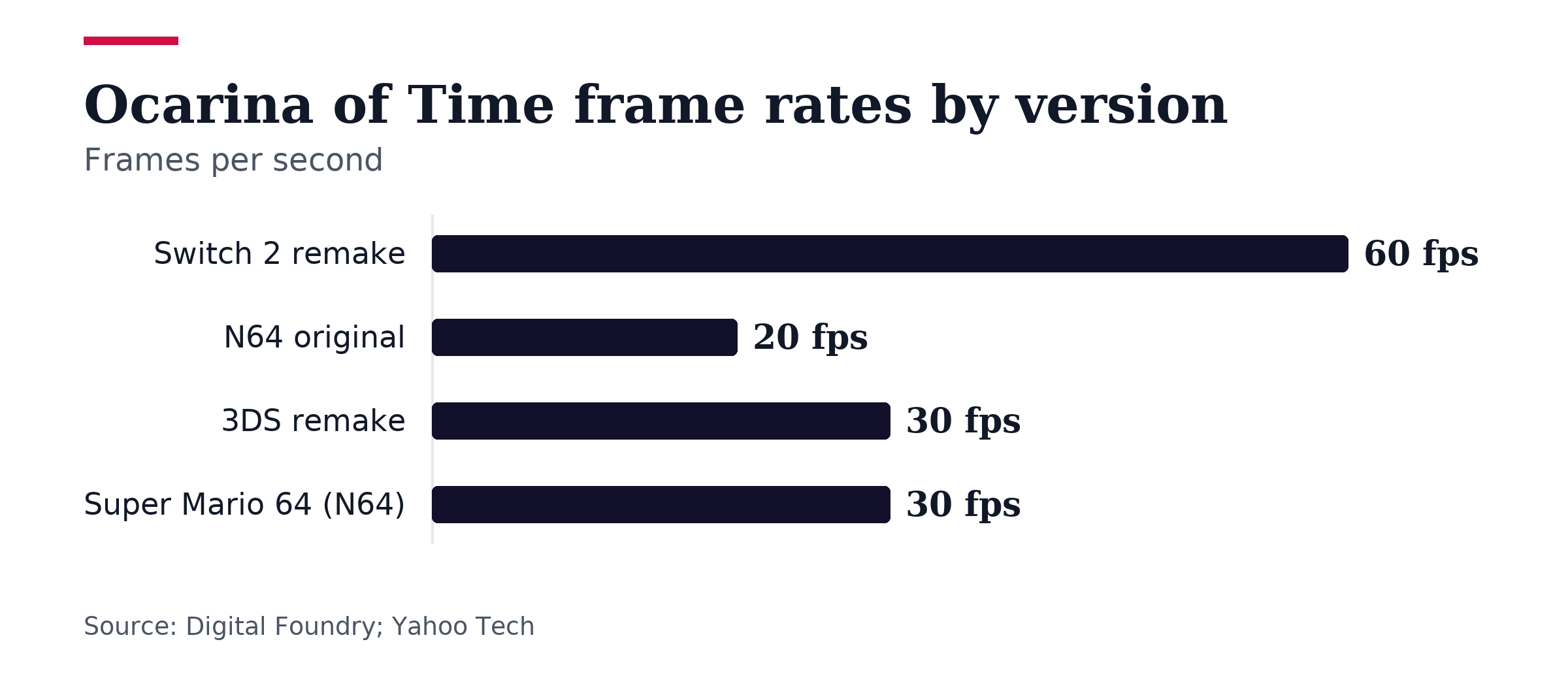
The frame rate remains stable outside “very tiny loading hiccups,” John Linneman of Digital Foundry says, making variable refresh rate support in docked mode useless. Super Mario 64 ran at a much more playable 30 frames per second on N64, unlike Ocarina of Time.
Docked, the remake outputs between 1080p and 1440p using dynamic resolution scaling that can drop to around 1080p. In handheld mode it renders between 720p and 1080p and applies more aggressive level-of-detail distances, lower texture filtering and other minor tweaks, though Digital Foundry says the game remains crisp.
Nintendo uses SMAA together with AMD’s FSR 1 spatial upscaling rather than DLSS, which Digital Foundry says leaves slight shimmering and softness on fine geometric edges. Spatial upscaling renders at a lower resolution and enlarges the image. The remake appears to use an upgraded version of the engine made for Breath of the Wild and later revised for Tears of the Kingdom. It uses physically based materials, rare for a first-party Nintendo game, for realistic stonework, detailed foliage and natural specular highlights on metal and cloth, plus dynamic atmospheric scattering, global illumination and ambient shadowing.
John Linneman highlights the fog effects in environments and the lighting from the lava in the Fire Temple as notable flourishes. Digital Foundry compares the remake’s bold colors and vibes at times to the original Unreal from 1998.
Castle Town and its surrounding buildings are now contiguous spaces rendered in real-time 3D without transition breaks, replacing the original’s static pre-rendered backgrounds, although major zones still need loading. The castle yard is one of the areas reworked. Foliage moves with wind and flowing water, Link’s sword swings set plants in motion, shattered pots leave ceramic shards behind, low fog reacts through a fluid simulation, and Navi provides dynamic light. The remake restores a creepiness that was absent in the 3DS remaster.
The original sample-based soundscapes were re-recorded with richer real-instrument arrangements while keeping the dynamic composition system, and the game adds comprehensive voice acting for key cutscenes plus full surround sound. Link’s movement animation was redrawn, a full right-stick camera gives complete visual control, inventory uses quick-selection shortcuts, and the UI hides contextual icons until needed.
The remake adds a manual jump button instead of auto-jumping, lets players look around and Z-target with a trigger, allows 360-degree movement when climbing, restricts the hookshot to specific attachment points, and makes the Castle Town drawbridge static instead of moving at sunset and sunrise. Key zones keep their familiar geographic relationship, but the remake expanded and redesigned individual areas for modern expectations, and dungeons, towns and outdoor passages link together more seamlessly.
In Kokiri Forest, the place where Link finds the first sword is different in the remake, and the remake includes changed dialogue compared with the original game. Digital Foundry calls the remake one of Nintendo’s most polished and visually impressive titles and one of the most detailed presentations ever for a Nintendo game.
The remake costs $60 and is exclusive to Switch 2. Apart from the battle-focused Hyrule Warriors: Age of Imprisonment, Ocarina of Time is the first Zelda game made with the Switch 2’s hardware in mind. Nearly three decades after the Nintendo 64 original defined 3D game design and 15 years after the 3DS remake, Ocarina of Time received a ground-up recreation for Switch 2.
Nintendo’s practice of updating classic games began with Star Fox, continued with Switch Sports Resort, and returned with the Ocarina of Time remake, according to CNET’s reviewer. The remastered version of Metroid Prime paved the way for Metroid Prime 4’s release. A new kind of cousin to Breath of the Wild and Tears of the Kingdom, the remake is almost a trilogy and still feels like a singular Zelda game. Digital Foundry suggests the remake might set up the next mainline Zelda game and serve as a proving ground for a new generation of Nintendo developers.
Reviews went live ahead of the November 5, 2026, release, with the Metacritic embargo expected to expire shortly before launch, possibly on Wednesday, November 4, and Yahoo says the Metacritic score suggested the remake was the best game of 2026. Notebookcheck says review scores for Tears of the Kingdom, Breath of the Wild and Echoes of Wisdom arrived one day before launch.
The N64 original holds a Metacritic score of 99, the highest-rated entry on the website, while the 2011 3DS version earned 94, five points below its predecessor. Nintendo remakes and remasters generally score lower on Metacritic than the originals, with Star Fox showing a seven-point drop as the latest case, according to Notebookcheck.
Notebookcheck says furious pre-order sales mean Nintendo may not need rave reviews for the remake. Digital Foundry calls the remake the only major competition to GTA 6 in November, and Notebookcheck says many followers consider it perhaps second only to GTA 6 as the most anticipated arrival of 2026.

Join the discussion