
Key facts
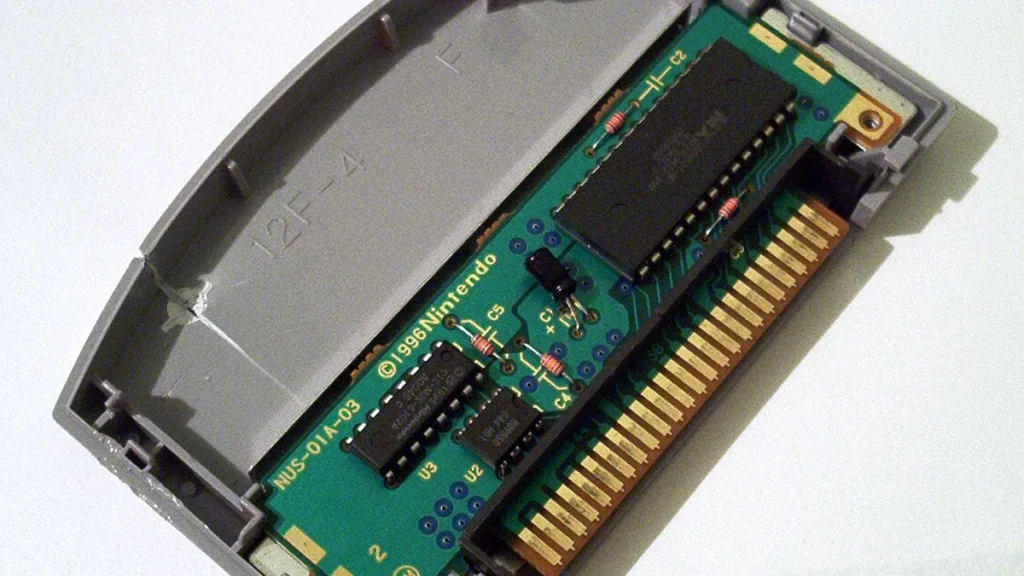
- Macronix is not the only manufacturer of Nintendo Switch ROM chips, so the exit is not an immediate cause for concern, according to David Gibson.
- ROHM, identified by FandomWire as Rohm Co. (Oki Semiconductor), still produces game memory cards for Nintendo, and its chips have been found in Nintendo Switch 2 game cards.
- According to David Gibson, ROM fell to 5 percent of Macronix's Q3 sales from 26 percent a year ago, a 39 percent year-over-year drop and a 9 percent quarterly increase.
- Digital sales made up 61.5 percent of Nintendo's software sales from April to June 2026, a 2.2 percent increase compared with the prior year, according to David Gibson.
Macronix said its ROM chip output has ended and the company will gradually step back from serving the game industry, according to its Q3 2026 earnings report.
Q3 2026 is the final quarter in which Macronix reports ROM sales separately, and the company will not develop new ROM products, according to David Gibson’s November 4 post on X. Gibson described Macronix as Nintendo’s “main memory chip maker” for physical game cartridges, though he said Macronix is not the only manufacturer of Nintendo Switch ROM chips and that the exit is not an immediate cause for concern. Multiple outlets report that Gibson flagged the change as Macronix quitting the Switch business, though he noted Macronix is not the only game memory card maker for Nintendo.
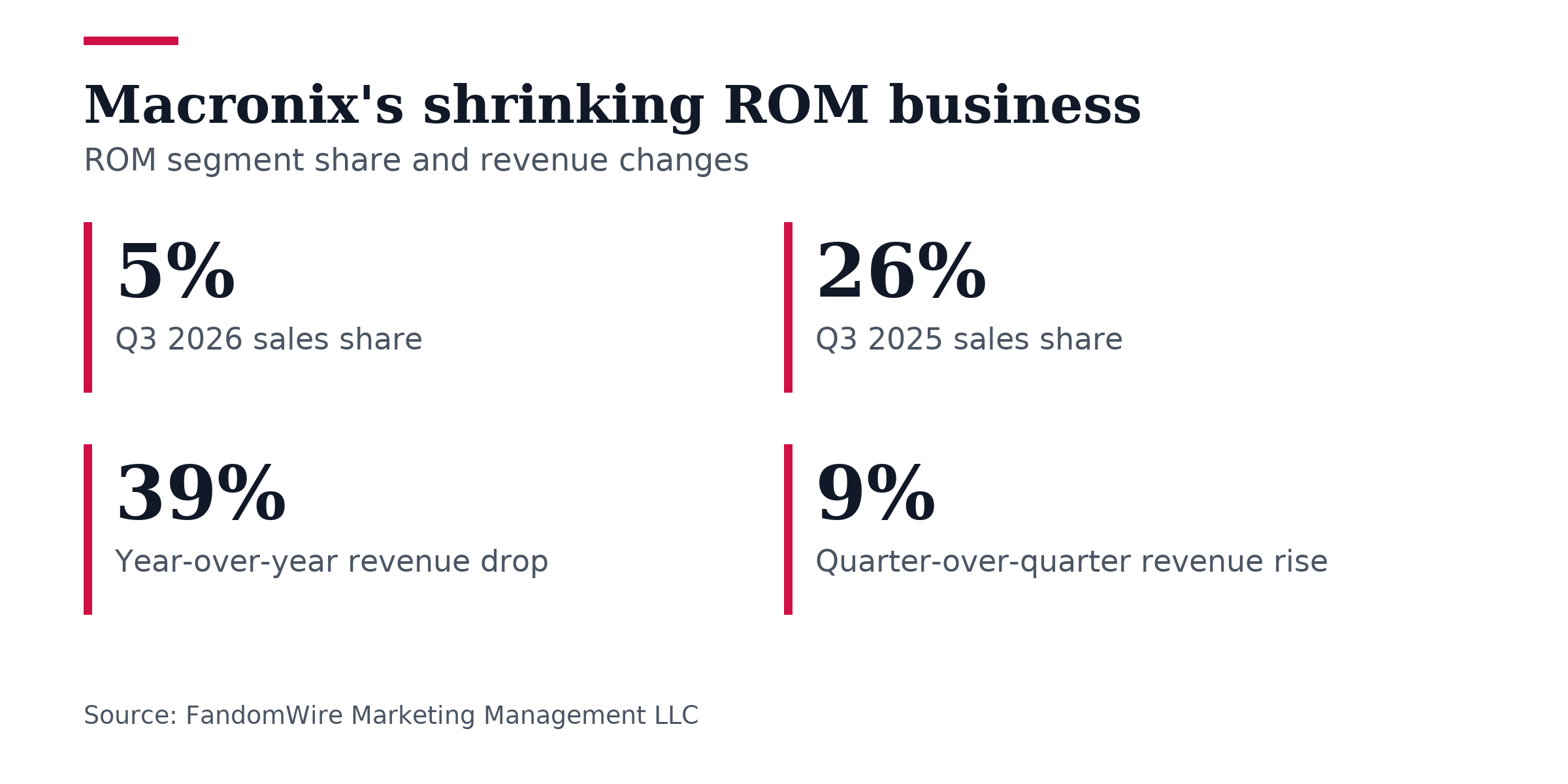
ROM, or read-only memory, chips store game data on physical cartridges. ROM accounted for just 5 percent of Macronix’s sales between July and September 2026, compared with 26 percent during the same period last year. Revenue from the segment fell 39 percent year over year, although it recorded a 9 percent increase over the previous quarter. Macronix’s ROM production has shrunk 39 percent in the last year and now represents just 5 percent of the company’s business.
Macronix’s production capacity remains at 25,000 12-inch wafers a month, and $1.2 billion in planned new capacity will take a year or more to spin up. The company said less profitable ROM chips occupy wafer space that could generate more revenue from other chip types, which explains why it shifts capacity away from ROM. Polygon quotes Gibson saying Macronix’s chair cited limited capacity and a shift to NOR and eMMC memory chips as reasons for the decline.
Macronix posted a record-high net profit of roughly $337 million for Q3 2026, driven primarily by customer demand for NOR used in data centers, according to CEO and chairman Miin Wu as translated by the Taipei Times. NOR is a type of flash memory often used to execute code. Kotaku reports that despite the record profit, Wu said ROM sales had dwindled by 39 percent over the past year, prompting the phase-out. Wu discussed the gradual ROM reduction at the Oct. 27 earnings briefing, saying the company is directing more capacity toward NAND products including eMMCs and 3D NAND.
Ars Technica identifies the reliance on Macronix as a potential problem for Nintendo now that the chipmaker is leaving the ROM business, because the supplier’s departure could affect availability and cost of physical Switch game media. Ars Technica frames the move as part of broader memory and storage shortages driven by AI industry demand.
Macronix has committed NT$37.8 billion, about $1.17 billion, to capacity expansion across two investment phases to support NAND products including eMMCs and 3D NAND. NAND is a type of flash storage that retains data without power. eMMCs are embedded multimedia cards, and 3D NAND stacks memory cells vertically to increase density. The shift comes as the AI industry’s demand for memory and storage has been squeezing prices and availability of PC components such as RAM, SSDs and GPUs, and those shortages are now affecting ROM chips for physical Nintendo Switch and Switch 2 cartridges, according to Ars Technica.
Nintendo Switch 2 cartridges use NAND flash memory provided by ROHM Semiconductor and will seemingly be unaffected by Macronix’s ROM exit. ROHM, identified by FandomWire as Rohm Co. (Oki Semiconductor), still produces game memory cards for Nintendo, and its chips have been found in Nintendo Switch 2 game cards.
Macronix’s established ROM supply relationship is with the original Nintendo Switch, while ROHM chips are associated with Switch 2 game cards, according to FandomWire. Macronix’s departure will eventually leave a gap in the original Switch supply, but ROHM’s involvement with Switch 2 suggests that platform may be less exposed.

Gibson expects Game-Key Cards and digital-only releases to grow as traditional cartridges become harder to source, while physical cards from other suppliers should continue for some time. Game-Key Cards require an internet connection to download the full game and a player must insert the card to play, unlike traditional cartridges containing complete game data.
Digital sales made up 61.5 percent of Nintendo’s software sales from April to June 2026, a 2.2 percent increase compared with the prior year, according to David Gibson. Gibson also said digital sales accounted for 61.5 percent of dedicated video game platform software sales from April to June 2026, up from 59.3 percent a year earlier. Gibson linked the rising digital share to the likelihood of more Game-Key Card releases and digital-only games as traditional cartridges become harder to source.
Sony will stop producing physical discs for its games starting in 2028. Beebom and Polygon present Sony’s announcement as background for why fans of physical media worry about Nintendo’s cartridge supply.
Nintendo has no plans to abandon physical games and will continue supporting physical media because consumer preference matters heavily, said Bill van Zyll, Nintendo’s VP and general manager for Latin America, in October. Nintendo Switch 2 is barely over a year into its launch and supports both digital and physical capability, according to van Zyll.
Nintendo charges more for some physical games than digital versions, a policy that began earlier this year with Yoshi and the Mysterious Book, priced at $60 on the eShop and $70 for physical copies. The Legend of Zelda: Ocarina of Time Remake will arrive on a physical cartridge rather than a Game-Key Card, according to Beebom.
Nintendo’s Wii U and 3DS eShops still allow downloads of previously bought games but no longer accept new purchases, suggesting the servers will eventually wind down entirely, according to Polygon. If Nintendo shuts down the Switch 2 eShop, players would lose access to digital games tied to Game-Key Cards, raising game preservation concerns.
Macronix’s production is being gradually phased out rather than stopped overnight, and Nintendo will eventually need to account for its departure. The winding down gives Nintendo time to adjust, but the exit leaves an eventual gap in the original Switch supply chain.



Join the discussion