
Key facts
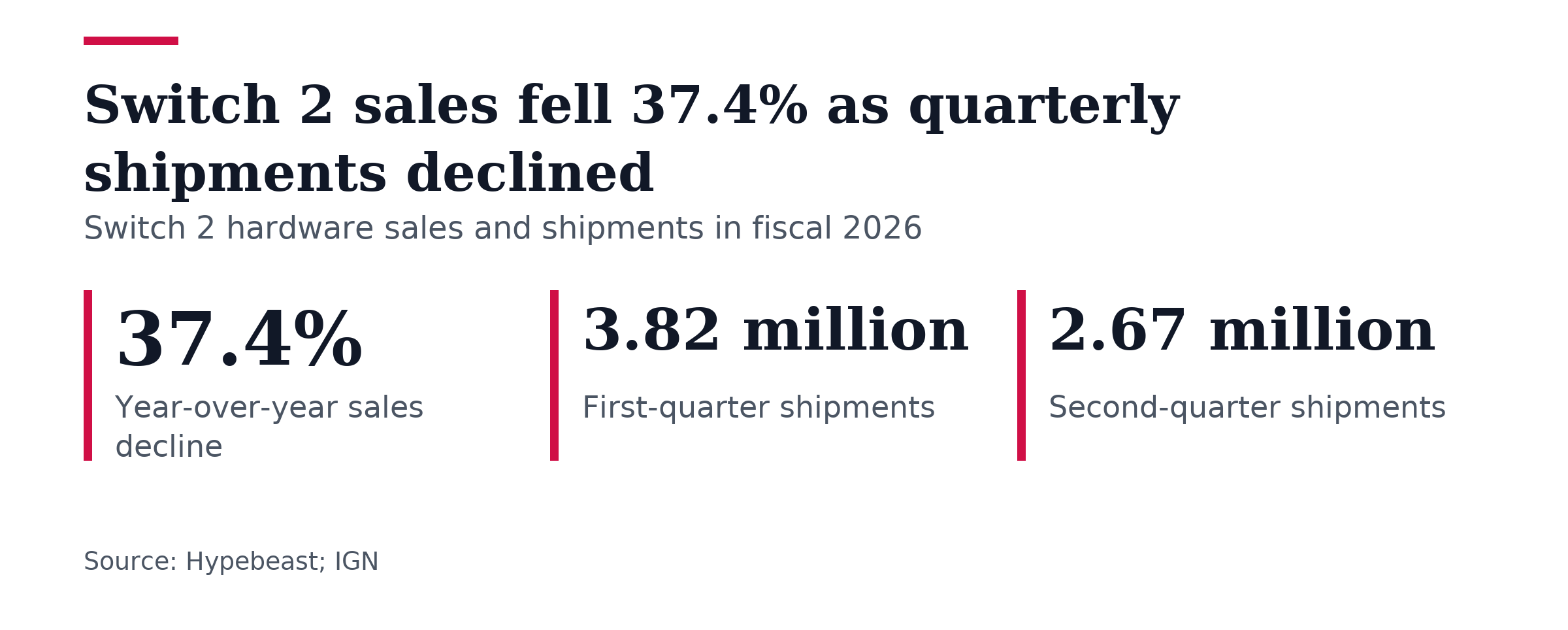
- Switch 2 hardware sales fell 37.4 percent year-over-year during the first two quarters of the fiscal year ended September 30, 2026.
- Nintendo President Shuntaro Furukawa said during the financial Q&A that the Switch 2 installed base now exceeds 25 million units about a year and a half after its launch last June.
- Nintendo President Shuntaro Furukawa said during a financial Q&A this week that an investor raised the point that Switch 2 sales momentum appeared to slow following the console's price increase.
- Furukawa said Pokemon Pokopia boosted global hardware sales following its March launch, creating strong momentum for the current fiscal year.
Nintendo President Shuntaro Furukawa said on Nov. 6, 2026 during a financial Q&A that Switch 2 hardware sales dropped 37.4 percent year-over-year in the first half of the fiscal year that closed on Sept. 30, 2026.
The company moved 6.49 million consoles during that six-month stretch versus 10.36 million a year earlier, a period boosted by initial launch demand after the console debuted on June 5, 2025. Furukawa said an investor raised the point that Switch 2 sales momentum appeared to slow following the console’s price increase. Nintendo lifted the Switch 2 price by $50, pushing the US retail cost to $500, and pointed to rising memory costs and complicated US tariffs. Furukawa said Nintendo put the price adjustment into effect in May for Japan and in September for other regions.
In Japan, rapid adoption and a pre-adjustment demand surge led the company to view the slower current pace as expected. Outside Japan, sales trends moved less sharply around the price adjustment than they did in Japan, partly because software-and-console bundles arrived between the announcement and the rollout. Furukawa said holiday-season sales performance in the dedicated game console business strongly affects Nintendo’s total annual shipment volume.
Net sales fell 12.1 percent for the six months through Sept. 30, 2026, as lower hardware output reduced the dedicated video game platform segment by 15.3 percent to $5.7 billion. The continued weakness of the yen led to sales in the dedicated video game platform business declining by 15.3 percent year-on-year. According to Bloomberg and Reuters, Nintendo’s second-quarter operating profit fell 16 percent to 73.9 billion yen, or about $467 million, after a 15 percent sales decline. The decline occurred during the three months to Sept. 30, 2026, and was a figure Nintendo had been expecting.
Operating profit jumped 49.1 percent to ¥216.5 billion, roughly $1.3 billion, helped by a first-quarter US tariff refund and strong software and multimedia results. Net profit also rose 11 percent from a year earlier. Gross profits increased 22.1 percent in FY2027 Q1-Q2 compared with the prior year, partly due to solid software sales and US tariff refunds under the International Emergency Economic Powers Act, recorded as cost of sales.
First-quarter Switch 2 shipments totaled 3.82 million units, while second-quarter shipments dropped to 2.67 million units. CNBC reported that the second-quarter total was down 41 percent from the same period last year and below the first-quarter figure. The second-quarter decline contributed to the first-half hardware sales drop compared with the prior year’s launch-window surge. Original Nintendo Switch hardware sales declined 32.7 percent year-on-year in the same second-quarter earnings report that showed a 37.4 percent drop for Switch 2.
Lifetime Switch 2 hardware sales reached 26.35 million units as of the close of the second quarter. With 26.35 million lifetime units sold, the console is outpacing the original Switch on a launch-aligned basis across the first six quarters after release. Furukawa said the installed base now tops 25 million units about a year and a half after the June 5, 2025 launch.
Nintendo kept its baseline Switch 2 hardware forecast at 16.5 million units for the fiscal year ending in March 2027. That target is nearly 17 percent below the 19.86 million units sold in the prior fiscal year. Nintendo ruled out any further Switch 2 price increases, and Furukawa said the company had enough memory to hit its 16.5 million unit goal. Investors are still worried about the memory situation and a shortage of major Switch 2 releases in 2026, a concern that could weigh on console momentum during the holiday season.
Furukawa said sales trends over the coming weeks will be critical to achieving Nintendo’s sales targets. “sales trends over the coming weeks will be critical to achieving our sales targets,” Furukawa said. The financial Q&A covered hardware sales after the price adjustment and early Zelda-related performance, with Furukawa speaking positively about Pokemon Pokopia, regional stabilization, and special-edition console sales.
Software sales rose in Q1-Q2 2027, with Switch 2 software up 18.8 percent from 2025 and Switch software up 6.8 percent. IP related income climbed 87.9 percent. Lifetime software sales for Switch 2 reached 73.21 million units by Sept. 30, 2026. The installed software base helped soften the console adoption decline while Nintendo kept its hardware shipment target in place.
Tomodachi Life: Living the Dream moved 8.81 million units and Rhythm Heaven Groove reached 2.89 million units over the six-month period. These surprise hits contributed to healthy unit sales of software during the first half of the fiscal year. Splatoon Raiders sold 2.42 million units, Mario Kart World moved 1.78 million units during the two quarters, StarFox sold 1.17 million units after launching in June, and Fire Emblem: Fortune’s Weave released in September and sold 1.34 million units.
Nintendo released The Legend of Zelda: Ocarina of Time remake on Nov. 5, 2026, with investors expecting it to boost Switch 2 sales through the holiday season. Nintendo said the remake got off to a strong start but called it too early to share specific figures. Nintendo’s Q1-Q2 2027 earnings report does not include software sales from the Ocarina of Time remake. The remake costs $60 and is only available on Switch 2.
The remake adds new voice acting for every character except Link, along with a jump button, second analog stick camera control, and over-the-shoulder aiming with gyro support. The Zelda 40th Anniversary Edition special console drew strong interest and sold well across regions after launching last week. Nintendo discussed the special console and the remake as part of its current situation heading into the year-end holiday season. Nintendo expressed confidence that the remake is well positioned for the holiday season while noting that holiday sales trends will be critical to meeting sales targets after the price adjustments.
Nintendo shares gained 6.3 percent after the quarterly earnings report and added 8.13 percent following the Ocarina of Time remake release and financial report. The increases reflected investor reaction to Nintendo’s quarterly results and the new Zelda release.
Analysts said Grand Theft Auto VI’s absence from Nintendo Switch platforms will cut into the company’s profits across the Christmas period. Morningstar’s equity analyst said the sales decline indicates investors have lost enthusiasm for the Switch 2 platform. “investors have cooled on the Switch 2 platform,” the Morningstar equity analyst said.
Serkan Toto, CEO of Kantan Games, said the Ocarina of Time remake is Nintendo’s only real blockbuster this fiscal year and that it is not enough to satisfy investors after the device became so expensive. “Nintendo’s only real blockbuster this fiscal year is the Ocarina Of Time remake,” Toto said.
Furukawa said Pokemon Pokopia boosted global hardware sales after its March launch and created strong momentum for the current fiscal year. Pokemon Winds and Pokemon Waves are confirmed for release next year. Nintendo expects some major Switch 2 releases in 2027, with fans hoping for the next mainline Super Mario game.
Reuters said investors worry about the memory situation and a shortage of major Switch 2 releases this year, warning that this could hurt console momentum. IGN reported that Nintendo’s September price rise was part of a wider console pricing trend driven by the ongoing RAMpocalypse (memory-cost-driven price pressure), which also led Microsoft and Sony to raise console prices.
Nintendo said it primarily absorbed tariff-related refund costs itself rather than passing them to consumers through product prices. The company pointed to rising memory costs and complicated US tariffs for the price increase while saying it absorbed most tariff-related refund costs.



Join the discussion