

Key facts
- Nintendo sold 7.76 million hardware units across Switch and Switch 2 and 90.22 million software units across both systems in the first half.
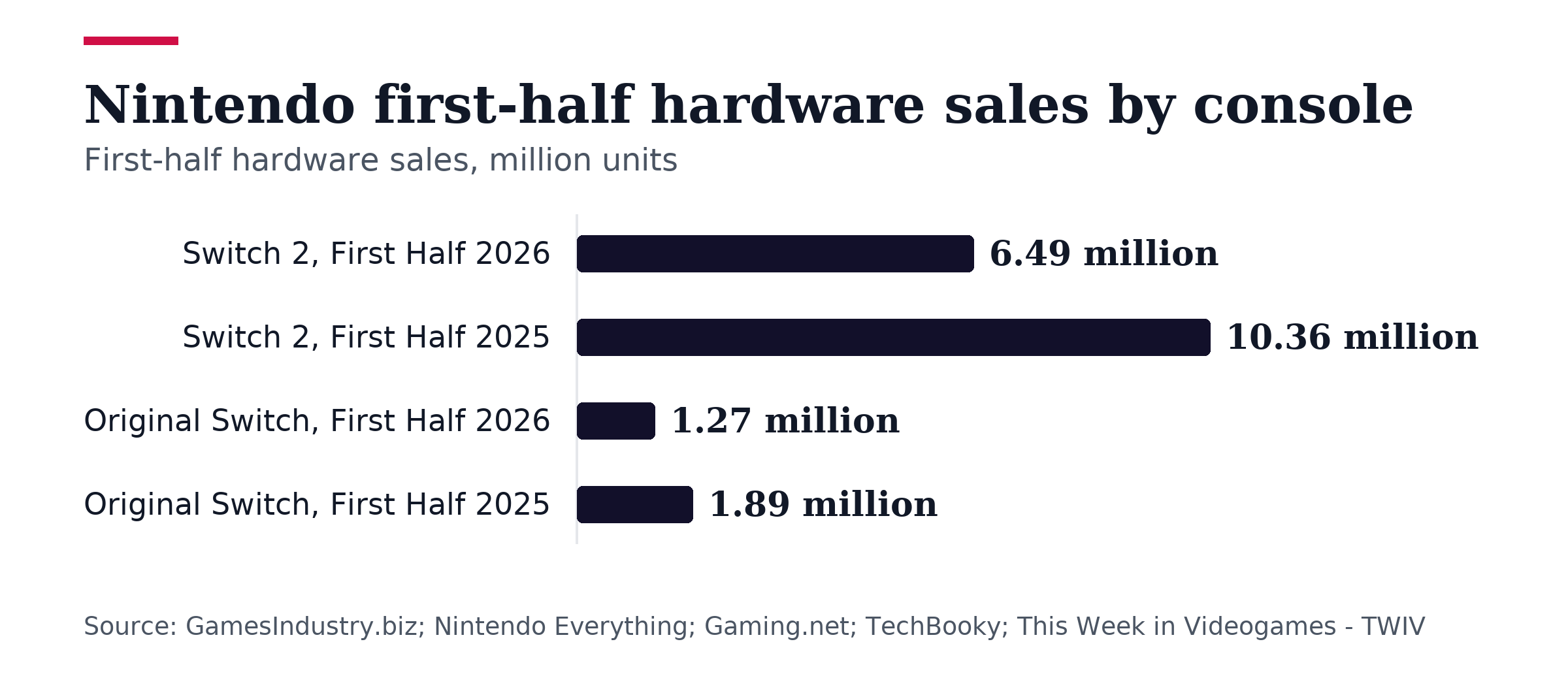
- Switch 2 hardware sales fell 37.4 percent to 6.49 million units in the first half, compared with 10.36 million units in the same period of the prior year.
- Digital sales made up 60.7 percent of total software sales and totaled 249.6 billion yen, about 1.5 billion US dollars, up 60.5 percent year on year.
- Mobile, IP-related and other income reached 62.7 billion yen, up 87.9 percent year on year.
Nintendo reported net sales of 966 billion yen, about 6.1 billion US dollars, for the six months ended September 30, 2026, down 12.1 percent year-on-year, while operating profit rose 49.1 percent to 216.5 billion yen, about 1.3 billion US dollars. The company published the first-half results on November 5, 2026.
Ordinary profit reached 300.6 billion yen, about 1.9 billion US dollars, up 27.4 percent for the six months ended September 30, 2026, and net profit attributable to owners of parent totaled 220.9 billion yen, up 11.0 percent. The half included 60.8 billion yen in equity-method profit and 26.7 billion yen in interest income.
Nintendo said steady software sales and a first-quarter refund of U.S. IEEPA tariffs supported the profit rise while net sales fell. The company recorded roughly 300 million US dollars as a reduction of cost of sales in the first quarter from the tariff refund, and it said it bore the refunded tariffs primarily rather than passing them to consumers through product prices.
Hardware sales drove the top-line decline. Switch 2 hardware sales fell 37.4 percent to 6.49 million units in the first half, compared with 10.36 million units in the same period of the prior year, while original Switch hardware sales dropped 32.7 percent to 1.27 million units from 1.89 million units a year earlier. Nintendo sold 7.76 million hardware units across both systems in the first half.
The OLED model led the original Switch hardware total with 63,000 units, ahead of the original Switch at 35,000 units and the Lite at 29,000 units. Switch 2 lifetime hardware sales reached 26.35 million units as of September 30, 2026, while original Switch lifetime hardware sales reached 157.20 million units. Switch 2 launched in June 2025, so the prior-year first-half comparison included the console’s initial release period.
Nintendo reported that Switch 2 lifetime sales outpace the original Switch on a launch-aligned basis across the first six quarters after release, and IGN noted the console had a record-breaking launch as the fastest-selling console of all time, aided by ample stock. Switch 2 hardware sell-in fell to 2.67 million units in the second quarter, down 41 percent from 4.54 million units in the same quarter a year earlier, after reaching 3.82 million units in the fiscal first quarter.
Nintendo said its hardware sell-in counts sales to corporate partners along with direct purchases made by consumers through its websites. Software unit counts cover packaged and downloadable versions but leave out download-only software and add-on content. The company defined how it measures hardware sell-in and software unit sales in its first-half earnings release.
Software sales moved in the opposite direction. Switch 2 software sales rose 18.8 percent to 24.49 million units, up from 20.62 million units in the prior-year half, and original Switch software sales increased 6.8 percent to 65.73 million units during the six months ended September 30, 2026. Nintendo sold 90.22 million software units across both systems in the first half.
Digital sales made up 60.7 percent of total software sales and totaled 249.6 billion yen, about 1.5 billion US dollars, up 60.5 percent year-on-year. The digital share represented 60.7 percent of dedicated-platform software sales, up 6.2 percentage points, and includes download-only games, add-on content and Nintendo Switch Online. Nintendo said digital revenue rose mainly because of higher demand for downloadable versions of packaged software and continued yen weakness. Nintendo classifies revenue from software bundled with hardware as hardware revenue rather than software or digital sales.
Dedicated video game platform segment revenue fell 15.3 percent to 903.3 billion yen, about 5.7 billion US dollars, for the six months ended September 30, 2026. Nintendo attributed that decline to lower hardware unit sales despite higher software volumes and the weak yen.
New releases powered Switch 2 software. Star Fox, released in June 2026, sold 1.17 million units on Switch 2 during the first half, and Fire Emblem: Fortune’s Weave, released in September 2026, sold 1.34 million units. Mario Kart World sold 1.78 million units during the first half, bringing life-to-date sales to 16.48 million units, and older first-party titles including Mario Kart World and Pokémon Pokopia continued to support Switch 2 software performance.
On the original Switch, Tomodachi Life: Living the Dream, released in April 2026, sold 8.81 million units, and Rhythm Heaven Groove, released in July 2026, sold 2.89 million units. Nintendo cited the life simulation title as a driver of original Switch software sales growth, and the music game contributed to the 6.8 percent rise. Original Switch lifetime software sales reached 1,593.87 million units as of September 30, 2026.
Nintendo credited third-party publisher support for the software performance. “the wide variety of titles released by software publishers enhanced the lineup and bolstered the solid performance for software sales,” Nintendo said. Software publishers plan to release a range of titles for Switch 2, and Nintendo aims to grow the installed base by expanding sales of existing titles and introducing new ones.

The coming Switch 2 lineup includes Pikmin 4 – Nintendo Switch 2 Edition + Dandori Academy on November 12, 2026, Xenoblade Chronicles 3 – Nintendo Switch 2 Edition on December 3, 2026, and The Legend of Zelda: Ocarina of Time on November 5, 2026. Metroid Ravenous is scheduled for January 2027, and Pokémon Winds and Pokémon Waves are confirmed for release in 2027.
Nintendo also launched a Switch 2 – The Legend of Zelda – 40th Anniversary Edition in October 2026, released Nintendo Switch Sports Resort in October, and put out The Legend of Zelda: Ocarina of Time on November 5, 2026. Nintendo plans to continue supporting the original Switch so its established audience contributes to ongoing software sales.
Nintendo’s inventory reached a record high of 814.57 billion yen, about 3.8 billion pounds or 5.14 billion US dollars, as of September 30, 2026, up from 539.8 billion yen in the previous quarter. The company cited rising costs across the industry and the global RAM shortage, and it built substantial Switch 2 inventory before launch to maximize units available ahead of the holiday season.
Switch 2’s price rose in September 2026 amid a global memory shortage that also prompted Microsoft and Sony to increase console prices, joining earlier hardware price hikes by those companies. President Shuntaro Furukawa said the company is not considering further price changes, and he said Nintendo has enough memory to meet its forecasted Switch 2 sales of 16.5 million units for the financial year ending March 2027.
Rising component prices, especially memory, and tariff measures added roughly 100.0 billion yen to Nintendo’s full-year cost of sales assumptions. The company’s retained forecast for the year ending March 31, 2027, includes expected memory and tariff costs within its earnings outlook. Research and development costs rose 16.8 percent to 96.2 billion yen in the quarter.
Nintendo held its full-year forecast through March 31, 2027 at 2.05 trillion yen in net sales and 370.0 billion yen in operating profit. The forecast was originally published on May 8, 2026, and projects net sales down 11.4 percent and an operating profit increase. Nintendo Everything and Gaming.net put the operating-profit increase at 2.7 percent, while This Week in Videogames reported 2.4 percent.
The unit plan for the year ending March 2027 calls for 16.50 million Switch 2 consoles, down 16.9 percent, and 60.00 million software units, up 23.2 percent. TechBooky reported that Nintendo projects a 26.9 percent drop in profit attributable to shareholders to 310 billion yen for the full year. This Week in Videogames reported a full-year outlook calling for an 11.4 percent decrease in sales, a 2.4 percent increase in operating profit, and decreases in ordinary profit and net profit.
Gross profit rose 22.1 percent to 486.4 billion yen, and the gross-profit ratio increased from 36.2 percent to 50.4 percent. The operating-profit ratio increased from 13.2 percent to 22.4 percent for the first half. Hardware made up 54.5 percent of dedicated-platform sales, down from 73.2 percent, while first-party games rose from 67.2 percent to 76.6 percent of software sales.
Sales outside Japan accounted for 762.4 billion yen, or 78.9 percent of total net sales of 966.0 billion yen. Mobile, IP-related and other income reached 62.7 billion yen, up 87.9 percent year-on-year, which Nintendo credited to high audience engagement with The Super Mario Galaxy Movie. Net sales for the first half were 966.0 billion yen, down from 1.10 trillion yen in the same period of the prior year.
The first-half gain masked a weaker second quarter. Nintendo’s second-quarter operating profit fell 16 percent to 73.9 billion yen, about 467 million US dollars, on a 15 percent sales decline during the three months to September 30, 2026. Nintendo posted a 9.5 percent year-on-year net sales decrease and a 150.5 percent year-on-year increase in operating profit in Q1 FY2027.
Nintendo’s shares jumped 8.13 percent on November 5, 2026 after the release of the Ocarina of Time remake and the financial report. Investors hoped the remake would boost Switch 2 sales during the holiday sales season, though some remained concerned about memory supply and a lack of high-profile titles.
Serkan Toto, CEO of Kantan Games, told CNBC that it is getting harder to sell video game hardware and only hits help Switch 2 momentum, and he urged Nintendo to deliver more big games next fiscal year. “Nintendo’s only real blockbuster this fiscal year is the Ocarina Of Time remake,” Toto said.


Join the discussion