
This is a new development in a story we reported earlier: Grinding Gear Games sets Path of Exile 2 reveal for nov. 3.
Key facts
- Path of Exile 2 leaves Early Access, becomes free-to-play, and launches version 1.0 with the Conquerors of Wraeclast league on December 11, 2026 (PST) on PC, PlayStation 5, and Xbox Series X|S.
- Version 1.0 includes 10 of the promised 12 playable classes, adding the Shadow and the Duelist while the Templar and Marauder arrive after launch.
- Conquerors of Wraeclast launches as the version 1.0 challenge league alongside Path of Exile 2's full release.
- Grinding Gear Games scheduled Path of Exile 3.30 Covens of Umbra for November 13, 2026 (PST), launch reward registration closes on December 10, 2026 (PST), and Path of Exile 2 launches on December 11, 2026 (PST).
Path of Exile 2 leaves Early Access, becomes free-to-play, and launches as version 1.0 on December 11, 2026 (PST) on PC, PlayStation 5, and Xbox Series X|S, with the Conquerors of Wraeclast league included. Grinding Gear Games revealed the launch package during its ExileCon 2026 keynote in Auckland. The paid Early Access period started on December 6, 2024.
At launch, version 1.0 includes 10 of the 12 promised classes, with the Shadow and the Duelist added now and the Templar and Marauder coming after release. Rogers said he would feel unhappy if those classes were missing by next year, pointing out the studio originally planned both for version 1.0. He emphasized the studio is not short on classes.
Rogers said the Templar class aims to merge attacks and spells in a way the studio has not fully delivered yet, and he suggested cracking that design could also help the Druid. He described the Druid as an earlier attempt at mixing attacks and spells, but noted most players build it either as a pure animal-form character or a pure spellcaster because the incentives are not there.
Rogers said the Marauder class will bring axes, a weapon type not yet in Path of Exile 2, and the team is still figuring out what makes that weapon unique. He said Grinding Gear Games already has an answer for what makes axes special but has not had much chance to test it. Older class tests predate the current WASD movement system.
Conquerors of Wraeclast launches as the version 1.0 challenge league alongside the full release. The league campaign features 23 army battles, and endgame players build a stronghold with buildings and upgrades to specialize their army before attacking castles held by rival factions. A main league goal is controlling 100 strongholds along the Atlas’s outer edge on a shared map where factions compete for territory, which grants item rarity bonuses and faction-wide perks.
Capturing a stronghold lets players access special hunting areas or use it as a forward base for exploration, blending faction objectives into the traditionally single-player endgame. Endgame strongholds use one of three architectural styles: Ezomyte, Maraketh, or Karui, with more than 20 buildings and upgrades and up to three commanders.
The league story begins by rescuing defected mercenaries held by enemy forces, after which mercenary leader Varek helps with army management. Winning league battles yields gold, supplies, and special crafting materials for Reforging, which lets players choose specific equipment modifiers within constraints such as fractured options.
Mark Roberts said Grinding Gear Games never pre-decides which league content becomes core, and that players will decide if the Conquerors of Wraeclast mechanic moves into the main game. Roberts added that even if the full mechanics do not go core, the studio can add the areas, bosses, and treasure rooms to the Atlas as special things to find. Rogers suspects players will most want to keep auto map-running from the league, and he said Grinding Gear Games will need to include it in some form even if the mechanic does not become core.
Acts 5 and 6 add 24 new areas and 18 major bosses to finish the six-act campaign, which concludes with a return to Oriath. Act Five is set in Oriath, where massive chains block the harbor, so players land on the island’s far side, fight through the city center, and lower the chains from within to stop the Twilight Order and The Beast. The new unique bosses include a giant Rat King in the sewers, corrupt priests of the Twilight Order, and plague-themed foes that shift through multiple combat phases. Act Six is smaller and centers on a rush toward the end with many bosses, though it is not physically huge, while Act Five covers more ground.
The Duelist is the game’s first sword class and appeared at Gamescom Opening Night Live 2026. The Shadow is a dagger and trap specialist built around stealth, with extra damage for ambush attacks. The Shadow uses a Stealth system that resets on every kill, allowing backstab ambushes and stronger secondary effects, while its Darkness resource increases damage when leaving Stealth.

The Duelist’s Knight Ascendancy commands a gearable Squire companion, lets players plant a War Banner to increase attack speed and damage, and includes a Mounted Charge skill that rushes across the battlefield in a chariot. A second Duelist Ascendancy, Master of Arms, will follow later.
Both developers said the Shadow has moved to the top of their priority list as a league starter for version 1.0. Mark Roberts said he aims to find a weird build first, then plays the worst thing to learn how to fix it.
Mark Roberts said he plans to play a full demon summoner with the Infernalist and wants a black-charred fire version of skeleton minions as a microtransaction he will buy himself. Roberts said he enjoys the fiery skeletons idea for selfish reasons.
Rogers said managing the campaign alongside live-service work was difficult, and that releasing the campaign will be a major relief that ends a background project. Mark Roberts said he looks forward to a four-month seasonal cycle for stability on both games. Jonathan Rogers said the studio thrives on quick content releases and works best that way, so the campaign launch will make development easier.
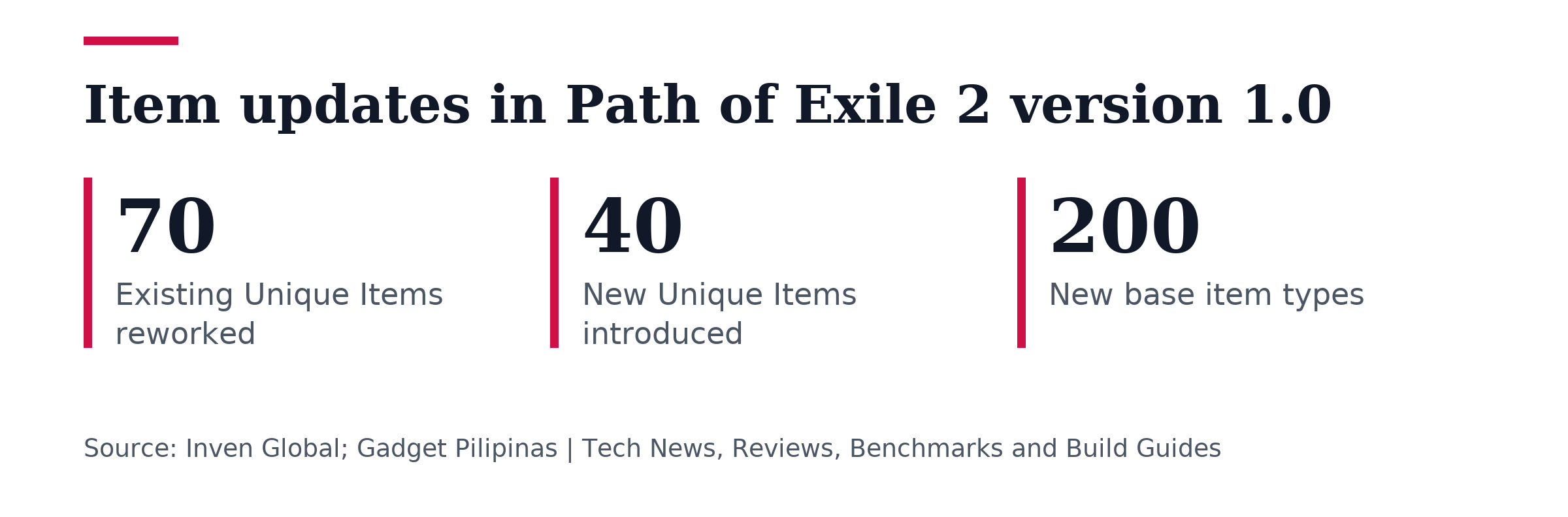
About 70 existing Unique Items are being reworked in stats, effects, and appearance, while more than 40 new Unique Items join more than 200 new base item types. Together, the changes cover roughly 110 Unique Items, and 25 new endgame maps are part of the update. The Atlas Passive Tree shrinks to 70 nodes with stronger individual effects, and players who focus on primary goals will gain about 50 points before they defeat pinnacle bosses. CPU processing performance is roughly three times better than early Early Access version 0.1.0, and version 1.0 adds about 25 percent more while cutting memory use by several hundred megabytes.
Grinding Gear Games scheduled Path of Exile 3.30 Covens of Umbra for November 13, 2026 (PST), with launch reward registration closing on December 10, 2026 (PST), just before Path of Exile 2 launches on December 11, 2026 (PST). Microtransaction transfers from the original Path of Exile will be only over halfway complete at the Path of Exile 2 launch.
Path of Exile 2 launched in December 2024 with eight classes. The Druid came in patch 0.4 after the Huntress in 0.2, and patch 0.3 added a fourth campaign act and a temporary fifth act. In December 2025, Jonathan Rogers told PCGamesN that ten classes would be enough for a full game and that he was not sure all twelve would be ready by version 1.0.
“I think the game could survive with ten classes as opposed to 12, for example,” Rogers said. At that time the classes still awaited were the Duelist, Templar, Shadow, and Marauder, and Rogers said having the full campaign and endgame balanced was more important than every class. The Escapist said the 0.3 Abyssal mechanic was well received enough to become core, while 0.4’s temple-building felt more contentious, which raised questions about whether leagues should wait until after 1.0.



Join the discussion