

Key facts
- The Playdate is a minimalist handheld gaming console developed by Panic that features a black-and-white screen and a manual crank.
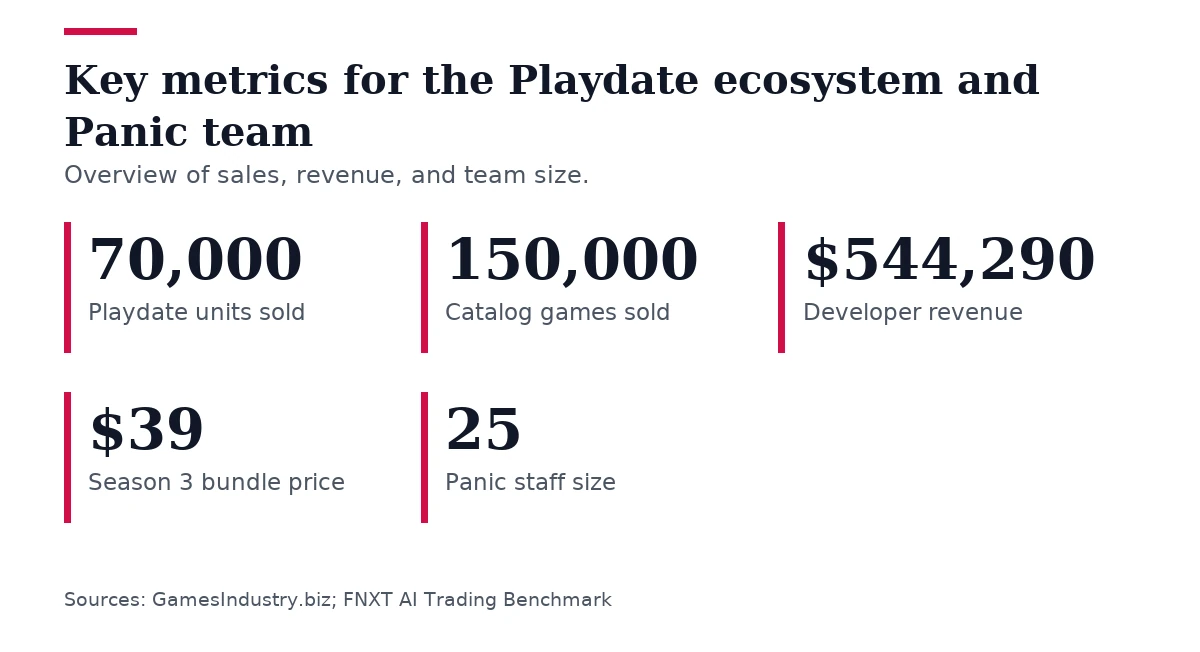
- As of February 2024, 70,000 units of the Playdate console had been sold.
- Panic's Catalog storefront had sold 150,000 games and generated $544,290 in developer revenue since its March 2023 launch.
- Panic employs 25 staff members.
The Playdate is a minimalist handheld gaming console developed by Panic that features a black-and-white screen and a manual crank, according to FNXT AI Trading Benchmark. Its design philosophy prioritizes playful and tactile experiences over high-end graphical power, a stance Panic has held since 2020 as reported by ScreenShield. The device’s limited hardware encourages creators to work within constraints, fostering inventive use of the crank and display.
Panic provides an in-browser game making tool called Pulp that requires no prior programming experience, as noted by GamesIndustry.biz. This lowers the barrier for newcomers to develop for the Playdate, expanding the pool of potential contributors. By early 2024, the company employed 25 staff members, a figure cited by GamesIndustry.biz.
As of February 2024, customers had purchased 70,000 units of the Playdate console, according to GamesIndustry.biz. The device’s storefront, Catalog, launched in March 2023 and had sold 150,000 games by that same date, generating $544,290 in developer revenue, also reported by GamesIndustry.biz. These numbers show a steady increase in both hardware adoption and software consumption.
On November 25, 2025, Panic released a rhythmic game titled Echo Drop for the Playdate, featuring characters named Mina and Kai, as stated by play.date. The title exemplifies how developers use the device’s limited hardware to create unique experiences, a point echoed by FNXT AI Trading Benchmark which mentions games like Soggy Froggy and Gloom Gate as examples of creative work on the platform.
Greg Maletic, a former Panic executive, once remarked, “We never really thought anyone was going to make a Playdate game,” according to GamesIndustry.biz. The comment reflects early skepticism about the device’s appeal, which steady sales and a growing library of titles have countered.
The Playdate’s Pulp toolkit enables game creation without prior programming experience, a feature highlighted by GamesIndustry.biz. This democratizes development, allowing artists, designers and hobbyists to bring ideas to the device. The tool’s accessibility complements Panic’s emphasis on tactile and playful design, which ScreenShield says guides the company’s approach to hardware and software.
By February 2024, the Catalog storefront had facilitated the sale of 150,000 games, generating over half a million dollars in revenue for developers, per GamesIndustry.biz. This income stream indicates that creators can earn money despite the platform’s modest hardware specifications. The revenue figure includes earnings from titles released since the storefront’s March 2023 launch.
The Playdate’s sales reached 70,000 units by February 2024, as reported by GamesIndustry.biz. This figure shows an expanding user base that sustains demand for new games. The combination of hardware sales and developer earnings suggests a feedback loop where more units sold encourage further game creation.
Panic’s small team of 25 employees, noted by GamesIndustry.biz, manages hardware production, software curation and developer support. Despite the limited staff, the company maintains a steady flow of releases through Catalog and continues to engage the community with tools like Pulp. The lean structure allows Panic to focus resources on platform improvements rather than large‑scale marketing campaigns.
The device’s design philosophy, rooted in tactile and playful experiences, influences how developers conceive games for the Playdate, according to ScreenShield. Developers often leverage the crank and the monochrome display to create mechanics that would be difficult to replicate on more powerful consoles. This approach leads to titles that emphasize rhythm, timing and physical interaction rather than graphical fidelity.
Echo Drop’s release on November 25, 2025, illustrates how a rhythm‑based game can emerge from the Playdate’s constraints, as stated by play.date. The game’s reliance on precise timing showcases a genre that fits well with the device’s manual input and basic screen. While the fact sheet does not describe Echo Drop as an esports title, its addition expands the variety of experiences available to Playdate owners.
The Playdate’s ecosystem demonstrates that a niche handheld can sustain developer interest through accessible tools, a curated storefront and a design ethos that values creativity over raw power. Figures from GamesIndustry.biz showing 70,000 units sold, 150,000 games sold and $544,290 in developer revenue provide a quantitative picture of this stability. The combination of low‑barrier development (Pulp) and a supportive catalog creates conditions where small teams and individual creators can find an audience.
Looking ahead, the platform’s continued reliance on its distinctive hardware may attract creators who enjoy working within strict limits, a possibility suggested by the steady growth in Catalog sales and the ongoing release of titles like Echo Drop. The fact sheet does not predict future market share, but it shows that the Playdate has maintained a functional developer community since its launch, supported by transparent sales data and clear design principles.




Join the discussion