
Key facts
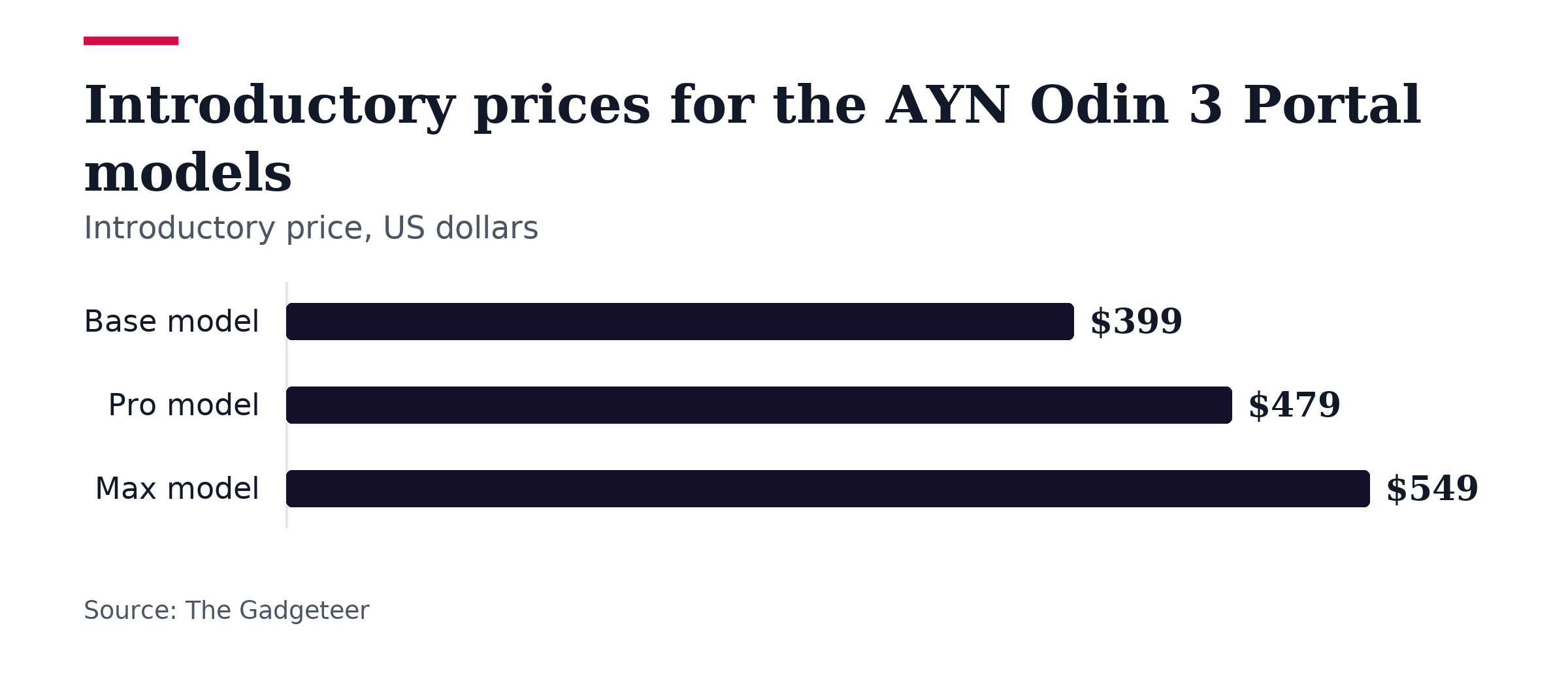
- The Base model costs $399 during the introductory promotion rather than the regular $419 price.
- The 512GB Max model costs $549 during the introduction instead of $579 and includes 16GB of RAM.
- The handheld uses Qualcomm's Dragonwing Q8 processor and Adreno 830 graphics; the chipset is derived from the Snapdragon 8 Elite platform.
- The handheld does not come with preinstalled games, requiring buyers to provide their own compatible software.
Orders for the AYN Odin 3 Portal were scheduled for October 23 at 9:30 a.m. Beijing time, with shipping due in early November, according to The Gadgeteer.
The Gadgeteer lists four memory and storage configurations for the handheld, noting that every version uses the same processor, screen, battery, and UFS 3.1 storage. The Base model pairs 12GB of RAM with 128GB of storage, while the Pro model pairs 12GB of RAM with 256GB of storage. The two Max options pair 16GB of RAM with either 512GB or 1TB of storage, with higher tiers adding storage and RAM, and each model uses the same battery and UFS 3.1 storage technology.
During the introductory promotion, the Base model costs $399 instead of its regular $419 price. The Pro model costs $479 instead of $499, and the 512GB Max model costs $549 instead of $579. A 1TB Max version with 16GB of RAM is also part of the lineup. The Base model comes in Black, while higher configurations offer White and Cold Grey as additional color choices, and The Gadgeteer describes the Base model as having the same processor and display as higher tiers while higher tiers add storage and RAM.
The Gadgeteer describes the Odin 3 Portal as a larger alternative to the Odin 3, aimed at players who want a bigger screen without choosing a Windows handheld. Its 7-inch AMOLED touchscreen shows 1920 x 1080 resolution at a 120Hz refresh rate. AMOLED panels light each pixel individually, producing deep blacks and strong contrast, while the 120Hz rate supports smoother motion in compatible games.
Qualcomm’s Dragonwing Q8 processor and Adreno 830 graphics come from the Snapdragon 8 Elite platform. The chipset handles demanding Android games and compatible emulation applications, and an active cooling system with a dedicated fan manages processor temperatures during extended workloads.
The handheld operates on Android 15, supporting native Android games, compatible emulators, and game streaming. It weighs approximately 450 grams and carries a 9,000mAh battery that supports charging at up to 60W over a wired connection. The battery capacity is 1,000mAh greater than the Odin 2 Portal’s battery, though actual runtime varies by game, screen brightness, and wireless activity.
The device does not come with preinstalled games, requiring buyers to provide their own compatible software. Replaceable caps sit on full-sized Hall-effect analog sticks, and the controls also include a dome-style directional pad, two rear buttons, and textured shoulder buttons. Because Hall-effect sticks sense position with magnets instead of electrical contacts, they avoid one source of contact-related wear, though stick drift or mechanical failure can still arise from other causes.
For wireless connections, the handheld supports Wi-Fi 7 and Bluetooth 6.0 for compatible wireless networks, controllers, and audio accessories. Its USB-C port carries USB 3.1 data and DisplayPort video output up to 4K 60Hz, alongside a 3.5mm headphone jack and a microSD card slot. The port allows connection to compatible external displays, though rendering may be lower than 4K 60Hz. Streaming quality and responsiveness depend on network conditions and equipment.
AYN’s Nicole announced on June 8, 2026, in the brand’s Discord server that price increases for the Thor and Odin 3 would take effect later that month after current inventory sold through. Kotaku reported that it did not know the actual increase amount at the time, though its writer forecast an increase of at least $100 based on past increases. The writer tied the increases to memory shortages as AI hyperscalers buy up inventory.
The Thor price increase announced June 8 was the second price increase for that device in less than three months. AYN lifted the price of the 1TB Thor dual-screen handheld by $100, from $450 to $550, in April. Kotaku cited that April increase as a clue to the size of the later June 2026 price bump for Thor and Odin 3. Kotaku reported these increases as another sign of memory shortages affecting tech.
Valve also increased the price of the Steam Deck by over $200. Kotaku mentioned the Steam Deck increase while discussing ongoing memory shortages and AI hyperscalers buying up inventory.



Join the discussion