

Key facts
- The SteamOS 3.10.0 preview rebases the Linux kernel on Linux 7.3 and updates the Arch Linux base.
- All AMD graphics cards gain support for HDMI 2.1 and Variable Refresh Rate, including HDMI 2.1 VRR, FRL, and ALLM, though the Dell G3223Q may show a blank display.
- Game Mode adds support for ASUS ROG Xbox Ally X20 HDR and brightness adjustment.
- NVIDIA graphics cards gain stability and performance improvements, Mesh Shader support on Turing and newer, and rendering corruption fixes in Shadow of the Tomb Raider and The Surge 2.
Valve put SteamOS 3.10.0 into the preview branch for Steam Deck and for handheld PCs on Nov. 14, 2026, Steam Deck HQ reported. Players can download the software through System Settings once the update channel is set to Preview.
Steam Deck HQ said the preview moves the Linux kernel to Linux 7.3 and refreshes the Arch Linux base, and it listed many security and stability improvements among its general changes. Desktop Mode shifts from KDE Plasma 6.7.3 up to Plasma 6.8.2, which brings better accessibility and deeper system monitoring along with improved remote desktop. Game Mode also adds support for VK_EXT_present_timing.
The general changes fix a faulty Slow Charger alert and repair Bluetooth audio disconnections when switching modes. Steam Deck HQ said the preview also updates timezone data for Cuba and for Manitoba and Canada’s Northwest Territories. Every AMD graphics card gains HDMI 2.1 support with Variable Refresh Rate, including HDMI 2.1 VRR plus FRL and ALLM. The Dell G3223Q may show a blank display.
Steam Deck HQ said NVIDIA graphics cards receive stability and performance improvements, Mesh Shader support on Turing and newer, and rendering corruption fixes for Shadow of the Tomb Raider and The Surge 2. Game Mode also improves frame timing with the frame rate limiter and VRR, and it cuts screen flickering when VRR is on while someone navigates the Steam UI or leaves it idle.
Steam Deck HQ said cursor movement under VRR now matches the game’s framerate over 30FPS and stops spiking the panel’s refresh rate to the maximum. The update also gives the ASUS ROG Xbox Ally X20 HDR and brightness adjustment through Game Mode. Game Mode also fixes scaling overexposure in HDR games such as Control, and it cures flickering and stale frames that appear in UBOAT and The Fruit of Grisaia.
Geeky Gadgets reported on June 28, 2026, that SteamOS 3.8 had widened hardware support to cover the Legion Go and Xbox Ally X, with GPU driver improvements and rendering fixes for devices other than Steam Deck. The update built upon SteamOS 3.7. It also said version 3.8 made Forza Horizon 6 play more smoothly with less stuttering and better frame pacing, took away texture flickering and loading delays for Crimson Desert, and offered intermittent FPS increases during graphically demanding scenes in 007 First Light.
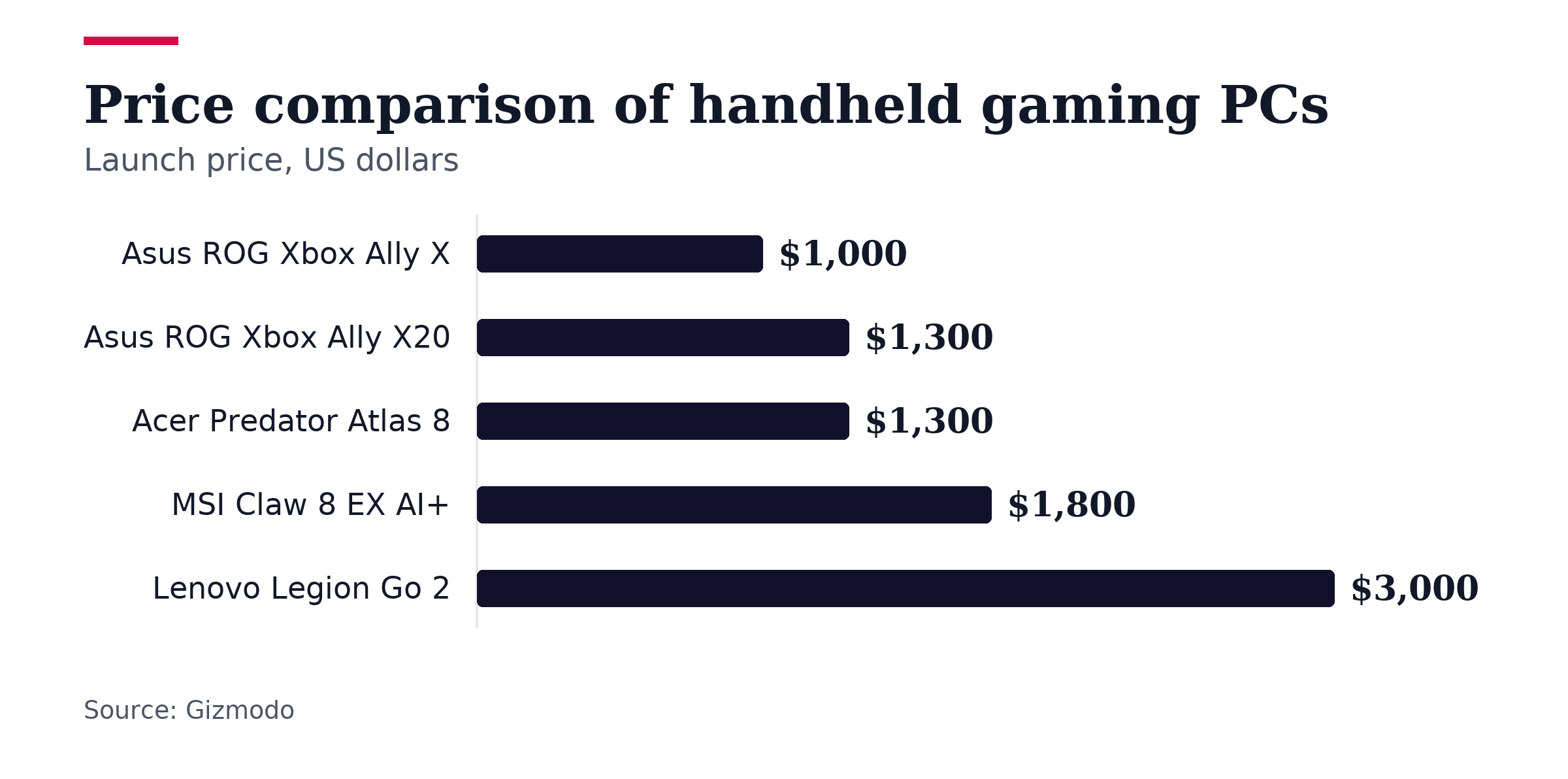
Gizmodo reported on Oct. 15, 2026, that the handheld costs $1,300, while a bundle with the Asus ROG Xreal R1 glasses costs $2,500. The device runs on an AMD Ryzen Z2 Extreme APU with 24GB of 8,000MHz LPDDR5X RAM and a 30W TDP, and it performs basically the same as the original Xbox Ally X. Its 7.4-inch 1080p OLED panel uses a 16:9 aspect ratio and reaches up to 120Hz refresh rates with VRR, hitting 600 nits typically and peaking at 1,400 nits for HDR. The X20 is a 20th anniversary edition model within Asus’ broader 20th anniversary product line and costs $300 more than the original Xbox Ally X, which launched at $1,000.
The X20 weighs 1.66 pounds, which is slightly more than the original’s 1.58 pounds, Gizmodo said, because the new display needed its cooling reconfigured. The screen measures 7.4 inches, larger than the original’s 7 inches, since bezels along the tops and sides shrank. It also brings TMR joysticks, which resist drift better than older designs.
Gizmodo said its B button sits flush with the shell instead of standing proud, and the bumper buttons feel more clicky. The D-pad starts as a dish-shaped four-way pad, but a user can lift and spin it into an eight-way pad that does not lock in place. Grips based on an Xbox controller make the handheld thicker than comparable devices.

Gizmodo said Armoury Crate and the screenshot Action Button sit above the usual in-game menu buttons, and the Xbox button shows a green backlight that turns off when the user is not browsing menus. It offers two top-mounted USB-C ports with power delivery, but only one supports USB4 and Thunderbolt 4. A microSD card slot on top expands the base 1TB of storage, and the handheld includes two front-facing speakers, Dolby Atmos support and an extra headphone jack.
Gears of War: E-Day runs at about 16 fps in benchmarks and averages 35 fps in gameplay with max 1080p and medium settings and no upscaling, Gizmodo said. The MSI Claw 8 EX AI+ costs $1,800 and runs on an Intel G3 Extreme chip that peaks at 35W TDP. It performs nearly 40% better than the X20 in named titles, and the Intel-based machine can exceed 40 fps in Forza Horizon 6 away from a power source while the X20 cannot keep pace. Microsoft added an advanced shader delivery profile for hardware based on AMD chips, but Intel hardware can run into shader load times of upwards of 30 minutes.
Star Wars: Galactic Racer manages more than 30 fps at high settings with upscaling on the X20 but can fall into the 20s in small third-person areas, Gizmodo said. The Acer Predator Atlas 8 will arrive in October, matching the Xbox Ally X20’s $1,300 price, and the Lenovo Legion Go 2 costs close to $3,000. Microsoft introduced its full screen experience for handheld PCs more than a year ago, but routine software problems persist, including handhelds that switch on by themselves.
Gizmodo said Xbox added default performance profiles for certain Xbox games to keep performance steadier at base settings. A preliminary Xbox PC app called Garrison is circulating as a cleaner, controller-focused interface based on the Xbox Cloud Gaming app. Microsoft has not added a main-menu option in the Xbox app or Quick Access menu for changing display settings and power modes. Sleep issues have gotten better, but random turn-ons still happen.




Join the discussion