
Key facts
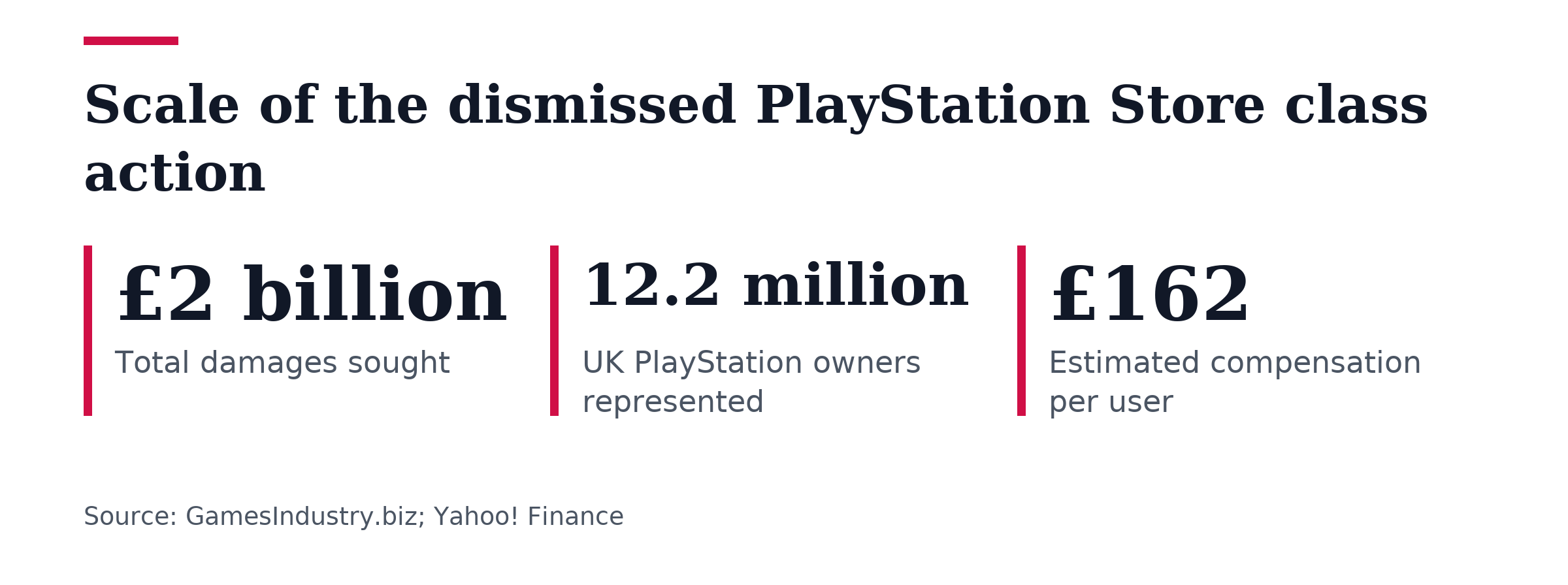
- Alex Neill, a consumer campaigner, brought the case in 2022 on behalf of approximately 12.2 million UK PlayStation owners.
- The claim sought around £2 billion ($2.6 billion) in damages and said 12.2 million users were in line for £162 each.
- The tribunal found buyers had sufficient alternatives to the PlayStation digital store, including physical copies and rival platforms.
- The tribunal said the closed-ecosystem argument was not credible because it relied almost entirely on theoretical assumptions that did not hold good in important real-world respects.
The UK Competition Appeal Tribunal dismissed in its entirety a roughly £2 billion ($2.6 billion) class-action lawsuit against Sony over PlayStation Store pricing in a judgment issued on Nov. 17, 2026.
Alex Neill, a consumer campaigner, brought the case in 2022 on behalf of approximately 12.2 million UK PlayStation owners. The claim sought around £2 billion ($2.6 billion) in damages and said 12.2 million users were in line for £162 each. If the claim had won, eligible consumers would have received about £162 ($214) apiece.
The dismissal followed a trial held earlier in 2026. It ends a long-running case alleging monopolistic behavior and unfair price-fixing by Sony on PlayStation games.
The claim argued digital games would have cost roughly 20% less absent Sony’s practices. The tribunal said the claim that prices would be 20% below the actual retail price was not made out.
The tribunal found buyers had sufficient alternatives to the PlayStation digital store, including physical copies and rival platforms. This finding supported the dismissal even though Sony had recently announced physical copies of new PlayStation games would be discontinued.
Sony recently announced it would discontinue physical copies of new PlayStation games. The tribunal had cited physical copies as an alternative to the PlayStation Store.
The tribunal said the closed-ecosystem argument was not credible because it relied almost entirely on theoretical assumptions that did not hold good in important real-world respects. Separately, the tribunal found the PlayStation ecosystem was not designed as an open platform.
The tribunal cited strong evidence that buyers would switch consoles after game-price rises. The evidence drew on Sony research forecasting commercial harm if PlayStation prices were uncompetitive with Xbox. This evidence undercut the claim that digital users were a captive class unable to leave the PlayStation ecosystem.
The tribunal concluded opening the PlayStation ecosystem to third-party stores would need significant cost and effort. It would likely reduce security and performance. Sony told the tribunal that backing third-party storefronts would be prohibitively expensive and would diminish security and performance.
The competition tribunal ruled against Apple in 2025 over the App Store. It found Apple abused dominance by forcing users through its store and 30% commission. Afterward, Apple loosened its rules to allow alternative web stores. This sparked growth in third-party stores from firms including Xsolla and AppCharge.


Join the discussion