

Key facts
- Epic Games revealed a newly refreshed Epic Games Launcher that was created using generative AI ("vibe coded"), which Epic claimed launches in 5.47 seconds, faster than Steam's 10-second boot time.
- Epic Games announced the 2026 Epic AI MegaJam, an Unreal Engine game jam starting on November 12, 2026, which initially required AI usage but was later updated to allow optional AI use.
- Valve has remained silent in response to Tim Sweeney's repeated criticisms of Steam's policies, including the AI disclosure requirement and the Steam Deck price increase.
- Tim Sweeney had been campaigning against Steam's AI disclosures as early as November 2025, calling the policy nonsensical, and doubled down in June 2026 by comparing it to a "Scarlet Letter" that harms developer success.
On October 24-25, 2026, Tim Sweeney, CEO of Epic Games, criticized Valve’s mandatory AI content disclosure policy on Steam, calling it a “political act” that forces developers to write political statements used against them by a “hate mob.” Sweeney made these comments on social media in response to Valve’s policy, defending his stance after facing backlash from developers and industry figures who argued the policy simply provides transparency. In a reply to Matt Workman of generative media company Fal, who had called the disclosure requirement absurd in 2026, Sweeney posted on X that “Forcing developers to write a political statement to be used against them by the hate mob they’re helping organize is abhorrent.” Workman, who works in “Content & Vibes” at Fal, had argued that “the premise of an AI Generated Content Disclosure is ABSURD in 2026, truly embarrassing [for] Valve and Steam.”
David Goldfarb, founder of Metal: Hellsinger developer The Outsiders, rebutted Tim Sweeney‘s claims, arguing that customers have a right to know what they are buying and calling the “hate mob” characterization far-fetched. Goldfarb responded to Sweeney’s October statement on social media, pointing out that games with AI disclosures like Arc Raiders still achieve commercial success, and questioned whether AI disclosures disadvantage small teams who need to leverage AI to survive. He stated that customers “will definitely buy games they want to buy, AI use or no,” directly countering Sweeney’s claim that labels harm revenue. Goldfarb said the evidence on whether the policy hurts small teams is still out, stating “Jury’s out” on the matter.
Sweeney compared Steam’s AI disclosures to a policy under which Valve would require developers to list their political affiliations, such as Democrat or Republican, to drive cancel campaigns. He called both approaches partisan and anti-consumer, and said their primary purpose is to push cancel campaigns unless developers align with a movement’s political goals. He also claimed that a number of users would welcome mandatory political opinion disclosures for developers, with some already surfacing that information in reviews because it is not listed on product pages. The comparison drew ridicule online, with one commenter describing it as equating AI to how a person votes.
Tim Sweeney claimed that Valve’s AI disclosures undermine developer businesses and impose a real economic cost by fueling “AI hate campaigns” and cancel campaigns that deprive developers of revenue. He argued that the labels make it “much, much, much harder for a game developer to have a chance of success,” a stance he has held since at least November 2025, when he called the policy nonsensical in a world where “AI will be involved in nearly all future production.” In June 2026, he doubled down on his criticism, comparing Steam’s AI disclosures to a “Scarlet Letter” that harms developer success. In an earlier interview, Sweeney said “I think it’s really irresponsible of Valve,” and spoke of a “hater community trying to kill the game.”
In a move that underscores the irony of the situation, Epic Games revealed a newly refreshed Epic Games Launcher that was created using generative AI, a process the company jokingly called “vibe coded.” Epic claimed the launcher launches in 5.47 seconds, faster than Steam’s 10-second boot time, and accompanied the release with a blog post that joked that “programming is hard” and that they instead “vibe coded” the launcher. However, many Epic Games Store users have reported bugs and other issues with the new launcher that Epic has yet to address, highlighting the quality concerns with AI-accelerated development. Tim Sweeney said Epic recently triggered a “huge pivot” to retool the company for “maximum AI acceleration.”
Epic Games announced the 2026 Epic AI MegaJam, an Unreal Engine game jam starting on November 12, 2026, which initially required AI usage and promised unlimited agentic support but was later updated to allow optional AI use. The contest, promoted with an image of a six-fingered hand as a joke about poor quality AI images, offers a $50,000 prize with the tagline “Vibe your way to 50K.” This event is part of Epic’s broader strategy to promote AI tools in game development, even as its CEO criticizes similar practices on competitor platforms. The MegaJam initially mandated AI usage, but Epic reversed course after the initial announcement on October 22, 2026, now allowing participants to use as little or as much AI as they want.
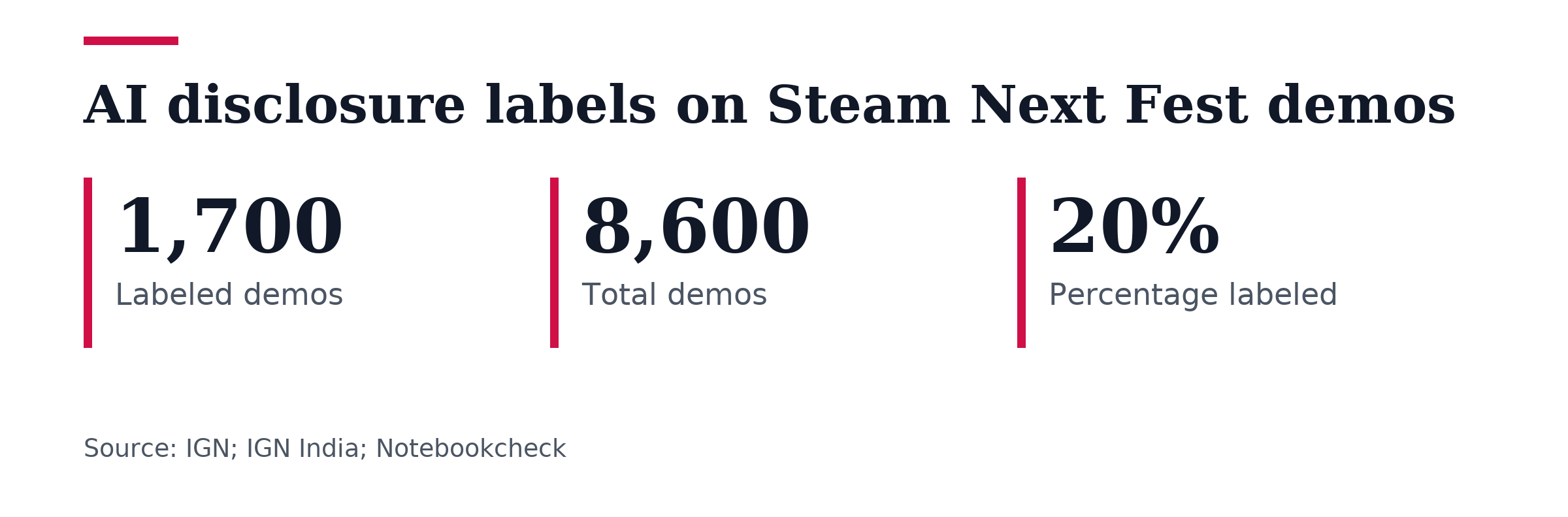
While Sweeney was criticizing Valve, Steam broke its all-time record for concurrent users earlier in October 2026, reaching 43.5 million people logged in simultaneously, highlighting Steam’s continued market dominance. Steam’s AI content disclosure policy, which has been in place since 2024, requires developers to disclose AI use in player-facing content like artwork, sound, narrative, and localization, but excludes efficiency gains and code-assist tools. At the October 2026 Steam Next Fest, nearly 1,700 titles out of more than 8,600 demos carried the AI disclosure label, putting generative AI use at nearly 20% of all demos. The October event featured more AI-aided games than ever and had nearly double the total demo volume of the June 2026 event, showing the growing scale of AI-assisted game development on Steam.
Hit games including Clair Obscur: Expedition 33 and ARC Raiders carried Steam’s AI disclosure labels but still enjoyed monumental commercial success, contradicting the claim that such labels harm developer revenue. Valve has remained silent in response to Tim Sweeney’s repeated criticisms, including the AI disclosure requirement and the Steam Deck price increase. In its updated AI disclosure terms, Valve acknowledged that “AI in games is rapidly evolving” and that “many artists and creators are rightfully concerned about exploitation and misuse,” maintaining the policy to provide clarity to customers. Observers note that Valve’s strategy of staying quiet while competitors make mistakes has historically served it well, even as Steam continues to dominate the PC gaming market.
The Epic Games Store has struggled to challenge Steam’s dominance in the PC gaming market, despite offering developers more financially beneficial terms. This long-standing rivalry is the backdrop for Sweeney’s current criticism, as Epic continues to push its own platform and AI initiatives while Steam continues to break records. Sweeney has also criticized Valve’s Steam Deck price increase as part of his broader criticism of Steam’s policies.




Join the discussion