

Key facts
- Valve said some builds arrive at review without ever having run through Steam, which can conceal broken launch options or missing content or depots.
- Steam build reviews normally target three to five business days but were taking up to 12 business days as of early November 2026, with some developers reporting waits of two to three weeks.
- Valve said much of the delay stems from games failing basic checks and needing a second review, which is not great for developers or for Valve.
- Valve said more changes to Steam's build-review process are on the way and described the current checklist update as only the first step.
Valve announced that developers must launch their latest game build through the Steam client and play it for at least five minutes before submitting it for review, though outlets disagree on whether the announcement came on November 3 or November 4, 2026. Notebookcheck and Inven Global date it to November 3, while Beebom says Valve announced the changes on November 4, 2026. Inven Global says the announcement appeared on Steamworks Development on November 3.
Valve said some builds arrive at review without ever having run through Steam, which can conceal broken launch options or missing content or depots. “Believe it or not, sometimes we review builds that have not ever been played through Steam,” Valve said. The five minutes of playtime can come from any user rather than only the developer. To count toward the requirement, the playtime must fall within the past seven days or since the latest build upload when that upload is older than seven days.
Steam build reviews normally target three to five business days. As of early Nov. 2026, they were taking up to 12 business days, with some developers reporting waits of two to three weeks. Valve said much of the delay stems from games failing basic checks and needing a second review, which is not great for developers or for Valve. The company acknowledged the backlog and says it knows the delays have been stressful for developers.
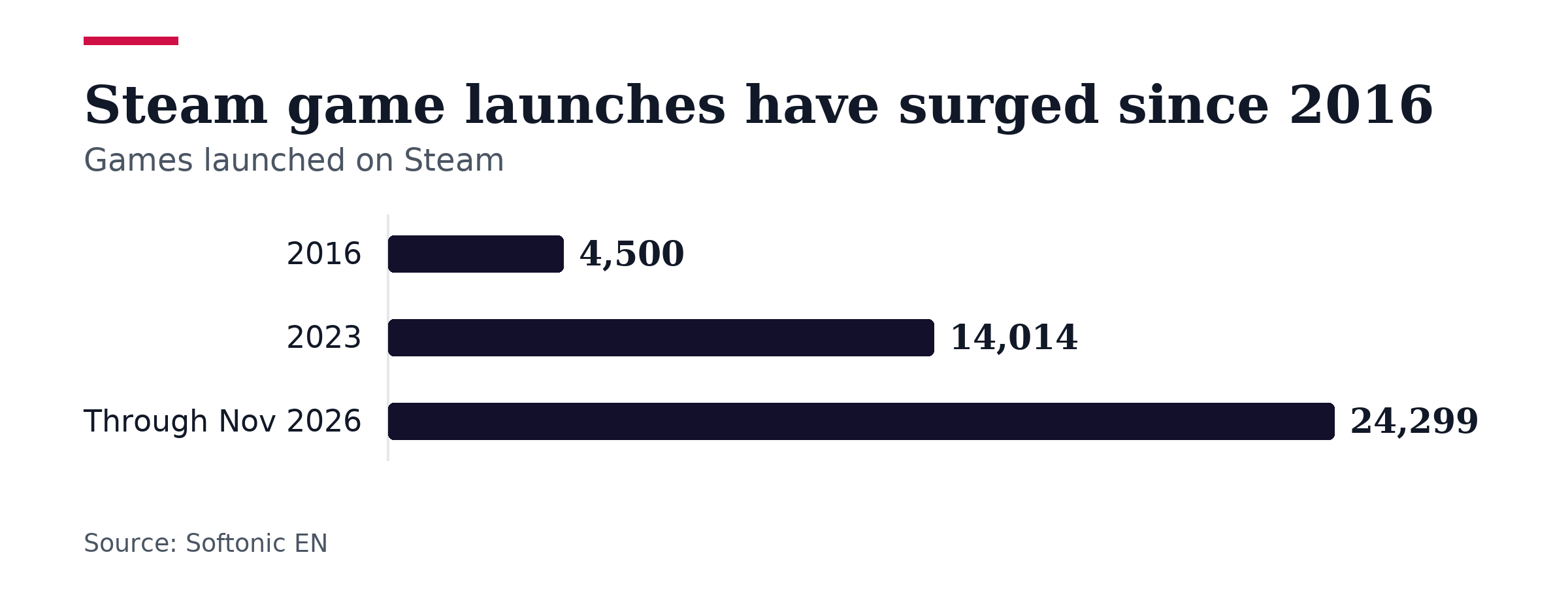
Valve said it has seen a significant increase in store page and build review submissions over recent months and spent several weeks trying to scale its review process. The company has not disclosed how many games have been submitted for store page and build review. By early November 2026, 24,299 games had launched on Steam, compared with 14,014 in 2023 and about 4,500 in 2016.
Valve has not identified what is driving the surge. TechPowerUp frames the submission surge as connected to growing complaints about AI slop, although Valve does not identify the driver. Reports about low-effort “AI slop” games are rising, and Valve has said it will not ban them outright because it does not want to be a gatekeeper. “Valve has said they won’t “be gatekeepers” by banning them outright.”
At the Steam Indie Connect event in Korea on October 27th, Valve staff said the company does not wish to serve as a gatekeeper regarding the tools developers choose, responding to concerns about AI slop and clone games. Reddit commenters blamed mass-produced AI games for the growing number of Steam submissions and called on Valve to take stronger action, while it remained unclear whether Valve would introduce stricter entry requirements.
Tom Giardino and Marc Wilkinson of Valve said the company prefers to tackle the issue using its recommendation algorithms rather than stricter rules. Before submission, developers must state which shared redistributables Steam should install, such as DirectX or Visual C++, or declare that the game requires none. For Steam Cloud titles, the developer’s partner group must create a cloud save file before review.

Store pages need at least five screenshots tagged as gameplay, and screenshots may carry labels such as gameplay, menus, concept art or cinematics. The rule applies on PC or the Steam Machine. Steam now flags incomplete achievement setups when names, icons, or duplicates are missing or repeated.
Valve added reminders to help developers verify that submitted builds include all features advertised on the Steam store page. Valve’s reviewers verify three points: the store page is clear and complete, the build matches the page’s promises, and sensitive material such as mature content and AI usage must be properly disclosed in the content survey.
Valve plans to expand Steamworks review documentation by adding a complete release checklist guide. Valve said more changes to Steam’s build-review process are on the way and described the current checklist update as only the first step.
Studio Daimon’s Food Devils remains pending approval for a November 3 Early Access release even though Studio Daimon submitted the build on October 12, 2026. The developer of Cubic Earth said a delay made them lose all momentum after a trailer drew 60,000 views. For smaller teams, delays can move a launch date back, disrupt marketing plans, and reduce visibility at the moment of release.




Join the discussion