

Key facts
- Valve said the review backlog largely results from re-reviewing games that have basic functional issues, and it hopes the new checklist will help developers sidestep those problems.
- Valve said it has seen significantly more submissions involving store pages and build reviews in recent months and has spent recent weeks working to scale its process to match demand.
- Food Devils by Studio Daimon awaits approval for a planned November 3 Early Access launch on Steam even though the build was submitted on October 12, 2026.
- Developers must now run their latest game build through Steam for at least five minutes and record that playtime before review submission.
Valve updated Steam’s pre-release checklist on November 4, 2026, to help developers pass game reviews on the first attempt, while game build reviews are taking up to 12 business days on average, compared with the usual three to five business days. The company typically aims to complete reviews within the shorter window, and Valve said the longer wait comes partly from developers submitting builds that are not ready, games being rejected, and titles requiring retesting.
Valve said the backlog largely results from re-reviewing games that have basic functional issues, and it hopes the new checklist will help developers sidestep those problems. The company said it has seen significantly more submissions involving store pages and build reviews in recent months and has spent recent weeks working to scale its process to match demand.
The updated checklist is part of initial improvements Valve shipped over the past weeks, and the company made the announcement on the official Steamworks Development page. Many games are missing release dates because of the backlog, and developers have told Valve that waiting for review build updates beyond the expected timeframe is stressful.
Studio Daimon submitted the build for Food Devils on October 12, 2026, but the game still awaits approval for a planned November 3, 2026, Early Access launch on Steam. Beebom cited the title as an example of an indie developer affected by the longer review window while preparing a Steam release.
Under the updated checklist, developers must run their latest game build through Steam for at least five minutes and record that playtime before review submission, with the recording taken within the past seven days or after a build uploaded more than seven days earlier. They must also confirm which common redistributables (shared code libraries that games install) their games require.
Valve added other checklist items, including checks for achievements and cloud saves, to verify that submitted builds match what the store page advertises. The goal is to catch cases where advertised features are missing from submitted builds.
The achievement checks cover missing names, missing icons, and duplicate names. Developers may sort store-page screenshots into gameplay, menus, concept art, or cinematics from inside the game, while at least five screenshots must remain categorized as gameplay on PC or Steam Machine.

All games must pass Valve’s testing process to confirm they are fit for Steam and free of malware unless the developer is a major publisher with a proven track record. Valve said its testing ensures games are fit for Steam and do not expose players’ computers to malware.
Steam has seen approximately 24,299 games released in 2026 alone as of November 2026, compared with around 4,500 games launched across 2016. IGN said the surge in submissions has grown with the advent of generative AI, and the outlet said Valve’s approval process has taken much longer lately because of the volume. Valve said it has no plans to ban AI games outright from Steam and wants developers to do more to stand out so their games cannot be easily cloned.
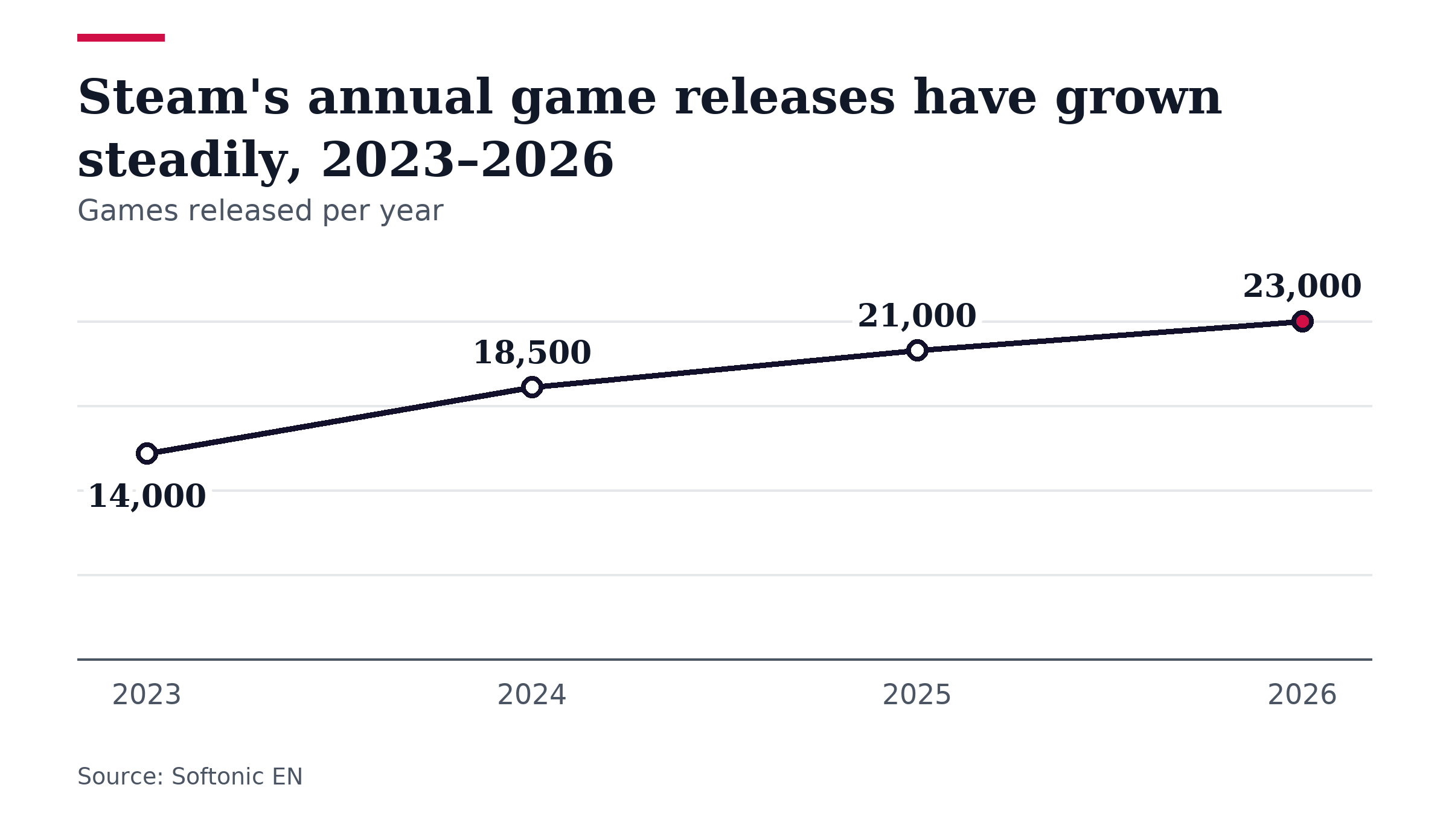
SteamDB figures show nearly 23,000 games released on Steam in 2026, around 21,000 in 2025, 18,500 in 2024, and 14,000 in 2023. Softonic said the exponential growth in releases keeps making Steam’s store harder to navigate and that Valve has not offered a solution to the problem. The outlet compared the 2026 figure to earlier years when AI did not exist or was less prevalent.
Developers must disclose AI usage on Steam so customers can vote with their wallets. Tom Giardino and Marc Wilkinson said at the Steam Indie Connect event in Busan, South Korea, that Valve knows the scale of the AI-made game problem but will not act as arbiters of which tools developers use. “we don’t want to be arbiters telling developers which tools they should or shouldn’t use,” they said.
“We’ve seen a significant increase in submissions for store page and build review in recent months,” Valve said. The company described the initial changes as a great starting point and said more improvements are coming.




Join the discussion