
Key facts
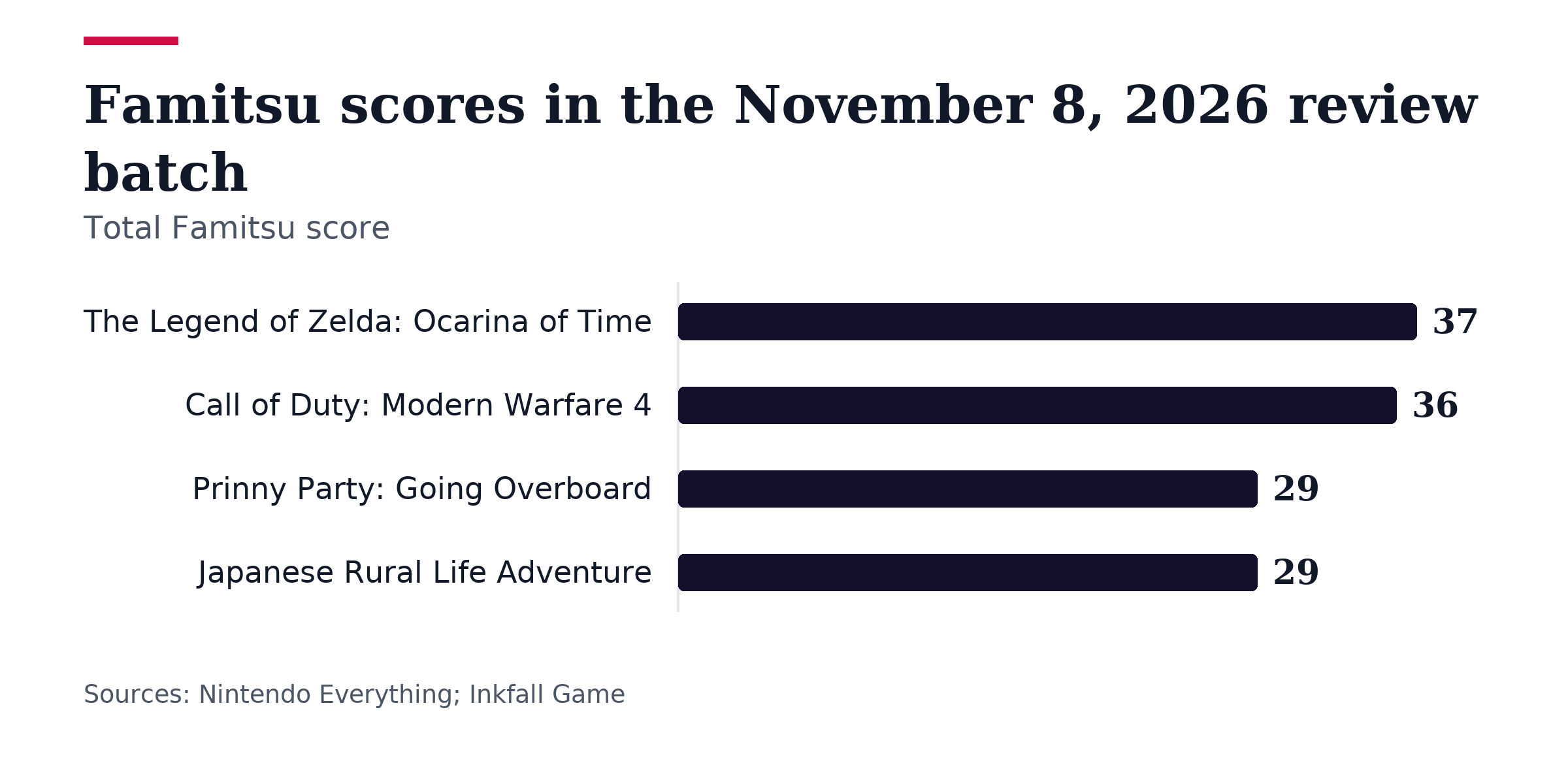
- Famitsu awarded The Legend of Zelda: Ocarina of Time four individual scores of 9, 9, 9, and 10 in its review batch for the week of November 8, 2026.
- Call of Duty: Modern Warfare 4 received four Famitsu scores of 9, 9, 9, and 9 in the November 8, 2026 review batch.
- Prinny Party: Going Overboard received its first Famitsu review scores of 7, 7, 8, and 7 in the November 8, 2026 batch.
- Famitsu's score of 37 out of 40 for the Ocarina of Time remake matches the score given to Ocarina of Time 3D on Nintendo 3DS in 2011.
Famitsu awarded The Legend of Zelda: Ocarina of Time remake scores of 9, 9, 9, and 10 — 37 out of 40 — in its November 8, 2026 review batch, topping a six-game list that included Call of Duty: Modern Warfare 4 at 36 out of 40 and Prinny Party: Going Overboard’s first scores of 7, 7, 8, and 7.
Nintendo Everything and Inkfall Game explain that four Famitsu editors assign each game scores from zero to ten, and the four numbers sum to a maximum of forty points. The same weekly tally gives Japanese Rural Life Adventure scores of 8, 7, 7, and 7, Moomin: Midsummer Madness scores of 7, 7, 8, and 7, and The Fallen Kingdom scores of 7, 7, 7, and 8. Each of those three titles totals 29 out of 40.
KeenGamer and Beebom report that the remake launches exclusively on Nintendo Switch 2 on November 5, 2026, making it Nintendo’s first major release of the month. The digital edition costs 59.99 dollars and the physical edition 69.99 dollars. Preloads began October 29, 2026; Nintendo’s store page lists a 27 gigabyte download, and the game takes up 24.5 gigabytes of storage.
KeenGamer reported on November 5, 2026 that reviews went live November 4, 2026, one day before launch.
KeenGamer says Nintendo made the remake with new graphics, fully voiced scenes, more character dialogue, an orchestral soundtrack, and updated camera and movement systems. Link can play the ocarina by humming or playing a real instrument into the Switch 2 microphone. Nintendo’s Threads of Time tracker helps newcomers follow the main story, and the game keeps the original story of Link’s journey from Kokiri Forest to defeat Ganondorf and save the Kingdom of Hyrule.
Beebom lists manual jumping, sprinting, free camera controls, expanded environments, and item quick-swapping among the changes from the 1998 original. Link can explore major parts of Hyrule Castle Town, which was only a backdrop before. The remake keeps loading screens and no fast-travel points, though the Ocarina can warp players to major dungeon locations and the Temple of Time.
KeenGamer and iXBT.games summarize the Famitsu panel’s praise: a smooth camera, improved controls, strong gameplay flow, and rebuilt graphics, while noting that the game is simple compared with many modern titles and that players can be unsure what to do next. Nintendo Everything’s report adds that the new elements and cooperative features are unique, that rematch bosses, formidable enemies, and expanded replayability stand out, and that the fairy Navi gives the player a word.
Famitsu’s 37 out of 40 matches the score Ocarina of Time 3D received on Nintendo 3DS in 2011, and it falls three points short of the 1998 Nintendo 64 original’s perfect 40, the first perfect score in Famitsu’s history. IGN’s guide describes the 1998 original as the series’ first 3D Zelda game. KeenGamer reports that the remake’s 96 Metascore, based on more than 80 critic reviews, makes it the highest-rated game of 2026 on Metacritic, pushing Sektori and its 93 to second place.
OpenCritic gives the remake a Mighty rating, a Top Critic Average of 97, and a 100 percent critic recommendation rate. Its 96 Metascore sits three points below the Nintendo 64 original’s 99, which remains the highest-rated game in Metacritic history, and two points above the 3DS version’s 94.
Prinny Party: Going Overboard is set in the Disgaea series world and mixes board game play with RPG-style character development and battles. It begins semi-cooperative, then becomes a free-for-all after a boss is defeated, with everyone hindering each other. Victory goes to the player who defeats the boss and brings them back to the starting square.
Players compete for credit after defeating the Demon King and the Four Heavenly Kings, and a throw command lets them stack identical facilities to rank them up. The game includes special event maps, though reviewers wanted more main map types and a better final result announcement. Because only the player who returns the boss wins, it is a one-shot game in which earlier efforts can feel futile. The panel also faulted the game because online support varies by platform and because character growth depends largely on luck.
Inkfall Game calls Prinny Party a respectable debut for a niche party-board hybrid, and says the scores illustrate Famitsu’s continued influence on Japanese consumer expectations, especially when legacy titles receive modern upgrades.



Join the discussion