
Key facts
- AOD is a WMI driver that lets Linux control Ryzen platform firmware overclocking settings through the same interface Ryzen Master uses on Windows.
- AMD has not confirmed whether it will build a Ryzen Master-style software interface for Linux, and no graphical application accompanies the driver; controls use sysfs only.
- Shyam Sundar S K, an AMD engineer, sent a three-patch AOD series to the Linux kernel platform-driver-x86 mailing list on October 10, 2026, local time.
- The driver is significant for Bazzite and SteamOS users and others on Linux who previously relied on community workarounds or motherboard UEFI for Ryzen power-limit changes.
AMD engineer Shyam Sundar S K sent a three-patch AMD Overclocking Driver series to the Linux kernel platform-driver-x86 mailing list on October 10, 2026, beginning a kernel review for official Ryzen overclocking on Linux.?
AOD is a WMI driver allowing Linux to manage Ryzen platform firmware overclocking settings through the interface Ryzen Master uses on Windows. WMI serves as a firmware management interface backed by Linux.
The initial version includes a platform-level simultaneous multithreading switch, which lets a processor core run multiple software threads, plus a read-only memory clock readout. It also adjusts PPT, or processor package power limit, TDC, or sustained current, and EDC, or peak current, within supported ranges and step sizes. TechPowerUp says the SMT switch acts like a BIOS option instead of the kernel’s nosmt boot parameter, which disables simultaneous multithreading at boot.
TweakTown reports that the driver can toggle memory clocks, conflicting with other sources that describe the memory clock as read-only.
New PPT, TDC and EDC values apply only after a reboot, and because the firmware reports nothing active, the settings are write-only. AOD alters the PBO PPT limit, storing it so the change takes effect after a reboot, and the requested setup can differ from what is currently running until the system restarts.?
AOD changes persist like BIOS settings, unlike HSMP, which adjusts runtime limits in the SMU, the CPU’s internal power-management processor, but loses them on reboot. HSMP targets EPYC servers.
AMD has not confirmed plans for a Ryzen Master-style interface on Linux, and no graphical application ships with the driver; controls use sysfs only, a virtual filesystem for exposing kernel settings to user space. TechPowerUp reports that Ryzen Master itself is not coming to Linux with this driver.
Joho no Todai states that a graphical interface similar to Ryzen Master will probably never arrive on Linux. The outlet also reports that no one has submitted patches for a user-space graphical interface, so users adjust settings by writing to sysfs files with the echo command. “Live tuning similar to what Ryzen Master offers is currently off the table, but that should change over time.” — AMD
Projects such as CoreCtrl and LACT may build sysfs frontends, copying the approach AMD uses with its GPU driver, in which the kernel exposes controls and other tools create graphical interfaces.
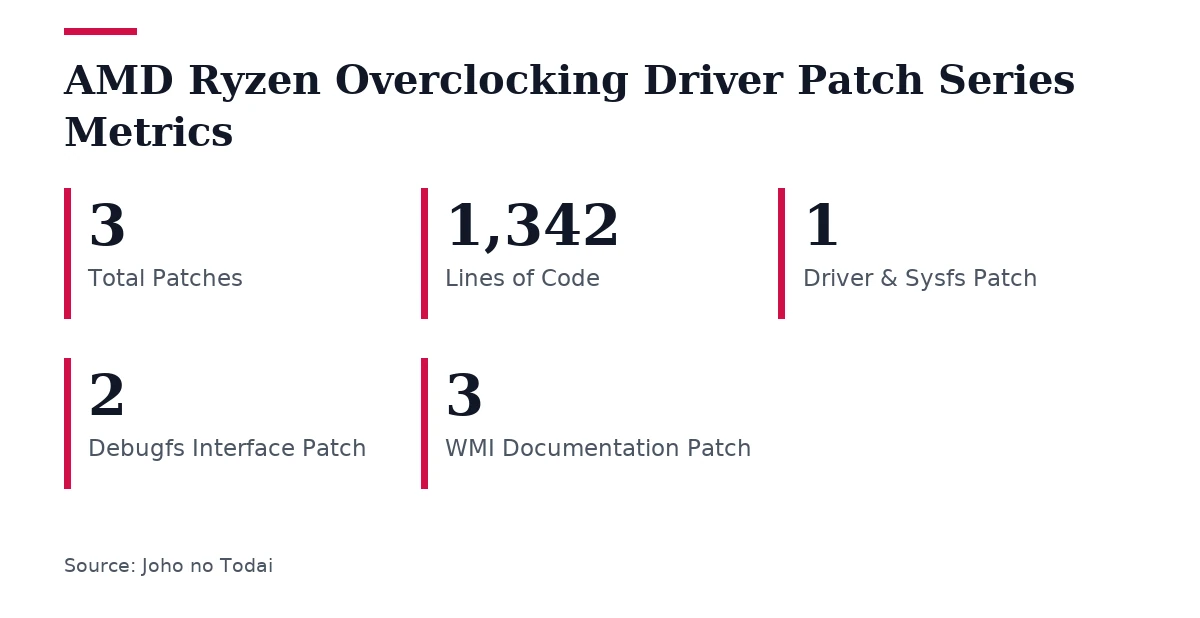
The submission totals 1,342 lines across three patches: the first implements the driver and sysfs interface, the second adds a debugfs debugging interface, a filesystem for kernel debugging data, and the third documents the WMI interface. The patches create a new drivers/platform/x86/amd/wmi/ directory, with one driver per WMI GUID (globally unique identifier) and aod.c as the first driver there, a structure intended to collect AMD WMI drivers over time.
Review is underway with three reviewers and no objections raised to the overall direction. Mario Limonciello of AMD gave a Reviewed-by on October 12, Armin Wolf commented on every patch on October 15, and Ilpo Järvinen, the subsystem maintainer, offered comments on the first two patches on October 21. Remio notes that Phoronix covered it on October 21, 2026, and identified AMD engineer Shyam Sundar S K as the author.?
The tool matters most to Bazzite and SteamOS users and other Linux players who previously depended on community fixes or motherboard firmware to adjust Ryzen power limits. TweakTown reports that every Ryzen owner can still overclock through the motherboard’s UEFI, so the software option mainly makes it easier to test overclocks and watch clock speeds inside the operating system. PC Perspective says the reboot-required tool is still far from the methods Linux users have used to change CPU power limits in the past.?
AMD warns that operation outside published specifications can cause instability, hardware damage and data loss, and resulting damage falls outside product warranty coverage. Since the driver talks to platform firmware, a processor name by itself cannot prove compatibility, and users need proof about their full system setup.
TweakTown reports that the driver does not yet adjust actual clock speeds, apart from any boost a user gains by raising the CPU’s power limit. Remio adds that seeing a memory clock value does not grant permission to change memory frequency, timings or voltage through the same interface. HotHardware says live tuning on the level of Ryzen Master is not ready yet, though the source expects that to change over time.
AOD is distinct from amd-pstate, Linux’s processor performance-scaling driver, which adjusts operating behavior as workloads change. Remio also cautions that a shared kernel interface does not guarantee consistent terminology across applications, and that a supported range is not the same as a recommended configuration.
Remio states that a driver loading does not establish that every exposed function behaves correctly, so testing should distinguish successful detection from successful operation. The announcement establishes development activity rather than a benchmark result, so performance claims require a separate standard of evidence.
More commands exist in the firmware than the initial patches enable, so controls could arrive later, although AMD has not announced which kernel release will include them. Remio notes that submission, acceptance into the upstream kernel and availability in a distribution update are separate milestones, and that acceptance would strengthen the case for maintainable Linux support without meaning immediate availability on every distribution.
AMD calls the Linux driver part of its effort to improve feature parity between Windows and Linux. Joho no Todai calls it significant that the kernel now offers a way to change PBO limits outside the BIOS.



Join the discussion