

Key facts
- Shacknews and Siliconera both published reviews of NIS's Village in the Shade on October 23, 2026.
- Both Shacknews and Siliconera state that village rules impose an 11 PM curfew and that breaking rules is necessary to learn the truth.
- Village in the Shade launches October 27, 2026 on PlayStation 5, Nintendo Switch, Switch 2, and PC.
- The Japanese console version released July 30, 2026; as of October 23, 2026 the Steam version was worldwide without English support, with English support coming next week.
Shacknews and Siliconera published reviews of NIS’s Village in the Shade on October 23, 2026, ahead of its October 27, 2026 launch on PlayStation 5, Nintendo Switch, Switch 2, and PC.
Shacknews calls the farming-horror juxtaposition a metaphor for community, tradition, sacrifice, and the justification of rule-breaking, and concludes that the ambitious game succeeds as one of NIS’s most compelling titles in years. Siliconera calls the game delightful, says the scares are optional, and suggests it may be one of NIS America’s best releases in years.
Both outlets note that village rules impose an 11 PM curfew and that breaking rules is necessary to learn the truth. Shacknews frames the horror as rural gothic rather than jump-scare-driven and likens threatening familiar faces with institutional power to Flannery O’Connor’s southern gothic. Siliconera praises the haunting opening as reminiscent of Yomawari: Night Alone and Midnight Shadows and says the first hour makes the player feel like an isolated outsider.
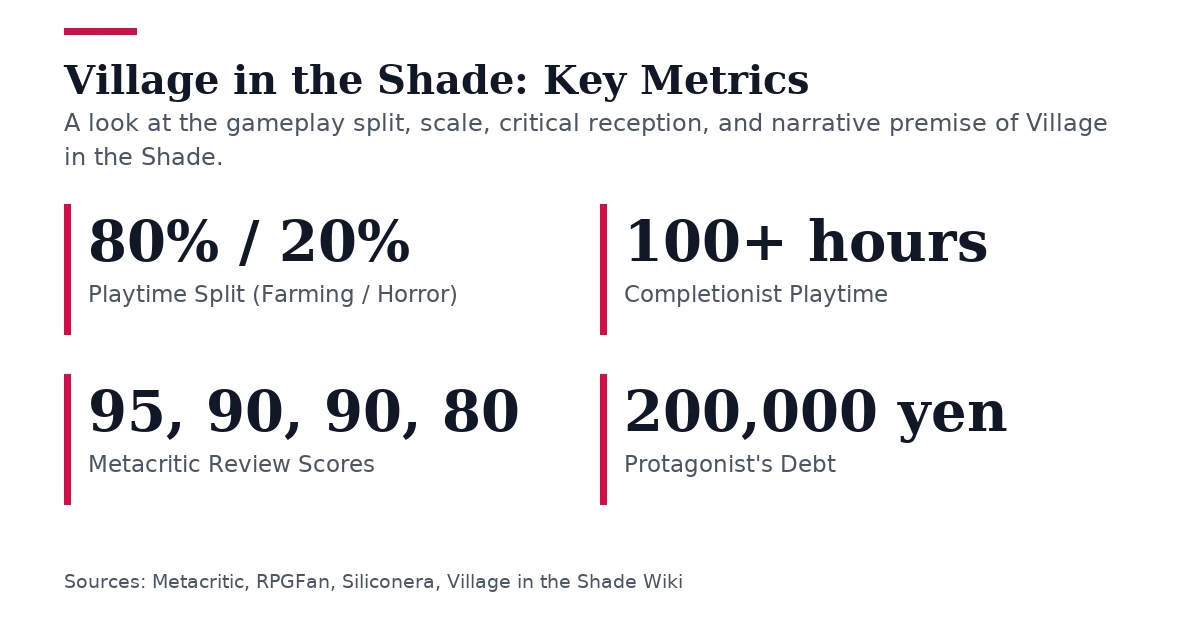
Designers Yu Mizokami and Mio Katsumata told Automaton-Media that roughly 80 percent of playtime is farming simulation and 20 percent is folk horror. The Village in the Shade Wiki describes the horror as creeping uncanny unease rather than jump scares and blood, woven into the social fabric. The wiki estimates over 100 hours of gameplay for completionists, covering farming progression, relationship building, and every village secret.
Shacknews praises the art as an improvement over Void Terrarium and Yomawari, with expressive portraits and sprites, and music resembling Animal Crossing with a folksy twist. Siliconera highlights the sepia-toned, overgrown isometric art direction and compares it favorably to Cozy Grove as the only similar aesthetic in farming sims.
Shacknews says farming balances familiarity, complexity, and friction without overwhelming multistep processes, citing cursed cucumbers and acquiring a cow. Siliconera outlines a daytime loop of tending livestock and crops, crafting, cooking, visiting townsfolk, petting cats, fishing or hunting, building platonic relationships without romance, and attending festivals.
Siliconera says nighttime horror follows the daytime farm loop and begins with the 11 PM curfew that the player must break, including helpful entities, dangerous monsters, and foes the player can fight. Shacknews notes the game builds unease through coy dialogue, red text, and subtly sinister UI before the first nighttime knock.
Siliconera warns that graphic violence, horrifying creatures, and animal harm make trigger and ESRB warnings valid, and urges cautious players to try the first in-game week before deciding; the game is rated T for Teen by the ESRB. Shacknews mentions a free-play mode to farm without scary content, while the Village in the Shade Wiki calls the equivalent Peaceful Mode and says switching back to the full game needs a new save file.
Metacritic shows four reviews for Village in the Shade as of October 23, 2026: scores of 95, 90, 90, and 80, with 100 percent positive and no mixed or negative reviews. The highest score, 95, comes from a reviewer saying the horror narrative and farming simulation can thrive when paired together. The lowest score, 80, praises the almost unparalleled atmosphere and notes the village relies on sacrifices to a dark, elder deity.
The Japanese console version released July 30, 2026, and as of October 23, 2026 the Steam version was worldwide without English support, with English support coming next week. RPG Site says visuals are similar across PS5, Switch 2, Switch, and PC and cap at 1080p, while Switch 1 has minor opening hitches and map delays not present on Switch 2.
RPG Site calls PS5 the best console version because of the fastest load times and trophy support, and calls PC the best for uncapped frame rates and more input options. PC supports uncapped frame rates, Steam Deck stays above 85 fps without locking 90, and handhelds such as ROG Ally and MSI Claw can reach high refresh rates at low wattage.
RPG Site notes console versions have good rumble including HD rumble and haptics, features missing on ROG Ally and Steam Deck, and says rumble helped make Switch 2 its main version. Switch 1 has a physical release, while Switch 2 uses a Game-Key Card physical release.
RPGFan reports the protagonist owes over 200,000 yen in debt to village leader Rin, effectively forcing indentured servitude, and describes eight village rules with each major story chapter seeing the protagonist violate one rule and endure consequences. The outlet identifies villagers such as Rokkako, Hasumi, Konno, Yuta, and Tobari, and says the protagonist resembles a child who went missing ten years ago.
South Korean outlet INVEN published the first critic review of Village in the Shade, scoring the PS5 version 81 out of 100. The outlet praised the Yomawari team for filling out genre fundamentals with quiet diligence and layering folk horror over village warmth.
The Village in the Shade Wiki lists three blunt instructions given to newcomers: don’t talk to strangers, don’t leave the village, and don’t go out at night. The wiki describes these rules as not flavor text but the engine that powers the horror layer, with each rule designed for players to break.




Join the discussion