
Key facts
- Aonuma said he is nervous about releasing the remake because he does not know how it will turn out and cannot stop thinking about it.
- Aonuma, who is 63 and has led the Zelda series for about 25 years, said he remains eager to guide the franchise's future and is interested in what younger staff will imagine for upcoming titles.
- The Ocarina of Time remake is structured as a faithful restoration of the 1998 original rather than a full reimagining, with dungeon and town layouts seemingly untouched and progression unchanged.
- The remake adds quality-of-life changes including a dedicated jump button, a dash move, unrestricted right-stick camera control, and a streamlined inventory system with single-button item swapping.
Nintendo Zelda producer Eiji Aonuma said younger members of the Ocarina of Time remake team who had never played the original game were a benefit to the project in comments dated Oct. 30, 2026, ahead of the remake’s Nov. 5, 2026 launch on Nintendo Switch 2.
Aonuma credited those younger developers with driving the remake by thinking through how to adapt the game in the best possible way. He said they made it fun once players have the controls in their hands, approaching the material as new players rather than inheritors of convention.
He also said he is nervous about releasing the remake because he does not know how it will turn out and cannot stop thinking about it. The remake’s source material is more linear than Breath of the Wild and Tears of the Kingdom, and players used to those open-world games may find that structure unfamiliar. The 1998 original defined Z-targeting (the lock-on system that lets players target enemies), the interplay between unique items and dungeons, puzzle design, and core combat mechanics.
Aonuma, who is 63 and has led the Zelda series for about 25 years, said he remains eager to guide the franchise’s future and is interested in what younger staff will imagine for upcoming titles. He said he is happy to offer his guidance so he and the younger team can think together about the next Zelda.
He suggested Nintendo’s collaboration with Koei Tecmo on Hyrule Warriors: Age of Imprisonment may influence the next mainline Zelda title, and he did not rule out a return to the Hyrule setting of Breath of the Wild and Tears of the Kingdom. “Please picture this while playing Age of Imprisonment, and look forward to our Zelda,” Aonuma said. Age of Imprisonment features Dynasty Warriors-style 1 vs. 1000 musou (a one-versus-many action genre) gameplay set during the Imprisoning War that sealed away Demon King Ganondorf, and Koei Tecmo’s new AAA Games Studio developed it in collaboration with Nintendo. Nintendo had stated in September 2023 that it had no plans to release downloadable content for Tears of the Kingdom and was instead moving on to a brand-new game in the series.

The remake is a faithful restoration of the 1998 original rather than a full reimagining, with dungeon and town layouts seemingly untouched and progression unchanged. It adds quality-of-life changes including a dedicated jump button, a dash move, unrestricted right-stick camera control, and streamlined inventory swapping with a single button. The visual style blends photorealism with stylized graphics and runs at 60 frames per second on Switch 2.
The game includes full voice acting for characters such as Navi and Saria, expanded cutscenes, and a day/night cycle that continues even when the player enters a town. A Threads of Time feature records story progress on an in-game visual record. Audio detection lets players play ocarina melodies through the console’s microphone, and players can use a physical ocarina accessory to input songs instead of button combinations. The remake expands zones such as Kakariko Village and Goron City, and adds boss rematches and the Hall of Fallen Foes.
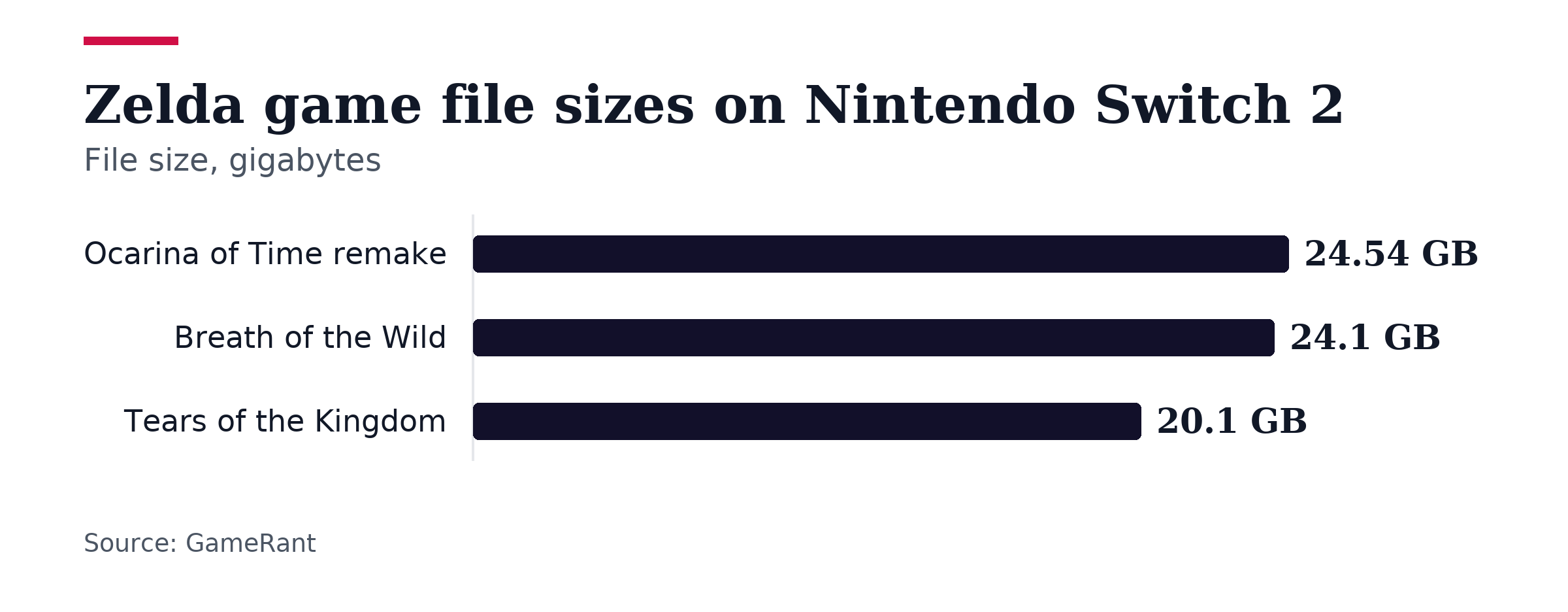
It launches Nov. 5, 2026, priced at $59.99 digital and $69.99 physical, with the first physical print run featuring textured foil cover art. The remake loads faster, features remastered sound, and includes a symphonic orchestral score alongside the visual overhaul. Its file size is 24.54 GB, larger than the Switch 2 versions of Breath of the Wild at 24.1 GB and Tears of the Kingdom at 20.1 GB. The ESRB rated it Everyone 10+ for animated blood and fantasy violence, and Nintendo developed and published the game.
The original Ocarina of Time launched in 1998 for the Nintendo 64, 28 years before the remake. It shifted the series from a 2D top-down perspective to full 3D environments with Z-targeting and context-sensitive buttons as the follow-up to Link’s Awakening. Nintendo re-released it on GameCube in 2003 and on Nintendo 3DS in 2011. Other Zelda games received HD or DX updates including Wind Waker, Skyward Sword, Twilight Princess, and Link’s Awakening on Switch in 2019, which offered a bold new graphical style as the most radical reimagining to date.



Join the discussion