
Key facts
- The European Commission formally presented its draft Digital Fairness Act on 2026-11-11 after an earlier leak that week.
- Sellers of virtual currencies would have to show the real-money value attached to those currencies.
- Minors would be barred from receiving paid-for variable reward systems, also known as loot boxes.
- The restriction covers in-game or in-app purchases deemed necessary, or presented as necessary, for progress or success within the game.
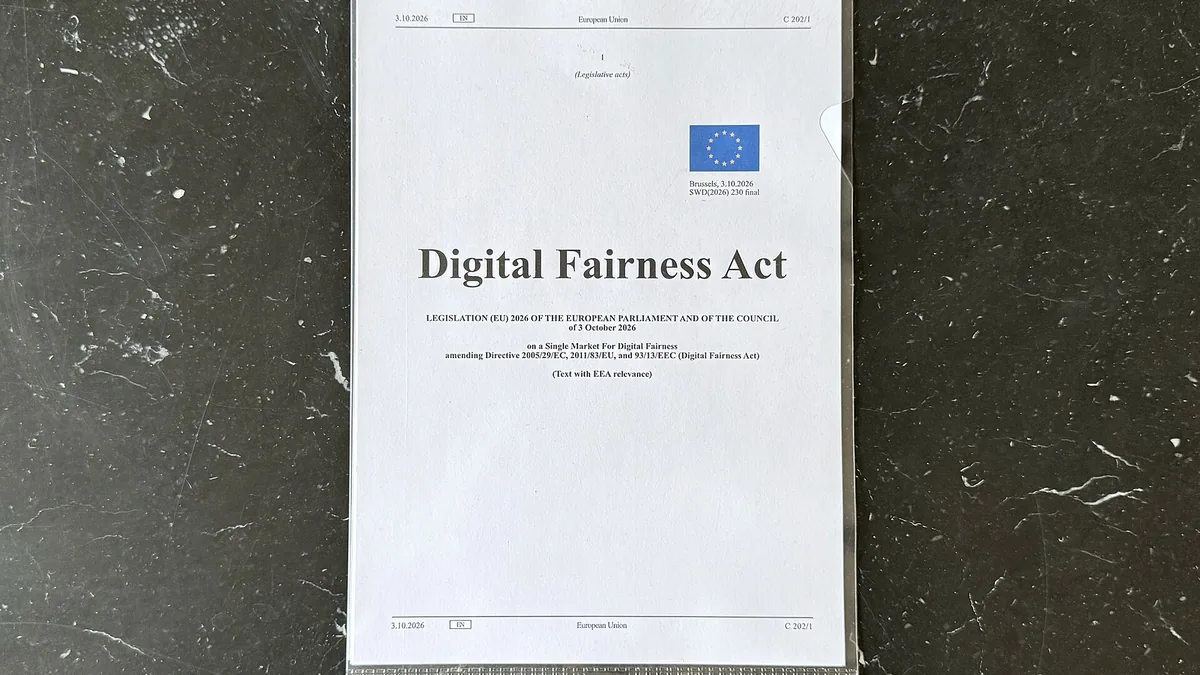
The European Commission formally presented its draft Digital Fairness Act on Nov. 11, 2026, after an earlier leak during the week.
Rock Paper Shotgun notes the full draft text had already circulated before the official unveiling. The draft regulation and an introductory explainer are available on the European Commission website. The explainer traces the Act’s history to 2020. Rock Paper Shotgun provides a link to the official EU Commission page hosting the draft and explainer.
If adopted, the proposal would become an EU Regulation applying directly in every member state without requiring national transposition. Penalties could reach 6% of worldwide annual turnover. The rules would take effect after a 12-month period following the regulation’s entry into force. GamesIndustry.biz places the fine and timing provisions within a broader enforcement package covering customer service and online contract rules.
Sellers of virtual currencies would have to show the real-money value attached to those currencies. Items bought with the currency would carry the same requirement. Rock Paper Shotgun extends the requirement to items bought with the currency. The demand traces to consumer groups, including BEUC’s 2024 report, and to recent CPC Network cases against games firms.
Products aimed at minors would have to disable paid-for virtual currencies by default, enabling them only after a parent or guardian approves. GamesIndustry.biz flags an unresolved question about whether the default disable requirement reaches the purchase mechanism alone or also covers in-game functionality itself.
Minors are defined as anyone under 18, and products aimed at or used by minors will be assessed through objective indicators such as age ratings. GamesIndustry.biz says age ratings count as one objective indicator for deciding whether a product targets minors or is used by them.
The draft would bar minors from receiving paid-for variable reward systems, also known as loot boxes. GamesIndustry.biz says the draft requires disclosure of item types and probabilities for adult users plus effective disable tools. Rock Paper Shotgun calls for an easily accessible off switch for everyone. Eurogamer’s leaked draft extends the default-off recommendation to minors.
The restriction covers in-game or in-app purchases deemed necessary, or presented as necessary, for progress or success within the game. GamesIndustry.biz says the interpretation of progress and success remains unsettled and the exact legal consequence is unclear, including whether adults can still buy advantages in mixed-age games. Rock Paper Shotgun confirms the outright ban for kids. Eurogamer’s draft adds that the bar applies when a trader knows with reasonable certainty that minors use the product.
Firms would need to offer consumers a way to switch off features designed to drive compulsive or excessive use. GamesIndustry.biz lists automatic content play, push notifications not tied to user activity, login rewards, engagement streaks and relationship-simulating features.
The alleged draft says all players, not only minors, should be able to switch off loot box and gambling offers. It also calls for showing the real cost of in-app purchases and the odds for loot box rewards.
PEGI assigns a default 16 rating to games containing loot boxes and an 18 rating to blockchain games under rating criteria changed last month. Rock Paper Shotgun ties the PEGI changes to a recent EU rating law change intended to protect children from habit-forming spending systems. Eurogamer points to EA Sports FC moving from PEGI 3 to PEGI 16 because of Ultimate Team.
Titles carrying an 18+ rating would encounter fewer restrictions than games rated for all ages, which might push developers toward higher age ratings. GamesIndustry.biz suggests developers might respond by aiming for higher age ratings to reduce the regulatory burden.
The proposal seeks to harmonise European rules. It also adds strict transparency requirements for influencers under Article 11. GamesIndustry.biz presents harmonisation as a benefit that reduces the complexity of complying with multiple national regimes across Europe.
Free trials could only become paid contracts with express consumer agreement. Online sign-ups must include easy termination and withdrawal functions. GamesIndustry.biz groups these rules under Articles 20 through 25, covering trial renewals, easy cancellation and human support for post-contract queries.
The Digital Fairness Act would cover subscriptions, in-app stores and sign-up flows for EU customers. That coverage reaches traders outside the Digital Services Act’s scope.
The law would reach every company operating in the EU, regardless of where it is headquartered. National governments can levy fines and consumers can seek compensation if they believe they suffered harm.
Eurogamer’s explainer timeline suggests adoption could happen late in 2027, with broader application by 2030. The Act is not yet law and must pass through further iterations and discussions before adoption.
Adoption by the College would send the proposal to the European Parliament and the Council. Tech Times says IAPP anticipates an early dispute over committee leadership, with Internal Market and Consumer Protection the likely lead and Civil Liberties, Justice and Home Affairs potentially claiming a role.
According to CMS, the law would not come into force before the end of 2028 at the earliest. Tech Times ties that outlook to the remaining legislative steps in Parliament and the Council.
A 2024 fitness check found that 97% of examined sites and apps contained at least one dark pattern. The review estimated annual consumer harm at €7.9 billion, or $8.8 billion. Tech Times links the review to the proposal’s origins and notes President Ursula von der Leyen’s 2024 mission letter to Commissioner Michael McGrath.
Under Article 25 of the Digital Services Act, manipulative interface design is banned on online platforms, though micro and small enterprises and search engines fall outside the rule. Tech Times cites Pinsent Masons and says the Digital Fairness Act is widely viewed as closing gaps left by the Digital Services Act.
The Commission issued preliminary findings to TikTok on Feb. 6, 2026 and Meta on July 10, 2026 over addictive design under the Digital Services Act. Tech Times says penalties under that law may reach 6% of worldwide annual turnover, and that the Commission enforces directly for very large platforms. Preliminary findings are not final decisions.
Senior Commission figures are divided on expanding consumer-protection powers and adding new fines and obligations. Tech Times cites EU Today and July Financial Times reporting describing Michael McGrath as favouring stronger direct enforcement while digital chief Henna Virkkunen cautioned against overlapping obligations.
Negotiations will run in parallel with the EU Kids Act. The EU Kids Act was proposed Sept. 17, 2026, and remains unadopted. The 2025 public consultation received more than 4,300 responses. Citizens accounted for over 90% of them, according to IAPP.
Commissioner Michael McGrath’s published meetings include Google, Snap, TikTok, the IAB, Apple, Meta, Microsoft, Amazon and OpenAI. The meeting log shows access but not what was agreed.
It remains unclear whether the Digital Fairness Act itself includes any age verification requirements. Tech Times cites security incidents at AU10TIX in 2024, a Discord vendor breach in 2025 and a Persona exposure in 2026 as examples of risks in age verification systems.
The European Commission believes the industry has not done enough to ease consumer-group concerns. Industry says the regulator does not understand games and some demands are unworkable. GamesIndustry.biz concludes the draft is difficult for both industry and regulators to digest, and whether it actually benefits consumers remains uncertain.
Lawyers have filed actions in New York and Washington targeting Valve over Steam loot boxes, describing them as illegal gambling. Rock Paper Shotgun frames the US cases as a parallel legal challenge to Steam’s loot box tolerance.





Join the discussion