

Key facts
- RPG Site's review describes the game's art direction as a "tour de force" that drives the game's atmosphere, calling it worth experiencing despite gameplay shortcomings.
- Polygon's review calls Stupid Never Dies "dated" and "regressive," arguing that the story falls into the "woman in refrigerators" trope identified by Gail Simone in 1999.
- TechRaptor praises the game's visual style, music, and variety of combat styles, but notes gameplay can feel repetitive once most monster types are unlocked.
- Wccftech describes the game's cel-shaded visuals as gorgeous with a punk rock aesthetic and frames it as part of a shift away from homogenized AAA graphics toward distinctive aesthetics.
RPG Site reported that on Oct. 19, 2026, multiple professional reviews of Stupid Never Dies appeared, offering mixed to sharply negative assessments. GPTRACK50, a Japanese studio founded by former Capcom producer Hiroyuki Kobayashi and staffed by other Capcom veterans including Eiichiro Sasaki, developed and published the title.
RPG Site reported that GPTRACK50 released a First Bite Demo on Steam and PlayStation 5 covering roughly the first two hours of the game, with save data transferable to the full version; the demo introduced core combat mechanics and the character progression system, and the final game includes an optional Go Nuts mode that rebalances enemies to make Davy significantly stronger for players who find the difficulty or time pressure overwhelming.
RPG Site described the art direction as a “tour de force” that drives the game’s atmosphere and called it worth experiencing despite gameplay shortcomings, noting that the game transports players back to the late 1990s and early 2000s, evoking memories of renting games and watching Nickelodeon TV programs. The reviewer concluded that the title’s presentation alone makes it an interesting experience worth having, even if the gameplay design has faults.
Polygon labeled the game “dated” and “regressive,” arguing that its story falls into the “woman in refrigerators” trope that Gail Simone identified in 1999, and the reviewer spent 26 hours with the game, faulting the repetitive faux-roguelike structure, sluggish combat, and the story’s treatment of Julia. The review also criticized the game’s artificially extended runtime and suggested the experience should have concluded after five hours.
TechRaptor praised the visual style, music, and variety of combat styles but noted that gameplay can feel repetitive once players have unlocked most monster types, and the reviewer spent 21 hours playing on PC, finding the story, characters, and design appealing enough to sustain engagement despite repetition. The hot-swapping between monster forms creates a chaotic, frenetic experience that keeps the game fresh longer than expected.
Wccftech called the cel‑shaded visuals gorgeous with a punk‑rock aesthetic and framed them as part of a shift away from homogenized AAA graphics toward distinctive aesthetics, positioning GPTRACK50 alongside Grasshopper Manufacture as developers who prize creativity in the AA space. The review also noted that the game’s combat becomes engaging after the first five to seven hours as mechanics unlock.
Noisy Pixel found the combat deep and rewarding with aggressive mechanics and creative transformations, but criticized repetitive dungeon progression and poor opening pacing, and the reviewer appreciated the narrative contrast between Davy’s idealized image of Julia and her actual personality revealed through social media posts, though the story seemed excessive and weighed down by tutorials and lore dumps. The review highlighted that the opening hours suffer from poor pacing and excessive exposition.
RPG Site’s review noted that the game’s visual presentation employs film grain, illustrations overlaid on photography, papercraft cutouts, and creature designs inspired by classic monster films such as Creature from the Black Lagoon, and many story scenes feel deliberately shot by amateur filmmakers, creating an atmosphere that blends late‑90s/early‑2000s sensibilities with monster‑movie nostalgia. This aesthetic stands as rarely seen within the indie RPG space, contributing to a cohesive identity despite gameplay fragmentation.
Reviewers compare the game’s visual style and tone to the work of Suda51 and Grasshopper Manufacture, particularly the No More Heroes series, noting shared magazine collage aesthetics and punk‑rock styling, and TechRaptor described the game as a combination of Let It Die, No More Heroes, and Hades with Universal Monster Movie influences, while Wccftech positions GPTRACK50 alongside Grasshopper Manufacture as developers who prize creativity in the AA space. The comparisons are aesthetic rather than indicating any direct relationship between the studios.
Reviewers frame the game’s distinctive visual identity as part of a broader industry movement away from homogenized AAA graphics toward creative, retro‑inspired aesthetics, and RPG Site notes that the game’s aesthetic is rarely seen, suggesting that retro‑inspired visual approaches remain underexplored in the indie RPG space despite the genre’s popularity.
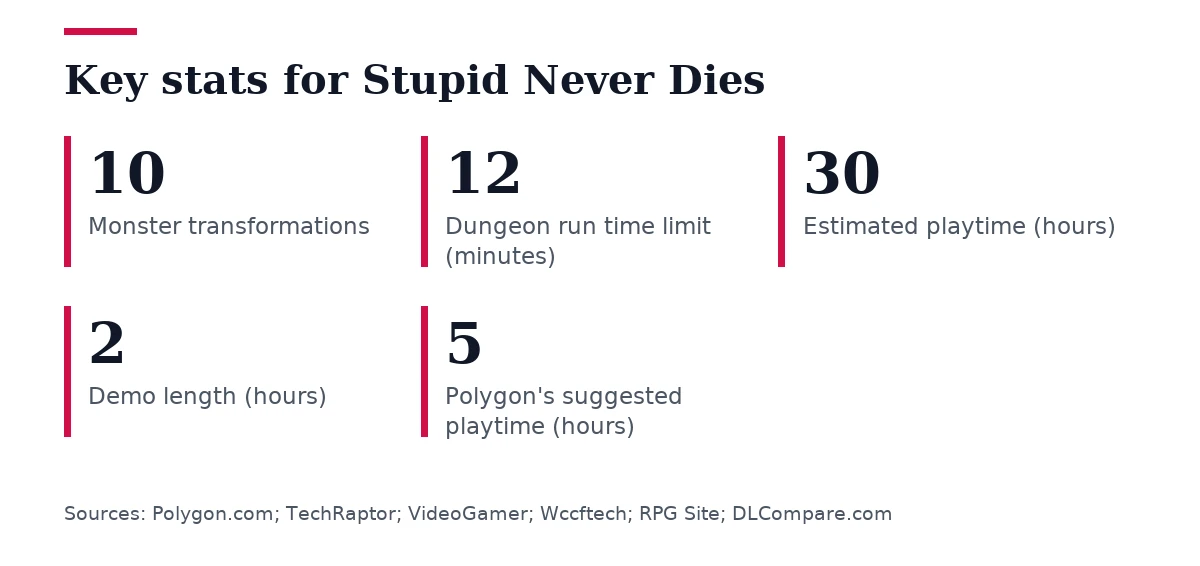
Stupid Never Dies features ten monster transformations—Werewolf, Harpy, Golem, Vampire, Will‑o‑the‑Wisp, Cyclops, Snow Fairy, Merfolk, Lich, and Demon—plus Davy’s default zombie form, each with unique abilities, and the Style Eat mechanic allows Davy to devour monster cores to absorb their powers, with transformations lasting a limited number of dungeon floors. The Body Hack system further customizes Davy with Overtech equipment providing passive stats and active attack abilities, and some dungeon areas require specific monster forms to access elevated platforms or breakable walls.
The game’s roguelite structure includes a 12‑minute time limit per dungeon run, which critics argue adds unnecessary pressure, particularly during boss fights, and failed runs still increase an EXP multiplier, allowing Davy to level up faster in subsequent attempts. A mandatory collectathon late in the story requires gathering 30 randomized resources, and the optional Go Nuts mode significantly increases Davy’s power to alleviate pressure from the time limit and difficult bosses.
The game’s story follows Davy, a bottom‑rung zombie who falls in love with Julia, a human woman frozen in a mall freezer, and embarks on a quest to defeat KOM, the King of Monsters, to revive her, and the narrative takes place after a Great War between humans and monsters that nearly wiped out humanity. Davy’s motivation is love, supported by a Phoenix Egg that grants him the Style Eat ability, and Polygon’s reviewer criticized the story for falling into the ‘fridging’ trope, while other outlets found the premise charmingly absurd.
The game’s combat features a “Stupid Parry” defensive mechanic with a “Stupid Impact” counterattack, and healing is achieved through biting enemies and eating their cores, with the bite gauge limiting how much Davy can feast. Repeated bites can activate “Davy Burst,” a temporary powered state that enhances all abilities, and the combat also uses a recoverable damage system where some incoming damage accumulates as recoverable HP that must be reclaimed through attacks like parries and bites.

RPG Site’s review noted that Director Eiichiro Sasaki confirmed at Gamescom 2026 that the absence of a traditional lock‑on system is a deliberate design choice, though they added a soft lock‑on after public demo feedback, and reviewers found the soft lock‑on insufficient, citing off‑screen projectile attacks and the system sometimes prioritizing biting non‑healing skeletons over cores that would restore HP.
RPG Site’s review noted that the game’s soundtrack blends pop‑punk, metal, rock, electronic music, and traditional Japanese instrumentation, with each boss providing a remixed track, and producer Hiroyuki Kobayashi discussed the music design in the Deep Bite video series, explaining that initial pop‑punk inspirations evolved into a broader genre blend. Reviewers noted that players cannot set unlockable tracks as background music during dungeon traversal, a design choice that frustrates some players.
The game was reviewed on PS5 Pro and PC, with Wccftech reporting smooth 4K 60 FPS performance on an RTX 4080 and near‑locked 120 FPS with DLSS Quality Mode, and Polygon’s review was conducted on a PS5 Pro with prerelease code, while TechRaptor, Wccftech and Noisy Pixel played on PC via Steam, and Noisy Pixel also tested on PS5. The use of DLSS Quality Mode helped achieve higher frame rates on capable hardware.
The game’s dungeon features procedurally generated layers set in biomes inspired by historical eras, including Imperial Rome during the 79 AD eruption of Mount Vesuvius, Medieval Europe, the Viking Age, and Edo period Japan, and each layer includes a regular floor and a gatekeeper battle floor against multiple enemies including elites. Some areas require specific monster forms to access elevated platforms or breakable walls, and the procedural generation eventually becomes repetitive in the game’s later stages.
The game’s estimated playtime is approximately 30 hours, though Polygon’s reviewer argues the experience feels artificially extended and should have ended after five hours, and Wccftech notes that the game eventually becomes engaging after the first five to seven hours as mechanics unlock, while a boss rush near the end requires five separate runs. Polygon’s reviewer wrote, “Dated doesn’t begin to describe the debut action RPG from GPTRACK50, a new studio founded by former Capcom producer Hiroyuki Kobayashi,” and the reviewer spent 26 hours with the game.
TechRaptor’s reviewer wrote, “It feels like a combo between Let it Die, No More Heroes, and Hades, with a dash of classic Universal Monster Movies thrown in,” and the reviewer spent 21 hours playing on PC, finding the story, characters, and design appealing enough to sustain engagement despite repetition.



Join the discussion