

Key facts
- Valve said its Steam build reviews now take as many as 12 business days, though its normal target is three to five business days.
- Valve said much of the current Steam review delay results from games being sent back for another review after elementary functional problems are found.
- Valve requires developers to run their game through Steam for a minimum of five minutes before requesting a review, and the session must be recent.
- Valve says additional review improvements are coming, though no date has been set for a return to the usual three-to-five-business-day standard.
Jacob Navok, a former Square Enix executive, criticized Valve over long Steam game-review queues in a Nov. 4, 2026 post on social media. “The problem is Steam is derelict of its duty,” Navok wrote. He urged Valve to invest more in staff and automated moderation to clear the queues.
Navok said Steam’s revenue is about three times Roblox’s. Roblox receives as many as 1,000 times more new games per day, he said, and automated reviews allow Roblox releases to appear within seconds, whereas Steam developers wait weeks.
The report publishing Navok’s post says it lacks a matched dataset for review workloads, staffing costs, or approval times. It also notes that Roblox and Steam handle different kinds of submissions because Roblox projects are private by default, with cloud publishing separate from public release.
Navok also said Valve underinvests in review infrastructure even though it takes a share of developer sales. He pointed to Roblox as proof that moderation can scale through research, automated content analysis, and appeals.
Reviews of Steam builds now take up to 12 business days, Valve said, compared with a normal target of three to five business days. Valve said much of the current delay results from games being returned for another review after basic functional problems surface. The company spent several weeks scaling its process, and says the delay comes from submission volume plus repeat checks meant to help more games pass on the first try.
Games rejected for missing key quality-assurance checks get sent back for another review, according to Eurogamer’s report. “Much of that delay is due to having to re-review games, which isn’t great for you or for us,” Valve said.
Developers must run their game through Steam for at least five minutes before asking for a review, and the session must be recent, Valve said.
The updated release checklist also flags incomplete achievements, asks creators to verify required software components, and checks cloud-save configuration. Cloud saves store a player’s progress on remote servers instead of only on the local machine. Required software components include DirectX, Visual C++,.NET and XNA, technologies games often need to run.
Valve says more review improvements are coming, but it has not set a date for returning to the usual three-to-five-business-day standard. Valve said the current approval backlog is not directly caused by AI-generated games, pointing instead to higher submission volumes and repeated reviews.
Navok rejected the idea that a rise in AI-made games sufficiently explains Steam’s review trouble. He cited Roblox’s spending on research and appeals, along with AI-assisted content review, as proof that moderation can scale. AI-assisted content review uses automated systems to scan uploaded material for policy violations.
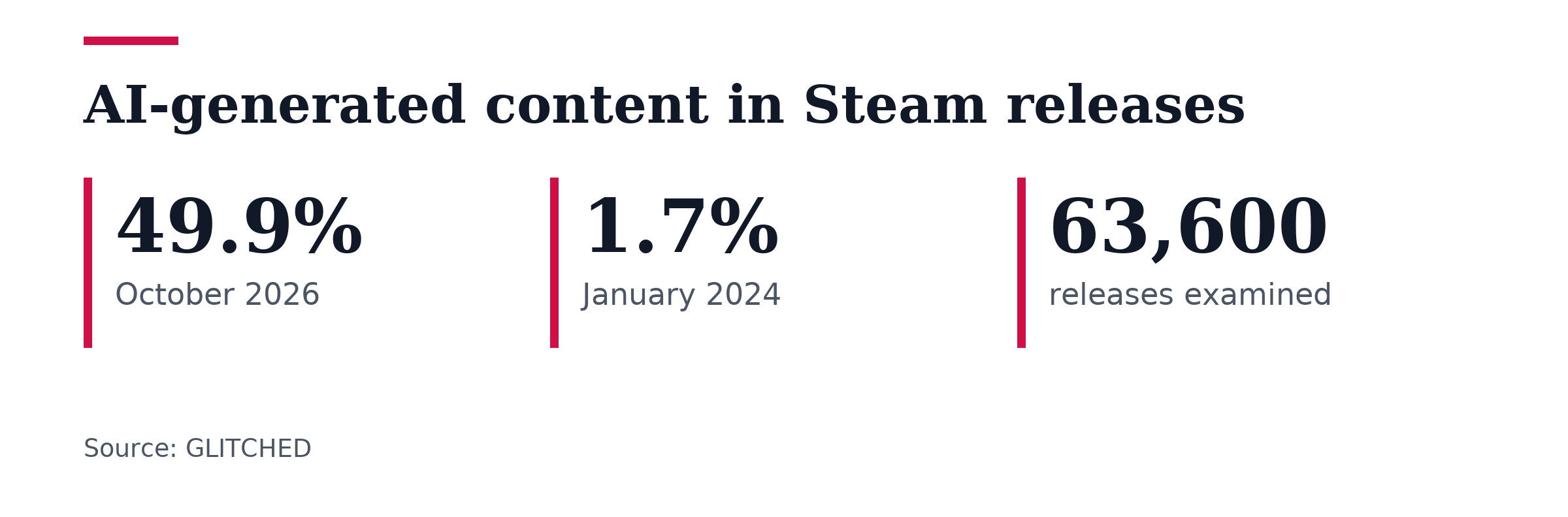
An independent analysis shared on Reddit examined roughly 63,600 Steam releases and found that 49.9 percent of games released during October 2026 reported some AI-generated content, compared with 1.7 percent in January 2024. AI-generated content means material such as art, text or code created by artificial intelligence tools rather than directly by a human developer. Studio Daimon’s Food Devils did not reach its planned Early Access launch, while 2 Left Thumbs said Wheel Make It waited nearly two weeks before approval.
Early Access lets players buy and play a game while it is still in development. Some developers with delayed Steam approvals worry that AI-generated copies of their games might launch on Steam before their own submissions are finished.
Kiaran Ritchie, a former Epic engineer, posted a lengthy critique of Steam last week. He challenged the 30 percent cut Valve takes from game sales and argued that users of the store are hostile to rival shops.
“Competition in this space is not only uninteresting to most Steam users, it’s actively denigrated!” Ritchie wrote.
IGN places Ritchie’s post in the context of Epic’s long-running effort to reduce marketplace cuts, including legal battles with Apple and Google. Epic paid Apple $6 million but won against Google.
IGN says most gamers prefer Steam and see rival stores as a threat to their investment, which means Epic’s effort to unseat Steam is unlikely to change. Those fights are part of Epic’s wider push to shrink the share marketplaces take from digital sales, IGN says, and they sit apart from its campaign against Steam.





Join the discussion