
Key facts
- Video Games Chronicle reports that most party members, including Lid and Nichol, are downplayed by the plot past their introduction chapters, becoming functional battle options rather than fully developed characters.
- Video Games Chronicle finds the game's side quests to be dull, often requiring backtracking through earlier dungeons, though some offer rewards such as upgrades for Lid's Mecha Chocobo.
- Nerd Reactor found that Espers, which serve as a temporary fifth party member in battle, do not have as much impact as expected and are mostly used as distractions to absorb enemy attacks.
- IGN finds it jarring that some Resonance attacks pull CGI cutscenes directly from Brave Exvius, breaking the immersion of the HD-2D remade presentation when transitioning to older visuals.
Square Enix released Final Fantasy Resonance, an HD-2D reimagining of the mobile game Brave Exvius, on September 24, 2026 for PS5, Nintendo Switch, Switch 2, Xbox Series X|S, and PC, according to VICE.
Nerd Reactor lists the launch for October 22, 2026 on Nintendo Switch, Switch 2, and PS5, while VICE placed the release on September 24, 2026 across PS5, Switch, Switch 2, Xbox Series X|S, and PC. The game landed in late 2026 to a divided critical reception: VICE awarded a 10/10, COGconnected named it their game of the year, Nerd Reactor gave it 4.5/5, IGN offered a mixed review praising presentation but criticizing storytelling, and Video Games Chronicle concluded it is not an essential experience for genre enthusiasts.
Square Enix announced earlier in 2026 that it was developing its first HD-2D entry in the Final Fantasy series. The game was built as a retooling of the 2015 mobile gacha title Final Fantasy Brave Exvius, with the gacha system removed and progression reworked for a standard single-player premium JRPG format. The announcement generated significant excitement for fans who wanted the franchise to return to its 1990s roots.
The game adapts the first story arc of Brave Exvius, following knights Rain and Lasswell of the Kingdom of Grandshelt as they protect elemental crystals from the Sworn Six. COGconnected described the opening as resembling Final Fantasy VI, with the player controlling a powerful sorceress of unclear alignment who encounters the Sworn Six led by Umbra, Veritas of the Dark, who destroys the Earth Crystal. Square Enix’s decision to create the turn-based title followed the commercial success of Clair Obscur: Expedition 33, which proved there was still a market for new turn-based JRPGs.
Reviewers across VICE, IGN, and COGconnected praised the game’s HD-2D pixel art as visually stunning. VICE described the graphics overhaul as massive, with every scene completely re-created using new cinematic storytelling, and called it Square Enix’s best-looking pixel game to date. VICE wrote, “Square Enix has pushed the HD-2D genre to the next level with incredible 3D CGI cutscenes, vision attacks, and pixel animated battle sequences.” COGconnected went further, calling it possibly the most visually gorgeous video game of all time: “Final Fantasy: Resonance, for my taste, might be the most visually gorgeous video game of all time.”
IGN highlighted the cutscene work as some of the best in HD-2D, with fluid animation and camera movement in a 3D plane. The HD-2D art style is a modern Square Enix trend that blends 2D pixel sprites with 3D environments, as seen in the Octopath Traveler series.
IGN also found it jarring that some Resonance attacks pull CGI cutscenes directly from Brave Exvius, breaking the immersion of the HD-2D remade presentation when transitioning to older visuals; examples include a large Shanttoto throwing a massive boulder of dark energy and Clive preparing to accept the truth. VICE stated that the HD-2D graphics overhaul is so massive that Final Fantasy Resonance and Brave Exvius barely resemble each other visually or narratively.
COGconnected praised the inclusion of a sprawling HD-2D world map as a rare treat in modern JRPGs, noting that only a tiny fraction of contemporary RPGs still include them and that they are tied to the core of what makes a JRPG for some players. The cutscenes feature dramatic camera direction reminiscent of PS1-era Final Fantasy titles, with some environments featuring fixed camera angles that create a thematic feel. The pixelated sprites are incredibly detailed and expressively animated during dialogue sequences, and character portraits balance Yoshitaka Amano’s art with modern anime aesthetics. The world map is described as a gorgeous HD-2D world with treasures, secrets, and encounters, and it can be navigated on foot or via a summoned Chocobo mount, with an airship becoming available later for full exploration.
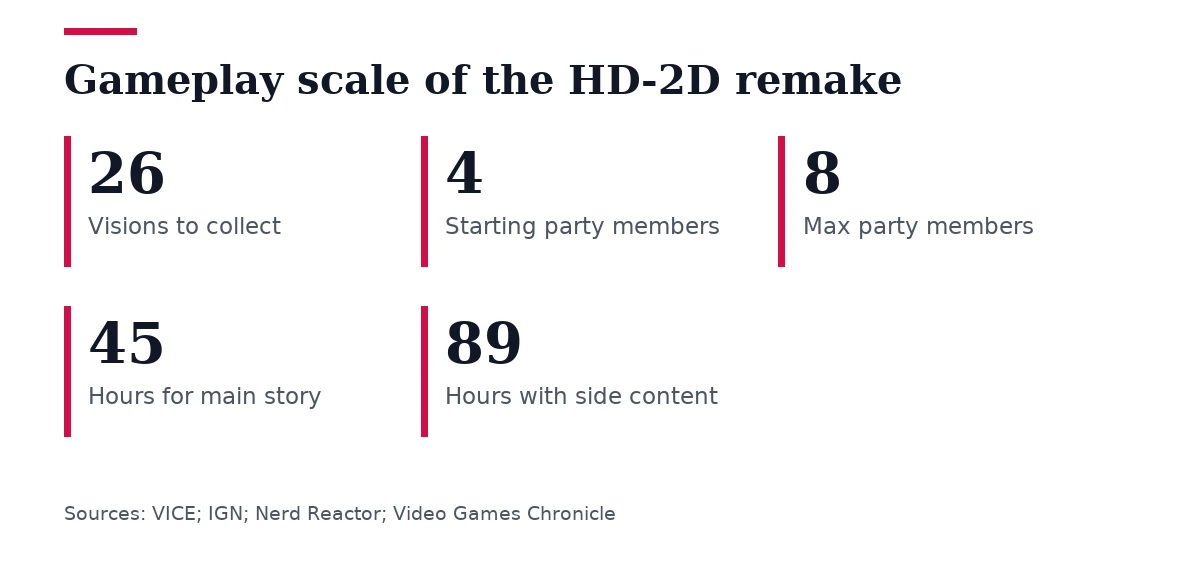
The game features a traditional turn-based combat system with a timeline showing attack order and elemental affinities, where players control four party members expandable to eight through Vision and Esper equipment. An action bar at the top of the screen displays attack order in real time, and a radar on the minimap changes from blue to yellow to red to warn players of an impending random encounter. The core gameplay loop centers on filling an enemy’s stagger meter to trigger bonus phases, including a sweeping stagger that grants all party members extra actions and culminates in a Resonance attack. The combat includes Limit Break abilities and summonable Espers that serve as a temporary fifth party member, with players using familiar Final Fantasy strategies like Protect and Haste while staggering and damaging foes.
Nerd Reactor found that Espers do not have as much impact as expected and are mostly used as distractions to absorb enemy attacks. The Vision system is the game’s main hook, letting players equip characters from across the Final Fantasy pantheon as job-like abilities. Around 26 Visions are available to collect through Sanctum of Light shrines and a quiz-like dialogue sequence. Battles grant MRP mastery points alongside experience, which level up Visions to unlock abilities; the earliest Visions are generic roles like white and black mages, while later ones become classic summons and major Final Fantasy characters.
Visions such as Lightning and Clive Rosfield are classified as Breakers, a class specialized in staggering enemy defenses. The system allows advanced builds, such as equipping the Warrior of Light Vision on Lasswell to combine Sentinel and Breaker abilities. Video Games Chronicle found the Vision collection quiz to be worded so obviously that players will understand the correct answers without ever playing the original game, calling these moments cheap and noting they evoke nostalgia for better games.

IGN argued that the Vision system’s flexibility can trivialize combat, letting players spam a single optimal element against bosses rather than creatively problem-solving with a limited toolkit, contrasting it unfavorably with Octopath Traveler’s more dynamic boost and break system. The late game does become tougher with harder hits and more status ailments, though the early flexibility can trivialize encounters.
Nerd Reactor reported that while the Vision system enables extensive build customization, characters with strong natural abilities like Nichol’s buffs and Lasswell’s stagger skills are difficult to remove from the party, limiting actual strategic variety despite theoretical flexibility. The narrative follows the first season of Brave Exvius, with knights Rain and Lasswell, a mysterious magical girl named Fina, and additional friends on a quest to stop the Sworn Six from destroying the world’s crystals.
IGN found the storytelling underwhelming, with long stretches of dialogue that feel like they were written for a middling young adult novel, an overly talkative contemporary twee tone, and mustache-twirly villains. The reviewer noted that characters like Dr. Lazarov are annoying throwaways, though Nichol and Sakura are better written, and that the Sworn Six are undersold in importance. IGN wrote, “Resonance has glimpses of hitting those same highs, yet I found long stretches of its storytelling to be quite underwhelming.” IGN also stated that the narrative momentum is shrouded in vagueness, relying on regional societal issues such as environmental tragedies, revolt against tyrannical governments, and exploitation of underclasses, with thematic coherence not emerging until much later.
VICE described the story structure as having a TV-series quality, with each chapter ending on a cliffhanger or tease. Nerd Reactor described Rain as a genuinely good-hearted main character and praised the party’s chemistry, mixing comedy with emotional moments, while noting the villains have understandable motivations rather than being typical world-ending bad guys.
Video Games Chronicle described Rain as a boisterous and innately talented warrior and Lasswell as his adopted brother who ensures Rain rises in the ranks, though their archetypes shine through more strongly than their personalities. The outlet also reported that most party members, including Lid and Nichol, are downplayed by the plot past their introduction chapters, becoming functional battle options rather than fully developed characters. Rain possesses unique magical abilities, though the origin of these powers is unknown to him.
Video Games Chronicle found the side quests to be dull, often requiring backtracking through earlier dungeons to witness new scenes or collect items, though some offer decent rewards such as upgrades for Lid’s Mecha Chocobo. The game’s map constantly shows the next main objective and any picked-up side quests, making navigation straightforward but limiting discovery. Optional content includes a Colosseum, ancient weapons, and concealed passages, and fast travel is implemented to allow players to return to discovered areas easily.
IGN praised the game’s soundtrack, which remixes Brave Exvius’ music with impressive arrangements, including a boss theme fusing piano jazz with orchestral metal, a double bass drum pedal, and a Latin choir. COGconnected described the soundtrack as including a variety of styles, including Celtic instruments and music evoking the style of composers Nobuo Uematsu and Howard Shore, and it opens with the main Final Fantasy theme. COGconnected described the English voice acting as hit and miss, with most main characters sounding good but a crop of actors from bad anime dub regulars making other characters sound disingenuous, breathy, or like they are doing an impression.
Nerd Reactor noted an MP tradeoff in combat where many of the best attacks consume MP, potentially causing battles to become repetitive as players repeat abilities while saving MP for the next inn or save point. COGconnected reported that the game’s difficulty can be adjusted at any time outside of battle, with harder difficulties granting greater rewards including more mastery points to level up Visions, streamlining the need for grinding.
The main story campaign takes approximately 45 hours to complete according to VICE and IGN, while Nerd Reactor reported about 89 hours to finish the story and almost all side content. Video Games Chronicle wrote, “The design of its mobile origins limits this game’s ambitions.” The outlet added that if it were a truly original title it could have been a bigger, bolder celebration of Final Fantasy’s history, and concluded the game is not an essential experience for genre enthusiasts. Nerd Reactor gave the game a 4.5/5 rating, hailing it as a tribute to the era of turn-based RPGs without simply rehashing the past.

Join the discussion