

This is a new development in a story we reported earlier: Pure Xbox lists over 20 Xbox games for Oct 19-23.
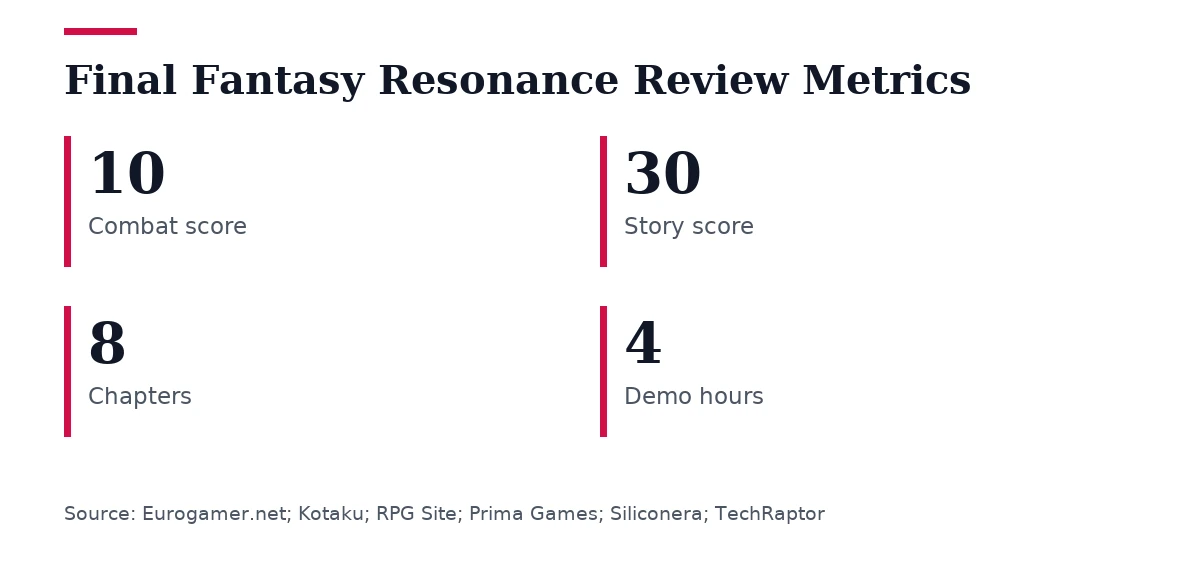
More reviews of Final Fantasy Resonance arrived on Oct. 20, 2026, two days before the game’s scheduled launch, adding to the first review score that published earlier this week. The new takes from seven major outlets produce a consistent consensus: the turn-based combat and HD-2D presentation are widely hailed as excellent, while the story and character writing are cited as the game’s weakest elements.
Final Fantasy Resonance is scheduled to launch on Oct. 22, 2026, on PlayStation 5, Xbox Series X/S, Nintendo Switch (including Switch 2), and PC via Steam. A demo covering the first chapter with roughly three to four hours of content is available on all platforms, and pre-orders are open across storefronts with multiple editions to choose from.
The game is a reconstruction of the now-defunct mobile game Final Fantasy Brave Exvius, which originally launched in 2015 and ceased operations in October 2025. Square Enix has adapted the first season of the mobile game’s story into a single-player console and PC RPG, stripping out the gacha mechanics that defined the original and rebuilding it as a premium, turn-based title that draws inspiration from 16-bit era Final Fantasy games.
The combat system has emerged as the game’s strongest selling point. Reviewers widely describe it as one of the best turn-based systems in recent years, fusing Final Fantasy V’s job system with Final Fantasy VI’s character roles and Octopath Traveler’s weakness and break mechanics into a deep, strategic whole. Producer Keisuke Nakashima has stated that the system is largely inspired by Final Fantasy V and Final Fantasy VI, with additional synergy and stamina mechanics drawing from Final Fantasy XIII, Final Fantasy XV, and Final Fantasy VII Remake.
Eurogamer called it “moreish, brain-scratching RPG combat puzzles” and said, “I couldn’t recommend it more.” Game Informer told Final Fantasy V job-heads, “You’ve come home.” The Visions system allows players to equip classic Final Fantasy characters like Cloud, Squall, Tidus, and Clive as secondary party members who grant new abilities, stat boosts, and job-like roles.
Each Vision has an Awakening Level raised with Magicite and a Mastery system that unlocks permanent skills as they gain experience. The system gives players staggering flexibility, with RPG Site noting that “the sheer variability in how you control Resonance’s systems is what makes this battle system sing.” The game offers extensive character customization, allowing players to build characters in highly flexible ways.
Rain can be turned into a damage-soaking tank that gains a massive boost to staggered-enemy damage output, while Nichol becomes an essential buffer with constant buffs and healing abilities. By the endgame, reviewers noted they could plan character progression three steps ahead and turn one character’s turn into eight actions by mixing and matching abilities from equipped Visions.
The combat’s stagger mechanic involves depleting an enemy’s stamina bar to interrupt attacks, trigger bonus turns, and enable powerful Vision Resonance attacks. Chapter-ending bosses are highlighted as particularly challenging and engaging encounters. However, some reviewers note that the stagger bonus turns lack a sense of exhilaration, tedious enemy attribute checking can slow things down, and Vision ultimate attack animations — high-fidelity Japanese cutscenes that cannot be fully skipped — pull players out of the game.
The HD-2D presentation has been almost universally praised as the best-looking in the genre, with detailed character sprites, lavishly created environments, fluid combat animations, and a vibrant, whimsy-filled soundtrack that exceeds earlier HD-2D titles like Octopath Traveler and the Dragon Quest HD-2D remakes. The normal battle BGM is particularly well-regarded, and occasional pixel-based cinema scenes are described as stunning. Siliconera said, “It’s the gameplay and the stunning variety of the game’s world that made it memorable for me.” TechRaptor predicted, “Final Fantasy Resonance is going to be one of those games that I see a lot of people latching onto.”
The story and pacing are widely criticized as the game’s weakest aspects. Reviewers describe the narrative as derivative, shallow, and lacking emotional weight, particularly in the final third where the main story slows down and side quests become more interesting. The story follows knights Rain and Laswell of Grandshelt as they journey across the world of Lapis to stop the Sworn Six from destroying all the crystals, spanning eight chapters that draw inspiration from various mainline Final Fantasy titles. Multiple outlets note that the plot feels generic, with a backdrop and plot points that lack lasting impact.
The main character roster receives mixed reviews. Some outlets praise the cast as quirky and lovable with strong voice acting, while others describe the characters as one-note, shallow, and overly reliant on Final Fantasy tropes. The protagonist Rain is frequently described as an amalgamation of past heroes, while supporting characters like Lasswell, Jake, Lid, and Nichol receive more specific praise for their personalities and party dynamics. The game’s party interactions are compared to the Tales series, with optional skit-like conversations that add personality.
PCGamesN said, “It’s chill, it respects my time, and it has Squall – what’s not to like?”
Side quests improve markedly in the latter half of the game, shifting from simple fetch quests to dedicated character arcs that dive deep into each party member’s backstory and place in the world. The airship unlocks the open world for rewarding exploration with hidden weapons, puzzles about hidden Espers, and caves full of Marlboros. The game offers three difficulty levels that reviewers say feel meaningfully different.
The English voice cast is praised as strong across the board, though side quests are not fully voiced, which is noted as a minor grievance. Towns are described as beautiful, unique, and filled with worthwhile quest-givers, though the game’s world has thin overworld connective tissue and dungeons that lack pizzazz.
Overall, reviewers describe Final Fantasy Resonance as a solid, enjoyable experience for fans of turn-based RPG combat and classic Final Fantasy nostalgia, but caution that it may disappoint players seeking a compelling story or meaningful thematic depth. Some call it nostalgic comfort food best suited for long-time series fans.


Join the discussion