

Key facts
- AYN opened pre-orders for the Odin 3 Portal handheld ahead of shipping scheduled for early November 2026. Pre-orders begin at 9:30 PM ET (6:30 PM PT).
- The Odin 3 Portal Base model costs $399 during an introductory promotion, down from a regular price of $419.
- AYN offers four configurations: Base with 12GB RAM and 128GB storage; Pro with 12GB RAM and 256GB storage; Max with 16GB RAM and 512GB storage; Max with 16GB RAM and 1TB storage.
- AYN added the 16GB/1TB Max variant after asking the community for feedback on a potential 1TB option.
AYN opened pre-orders for the Odin 3 Portal handheld on October 23, 2026, ahead of shipping scheduled for early November 2026. Orders began at 9:30 PM ET (6:30 PM PT), or 9:30 a.m. Beijing time and 01:30 UTC on October 23.
AYN offers four configurations. The Base pairs 12GB of RAM with 128GB of storage for $399 during the promotion, down from $419. The Pro pairs 12GB of RAM with 256GB of storage for $479, down from $499. The Max pairs 16GB of RAM with 512GB of storage for $549, down from $579, while a second Max variant pairs 16GB of RAM with 1TB of storage for $669, down from $699.
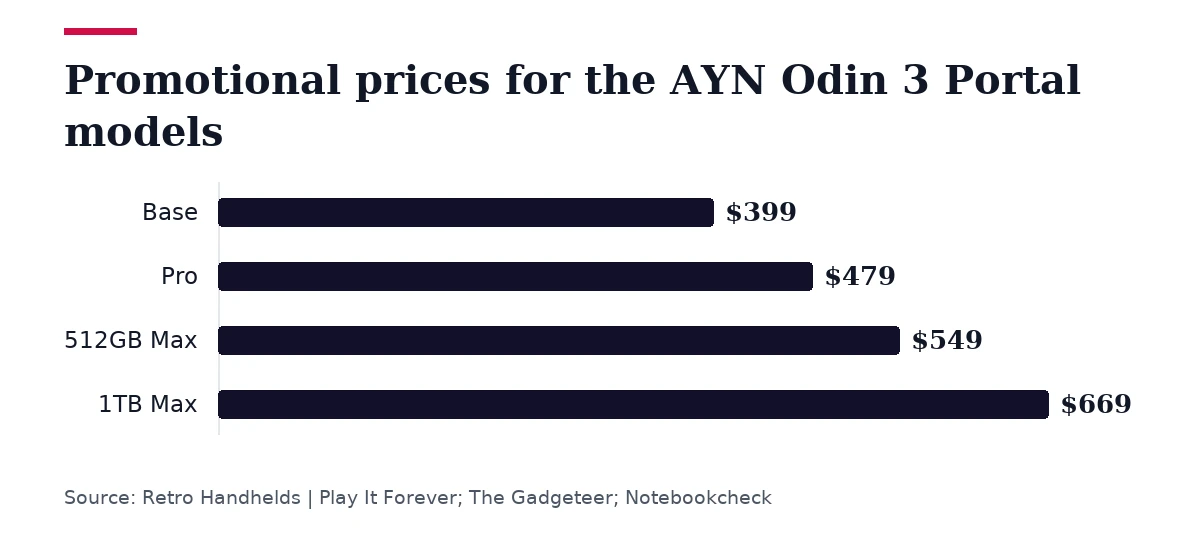
AYN added the 1TB Max variant after asking the community for feedback on a potential 1TB option. It costs $129 more than the 512GB Max and includes no upgrades beyond the extra storage. Colors run Black for the Base model, while White and Cold Grey are added for higher configurations; the 1TB Max is sold in Black, Cold Grey and White.
The processor is an 8-core Qualcomm Dragonwing Q8 variant of the Snapdragon 8 Elite platform, paired with Adreno 830 graphics. Notebookcheck identifies it as the IoT version of that platform. The display is a 7-inch AMOLED touchscreen with 1920 x 1080 resolution and a 120Hz refresh rate. PC Guide reported on October 19, 2026, that AYN had not confirmed the display specifications, though it expected a 7-inch OLED screen with 1080p resolution and 120Hz refresh rate based on the previous model.
The device runs Android 15 and supports native Android games, compatible emulators, and game streaming. Games are not preinstalled. Ports include USB-C with USB 3.1 and DisplayPort output up to 4K at 60Hz, a 3.5mm headphone jack, and a microSD card slot. All models use UFS 3.1 storage.
Its controls center on Hall-effect analog sticks fitted with replaceable caps, plus textured shoulder buttons, two rear buttons, a dome-style directional pad, and RGB lighting that rings the sticks. Hall-effect sticks reduce contact-related wear but do not remove every possible cause of stick drift or mechanical failure. Cooling uses an active system with a dedicated fan, and wireless connectivity includes Wi-Fi 7 and Bluetooth 6.0.
The battery holds 9,000mAh, an increase of 1,000mAh over the Odin 2 Portal, and supports up to 60W wired charging. AYN describes the battery as built for longer play. The Gadgeteer reports that battery endurance varies according to the game, display brightness, refresh rate, and wireless activity, and that the capacity increase does not automatically mean longer gaming sessions. It also reports that sustained performance depends on thermal conditions, game optimization, and graphics settings, and that independent testing has yet to establish battery endurance and sustained gaming performance.
The handheld weighs 450 grams, matching the Odin 2 Portal, and is about 60 grams heavier than the original Odin 3. At that weight it is heavier than many compact Android handhelds but lighter than many Windows gaming handhelds, and its larger body is less suited to pocket carry. Players who primarily want native Windows games should consider a different platform, while buyers prioritizing pocket size may prefer a smaller handheld.
PC Guide positions the Odin 3 Portal closer to established gaming PC handhelds such as the Steam Deck and the ASUS ROG Ally series, while describing it as a more lightweight Android device. The Gadgeteer says the larger screen makes the device relevant to remote play and cloud gaming as an alternative to smartphone gaming.
Pocket Tactics reports Ayn confirmed via Discord that the Odin 3 Portal launches October 22, 2026, with a $419 base price. Pocket Tactics also reports the cheapest configuration costs less than either the Nintendo Switch 2 or the Steam Deck OLED. Notebookcheck reports the $669 price for the 1TB Odin 3 Portal is 34% higher than a Nintendo Switch 2, which costs $499 on Amazon. Moving from 512GB to 1TB increases the price by almost 22%.
AYN increased the original Odin 3 price three times since launch because of memory and storage shortages, from a $299 early bird price to $369 for the cheapest 8GB + 128GB configuration. More performance video demos were expected before early November shipping on AYN’s official YouTube channel.



Join the discussion