

Key facts
- Vivrato's VAIA Report 2026 found that 97 percent of the 101 senior studio leaders interviewed between April and September 2026 have used artificial intelligence in some form during game development.
- Vivrato reported that European studios, including the UK, self-rated their AI pipeline integration depth at an average of 4.2 out of ten, compared with 3.5 out of ten in North America.
- Concept and pre-production work, including ideation and brainstorming, recorded 79 percent AI adoption among the studios surveyed.
- Design and prototyping work, covering mechanics, systems and features, had AI adoption at 68 percent of the studios interviewed.
Vivrato’s VAIA Report 2026 found that 97 percent of 101 senior studio leaders and decision makers interviewed in confidential one-on-one interviews between April and September 2026 have used artificial intelligence in some form during game development at PC and console studios across North America and Europe.
Vivrato, founded by former PlayStation executive Adam Boyes, conducted 101 confidential one-on-one interviews with senior studio leaders and decision makers between April and September 2026 for the VAIA Report 2026. Vivrato’s AI research vertical carried out the research, centering mainly on PC and console development across North America and Europe. The research used a uniform 44-question guide across nine production stages for every interview so results stayed consistent across the sample.
About 72 percent of respondents were chief executive officers, founders, presidents, general managers or studio heads, while 15 percent were chief technical officers, chief product officers, creative directors or tech directors. GamesBeat published the role breakdown after Boyes described most interviewees as chief executives, studio heads and general managers. The remaining group comprised vice presidents, directors, leads and specialists.
About 43 percent of the studios interviewed had around 24 people, 31 percent had between 25 and 100 people, and 26 percent were larger companies. GamesBeat included the studio size distribution to describe the sample behind the VAIA Report 2026 findings.
Vivrato reported that 94 percent of interviewed studio leaders said they use artificial intelligence in at least one of the nine game production stages covered by the study. The nine stages run from concept and pre-production through live operations and monetization, and every interview followed the same question guide to keep results consistent across the sample. The standardized structure allowed Vivrato to compare answers across studios and combine responses without identifying individual companies or people.
The research also found that 52 percent of the 101 interviewed studio leaders rated how deeply artificial intelligence is built into their full production pipeline at three or lower out of ten.
GamesBeat reported that the median rating for how deeply AI is built into the whole production pipeline was three out of ten, based on Vivrato’s interviews. GamesBeat attributed the median figure to the VAIA Report 2026 and noted it alongside the 52 percent of respondents who gave a rating of three or lower.
Vivrato founder and CEO Adam Boyes said the interesting question is no longer which game studios are using AI, but where they are using it, what is changing, what is helping and where teams face challenges. Boyes added this point to shift attention from adoption toward integration and real-world results in development pipelines.
Vivrato reported that European studios, including the UK, self-rated their AI pipeline integration depth at an average of 4.2 out of ten, compared with 3.5 out of ten in North America. GamesIndustry.biz presented the averages as evidence that European studios are further along in embedding AI. European studios also reported heavier use in code, design, art and analytics.
Vivrato found that 70 percent of European studio representatives said AI was used in art, assets and animation, compared with 53 percent of North American representatives. The regional disparity was one of several differences highlighted between European and North American studios, with Europe reporting deeper adoption overall in the research.
Boyes said European adoption of AI is outpacing North America and that his team is investigating the reasons behind that gap. GamesBeat reported Boyes calling the regional gap super fascinating, while also noting that the study excluded Asia. Boyes said he believes Asian studios are advancing more quickly with AI than studios in the West.
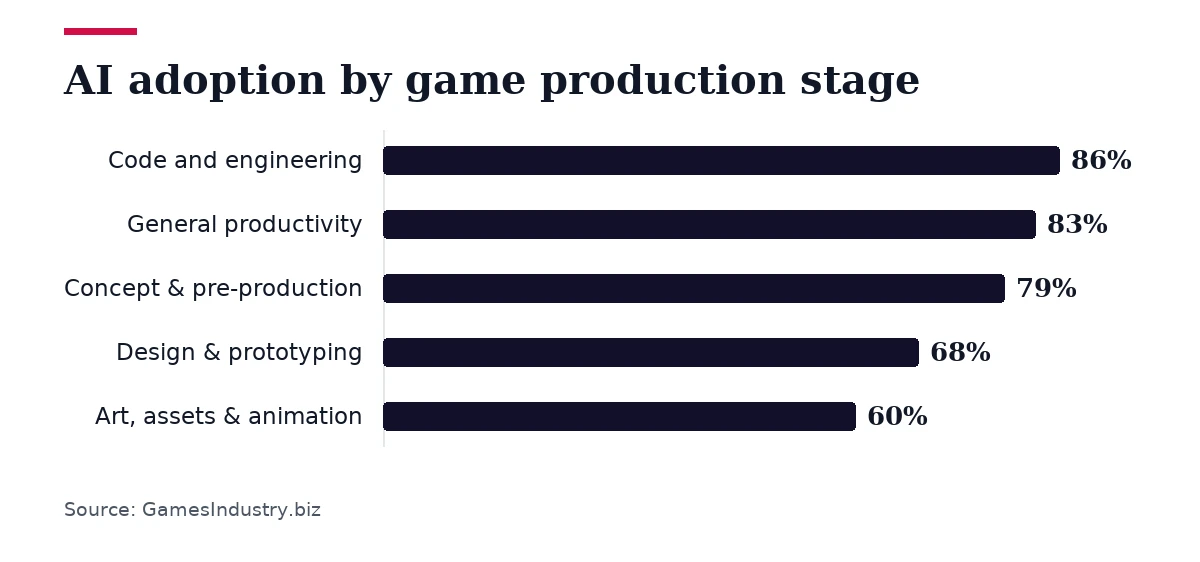
Among the nine production stages, studios most commonly used AI in code and engineering, including engine, tools and gameplay code, at 86 percent of studios. GamesIndustry.biz listed code and engineering as the top category, ahead of general productivity tasks and concept work, showing where AI has gained the strongest foothold in development.
General productivity tasks, such as documentation, email, meetings and planning, used AI at 83 percent of studios. Productivity ranked second among the nine production stages in the report’s breakdown of where studios actually apply AI. Concept and pre-production work, including ideation and brainstorming, recorded 79 percent AI adoption among the studios surveyed. The figure places early development work third in the ranking of production stages where studios use AI, behind code engineering and general productivity.
Design and prototyping work, covering mechanics, systems and features, had AI adoption at 68 percent of the studios interviewed. GamesIndustry.biz placed design and prototyping fourth in its ranking of AI use across the nine production stages. Art, assets and animation work, including characters, environments and motion capture, showed AI adoption at 60 percent of studios.
More than half of studios use AI for quality assurance and testing, as well as for narrative and world building, according to Vivrato. The report groups QA and narrative in the middle tier of adoption, while identifying analytics, LiveOps and monetization as the areas with the lowest uptake.
Analytics and player data, together with LiveOps and monetization, have the lowest AI adoption rates among the nine production stages. These backend and commercial stages lag behind creative and engineering uses, according to the stage-by-stage breakdown in the VAIA Report 2026.
Vivrato asked about six types of AI: generative AI with large language models and image and audio generation, classical machine learning, rules-based automation, retrieval-augmented systems, fine-tuned or custom-trained models, and agentic systems. GamesBeat’s methodology section listed the six categories to show the report looked beyond generative AI tools such as chatbots and synthetic voices.
The consultancy said studios should not equate their opinion of generative AI with their opinion of artificial intelligence as a whole. GamesIndustry.biz included the clarification alongside the six types of AI covered in the interviews to avoid conflating generative tools with all AI adoption.
Adam Boyes said public discourse about AI in games usually defaults to generative AI such as chatbots, image generation and synthetic voices. Boyes made the comment while explaining why Vivrato created the VAIA research vertical to set a clear baseline for what is actually happening in studios.
"We've noticed this year, public discourse and definitions about AI in games usually defaults to generative AI – chatbots, image generation and synthetic voices,"
Adam Boyes, Vivrato founder and CEO, Video Games Chronicle
Boyes said player and staff attitudes, budget limits, tool limitations, job-loss worries, fear and insufficient time hold back adoption. He also said one problem was reticence about diving into AI because the models change so frequently. GamesBeat reported Boyes’s comments after he described teams as experiencing pull-push pressure between leadership wanting AI and some team members not wanting it.
Boyes said developers use generative AI for early prototypes and concept communication, yet most oppose putting AI-generated content in shipped games, and narrative world-building sees minimal use. GamesBeat reported Boyes’s observation that teams rarely depend on AI for story creation or world building, even though the tools can speed up concept work.
Boyes said players have legitimate worries and feel frustrated by the industry’s direction on artificial intelligence. He argued that it is the industry’s job to uncover trends so studios do not have to be seen as villains.
Boyes said Vivrato’s best practices conclusion is to be thoughtful about AI tool use, measure everything, keep humans in the loop, keep creativity at the forefront, and talk openly with teams and players. GamesBeat reported Boyes describing these as the consultancy’s stance after talking to all 101 leaders.
Vivrato sells the full VAIA Report 2026 in two editions, one for studio benchmarking by headcount and one enterprise edition that includes the full data annex, client interviews and an in-person session. The report is also available as a 2026 VAIA Snapshot on Vivrato’s website. GamesIndustry.biz noted that Sheridans partner Anna Poulter-Jones published an overview of AI-related game development law earlier that same week. GamesIndustry.biz mentioned the legal overview as related coverage published alongside the Vivrato report.




Join the discussion