

Key facts
- Xbox and PC Game Pass titles start using Proton or FEX either from the Games tab or directly from Steam, and Game Pass games not yet installed can be installed from their store page.
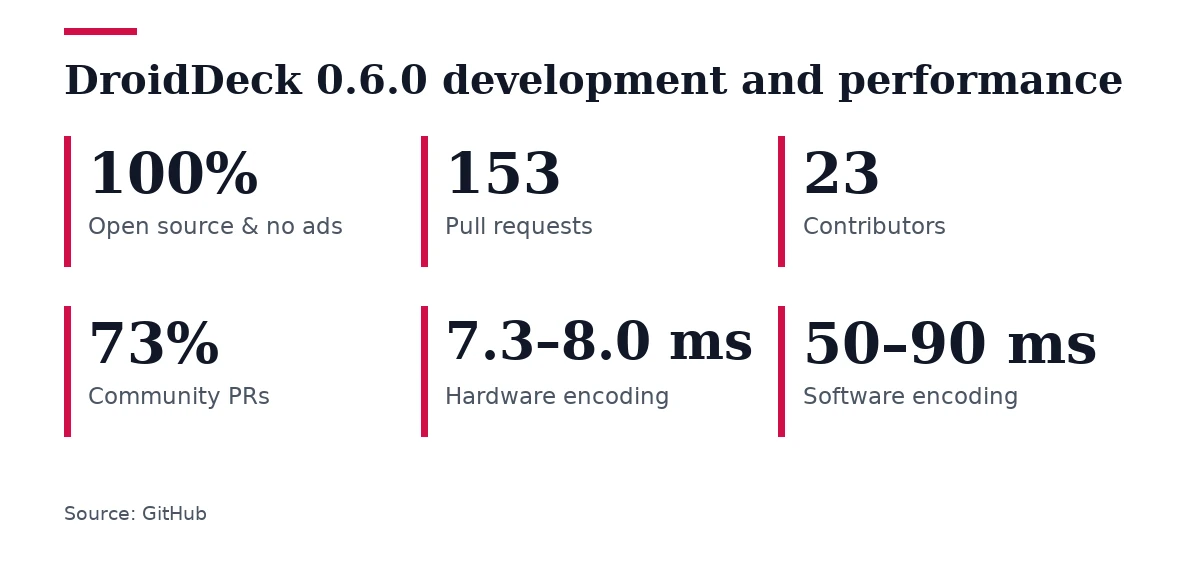
- DroidDeck is fully open source and carries no ads or telemetry, and version 0.6.0 included 153 pull requests from 23 contributors, 10 of them first-timers, with 73% of the pull requests coming from the community.
- The free, open-source app starts Valve's ARM64 Linux Steam client in Big Picture mode on Android so users can run their own Steam libraries locally on phones without a PC or game streaming.
- DroidDeck works without root access and keeps Android in place rather than replacing it with a different operating system.
DroidDeck released version 0.6.0 on GitHub on Oct. 22, 2026, adding an experimental Xbox and PC Game Pass store to its free Android app.
Players use a Microsoft account to sign in and see their owned and Game Pass games, then download them with pause and resume plus updates, verification and add-on management, according to the GitHub release notes and Retro Handhelds. Xbox and PC Game Pass titles use Proton or FEX, compatibility and translation software that lets Windows games run on Android, whether started from the Games tab or from Steam itself, and users can add games not yet installed from their store page, with search results opening on artwork and details.
Users open the itch.io store by signing in with an itch.io API key, which reveals their library. They can search or browse shelves listing the newest, on-sale, free and top-rated games, and DRM-free Windows builds install and launch through Steam. Retro Handhelds says the store requires an API key to work.
DroidDeck is fully open source and carries no ads or telemetry. Valve’s ARM64 Linux Steam client starts in Steam’s Big Picture mode on Android through the app, so players can run Steam libraries directly on their phones without a PC or streaming, TweakTown reported Oct. 14, 2026. Users can add GOG, Epic Games and Amazon Games as non-Steam games and run them through Proton, while existing Steam accounts remain accessible and games download directly to the device, the outlet said.
TweakTown reported Oct. 14, 2026 that DroidDeck works without root access and leaves Android in place instead of replacing it with another operating system. Graphics support begins at Adreno 730 and covers the full Adreno 8xx family, with Adreno 6xx experimental, while unsupported options include Mali, Xclipse, PowerVR and Adreno 710. Android 9 or newer must be present, and users must disable the system’s child-process restrictions before Steam can launch. The Linux runtime needs roughly 3GB of storage, Valve does not officially support Steam for Linux on ARM, results vary by device and game, version 0.3.2 was current and in active development, and DroidDeck is not affiliated with Valve.
Version 0.6.0 drew 153 pull requests from 23 contributors, including 10 first-timers, and 73% of the pull requests came from the community, according to the GitHub release page, which also thanks contributors for code, translations, device testing and bug reports. The release notes say version 0.6.0 adds SteamVR on Meta Quest 3 and 3S from the standard APK, detecting Quest headsets automatically, with immersive SteamVR running through a native OpenXR activity, an open standard for virtual-reality software, with headset tracking, Touch controllers and haptics.
DroidDeck’s release notes say version 0.6.0 adds configurable touchscreen gestures, including taps, double taps, holds, drags of one to three fingers and pinch zoom, each can map to an action from a searchable list, with default settings and per-game overrides. The same notes describe redesigned store pages that give each store Library and Store tabs, list installed games first, show portrait DVD-case art in a capsule view, let LB and RB switch stores and dim stores the user has not signed in to.
The release notes also cover a performance HUD that can show a colored graph of frame times along with battery temperature, with each element shown or hidden and colors and opacity adjustable. A custom Gradient theme adds a light app icon option and lets users pick primary and secondary colors using a color wheel, sliders or a hex code, and when a game started through the Games tab closes, the app sends the user back to the launch point rather than leaving them in Big Picture.
The release notes also say games that use Easy Anti-Cheat and offer an offline mode start without the anti-cheat bootstrapper by default, though users can turn the bootstrapper off per game, and online modes that require Easy Anti-Cheat remain unavailable. Steam Remote Play now sends video alongside audio and input, capturing the picture through PipeWire, a system for handling audio and video on Linux, as on SteamOS and encoding it with the phone’s hardware encoder; on a Thor, that takes 7.3–8.0 ms per frame compared with 50–90 ms using software encoding.
Notebookcheck reported Oct. 12, 2026 that developer William Allen, known on GitHub as wallentx, reportedly got Dark Souls Remastered running on a Pixel 11 Pro XL using a modified build and an experimental graphics profile based on libhybris, a layer that lets Android use Linux graphics drivers. The outlet also said it tested Tiny Combat Arena on the Pixel 11 Pro XL and that the game would not launch under standard settings but worked under the experimental configuration offered by an Oct. 11, 2026 prerelease.
Allen reported a PowerVR GPU lock-up that forced a reboot, and performance and game compatibility remain unverified, according to Notebookcheck. SPLATPLAYS published an experimental Mali/PanVK build for Tensor G3-powered Pixel 8, Pixel 8 Pro and Pixel 8a devices; tested on the Pixel 8 Pro, the desktop, input controls, Firefox and OpenGL software ran, but Steam Big Picture opened to a loading screen and then went black. The outlet said neither experiment shows dependable PC gaming on Google’s Pixel phones.




Join the discussion