

This is a new development in a story we reported earlier: More critics praise Final Fantasy Resonance combat, fault its story. Earlier in this story: Pure Xbox lists over 20 Xbox games for Oct 19-23.
Key facts
- IGN's Michael Higham describes Final Fantasy Resonance as a game of moments, where genre-fusing boss themes, perfect turn execution, and HD-2D cutscenes create memorable experiences.
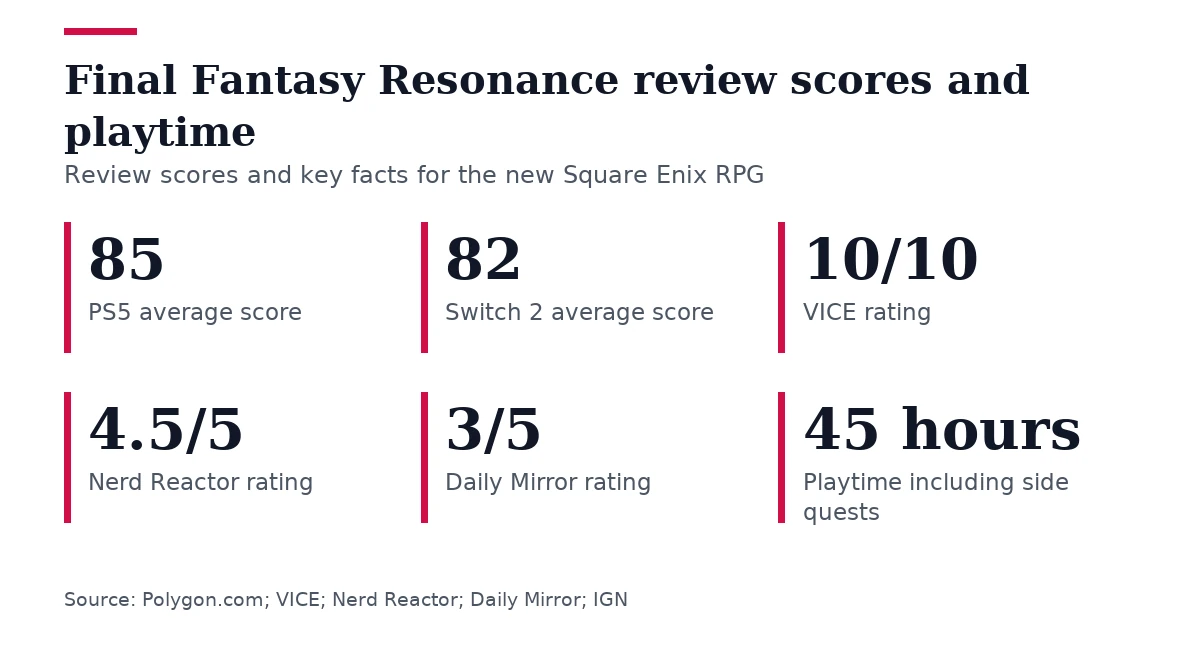
- Final Fantasy Resonance includes classic RPG elements such as an overworld map, towns, random encounters, an airship, and fully voiced main story cutscenes, with a playtime of around 45 hours including side quests.
- IGN's Michael Higham criticizes the script's verbose dialogue as feeling like it was written for a mediocre young adult novel, relying on clichéd villains and a modern, twee tone.
- Eurogamer's Dom Peppiatt criticizes the narrative as a collage of series tropes that fails to understand why they work, resulting in a 'grab-bag of nonsense.'.
Polygon published a roundup of reviews for Final Fantasy Resonance on Oct. 20, 2026, revealing an average score of 85 on PlayStation 5 based on 30 reviews and 82 on Nintendo Switch 2 based on 24 reviews.
The game, which retools the mobile title Final Fantasy: Brave Exvius into a traditional console RPG, releases on PC, PS5, Xbox, Nintendo Switch, and Nintendo Switch 2, with sources conflicting on whether the date is Sept. 24 or Oct. 22, 2026.
The critical consensus praises the game’s HD-2D visual presentation. IGN’s Michael Higham highlights the gorgeous HD-2D visuals, engaging turn-based combat, and outstanding soundtrack, while criticizing the weak narrative. Polygon’s roundup notes that critics widely praise the HD-2D art style, with Game Informer’s Nadia Oxford noting it differentiates itself from Octopath Traveler with highly detailed character sprites and pixel-based cinema scenes. VICE describes the HD-2D graphics as Square Enix’s best-looking pixel game to date, with gorgeously detailed levels balancing 3D and 2D retro graphics.
The game features 3D-rendered pixelated cutscenes resembling early PlayStation-era CGI and Limit Burst attacks with breathtaking full HD-2D pixel cutscenes.
The combat system is another point of praise. The game features a straightforward turn-based system with a timeline, focusing on elemental affinities and staggering enemies, inspired by Final Fantasy V’s job system via “Visions.” IGN’s Higham describes the combat as a game of moments, where genre-fusing boss themes and perfect turn execution create memorable experiences. Mashable notes the classic side-view layout with enemies on the left and party on the right, where spells can target single or multiple units.
Nerd Reactor praises the enjoyable turn-based RPG gameplay and the strategic depth of the Vision system, which allows for extensive build customization. IGN’s Higham finds the Vision system can sometimes trivialize combat, as optimal elemental strategies are often clear, reducing tactical variety.
The narrative is the primary point of criticism. IGN’s Higham criticizes the script’s verbose dialogue as if written for a mediocre young adult novel, relying on clichéd villains and a modern, twee tone. Polygon’s roundup highlights that Eurogamer’s Dom Peppiatt criticizes the narrative as a collage of series tropes that fails to understand why they work, resulting in a “grab-bag of nonsense.” VGC’s Dave Aubrey notes that the main party members are often downplayed by the plot after their introduction, serving primarily as functional combat options.
Polygon’s Willa Rowe notes that while the narrative occasionally finds its rhythm, it frequently falls into unfavorable comparisons with previous Final Fantasy games. Mashable describes the story as relying too heavily on tropes and concepts from previous Final Fantasy games, though the combat and exploration make it a satisfying 40-hour experience.
The game’s soundtrack is highly praised. IGN’s Higham praises the innovative remixes, such as a boss theme fusing piano jazz with orchestral metal and a Latin choir. A dungeon theme remixed into a bouncy electronic tune stands out on the soundtrack. Certain town themes use instruments that evoke a brutal industrialized empire or a mystical floating city, which IGN’s Higham describes as magical musical world-building.

Mashable credits composer Noriyasu Agematsu for delivering adrenaline-pumping battle themes, mood-setting overworld tracks, and emotional cutscene music that elevates even middling story moments.
The game includes classic RPG elements such as an overworld map, towns, random encounters, an airship, and fully voiced main story cutscenes, with a playtime of around 45 hours including side quests, according to IGN. The party consists of four active battlefield members but can expand to eight total units by equipping Visions or Espers, as noted by VICE. The game’s exploration includes concealed passages, treasures, optional bosses, ancient weapons, a Colosseum, and Vision shrines, with Chocobos available early and fast travel for revisiting areas, as noted by Nerd Reactor.
The Visions system is a key mechanic that replaces the traditional job system. Players obtain Visions by visiting shrines scattered across the overworld and completing quiz-like dialogue sequences that recap the stories of past Final Fantasy characters, which contain major spoilers for unplayed games, as noted by IGN’s Higham. The system includes one representative from each mainline Final Fantasy game, including Cloud, Terra, Squall, and Tidus, according to Mashable. Players can collect approximately 26 Visions, each with its own class assignment, as reported by VICE.
Equipping a Vision expands a character’s move arsenal to cover missing elemental types.
The combat features a timeline system like Final Fantasy X, showing upcoming actions to allow strategic planning, as noted by Nerd Reactor. Staggering enemies grants extra turns in a bonus phase, and staggering all enemies triggers a sweeping stagger phase where the party unloads attacks culminating in a Resonance attack tied to a chosen Vision, according to IGN. Players can adjust battle speed, and depleting an enemy’s stagger meter paralyzes them for a turn while making them highly vulnerable to damage, as noted by Mashable.
The narrative follows knights Rain and Laswell, the crystal-born magical girl Fina, and their allies fighting to prevent the Sworn Six from shattering the world’s elemental crystals, as noted by IGN and the Daily Mirror. The Sworn Six seek to destroy the eight elemental crystals that maintain world peace, with the player’s party perpetually one step behind them. IGN’s Higham finds the late-game narrative themes and character arcs, particularly Nichol’s emotional journey, to be more compelling than the early game, though the Sworn Six villains remain underdeveloped. Nichol and Sakura stand out as the better-written characters, with Nichol’s emotional arc providing one of the few moments of genuine depth.
The scores range from 3/5 (Daily Mirror) to 10/10 (VICE), with most mainstream outlets falling into the positive-to-mixed range. Daily Mirror describes it as a “meat-and-potatoes JRPG” that successfully sheds its mobile origins but plays it too safe. Nerd Reactor gives it 4.5/5, praising its enjoyable turn-based RPG gameplay, character-driven storytelling, and the strategic depth of the Vision system. VICE gives it a 10/10, calling it “Best In Its Class,” and praises its stunning HD-2D graphics, addictive turn-based combat, and massive world.



Join the discussion